

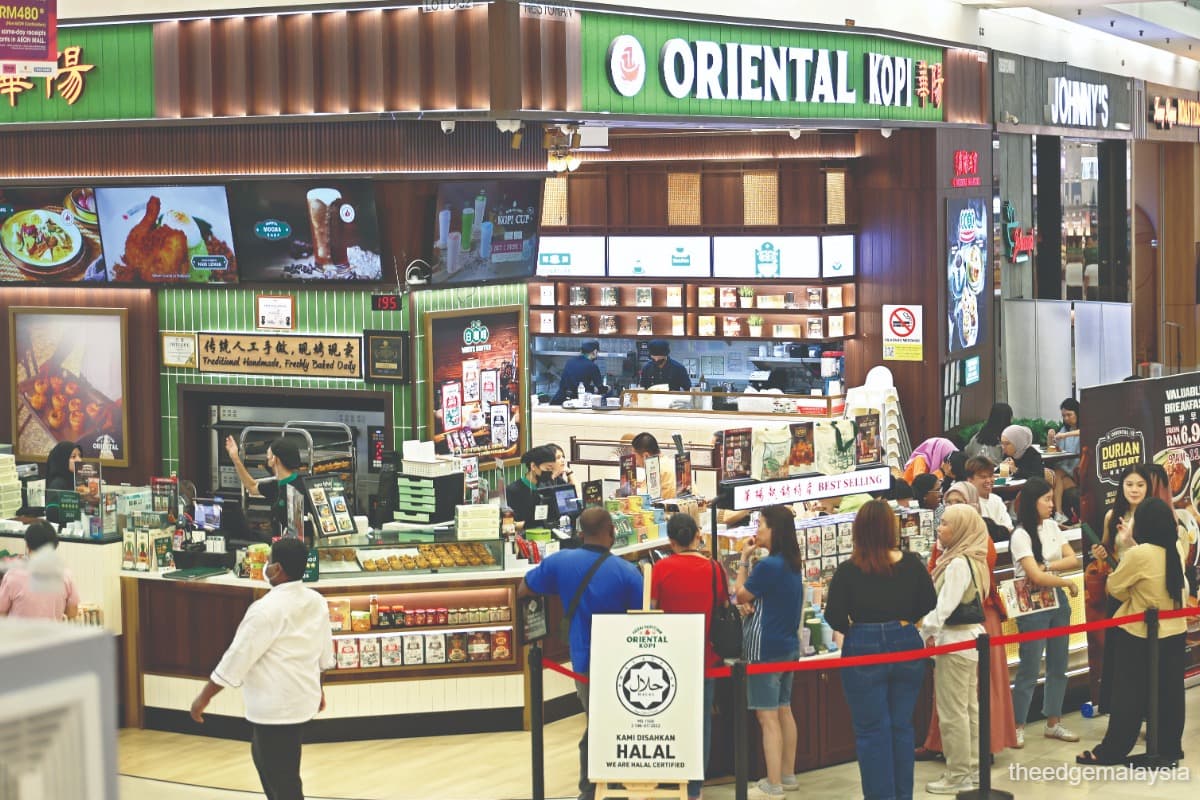
This article first appeared in The Edge Malaysia Weekly on July 20, 2026 - July 26, 2026
IT appears that Malaysian consumers may be holding back on discretionary spending despite the country experiencing a lot less pain than its Asean neighbours, which faced rationing and huge price increases as a result of the blockade of the Strait of Hormuz.
When releasing its report in June, Retail Group Malaysia (RGM) revised its projection for annual growth in retail sales for 2026 downwards to 3.8% from 4%. In addition, its numbers show that in the food and beverage (F&B) sector, the café and restaurants category experienced negative growth of 4.6% in the first quarter of 2026 — the first contraction since 2Q2023, or in nearly three years. Put another way, more people are either not eating out as much or opting for cheaper food.
The café and restaurants category contracted despite the major festivals and school holidays falling in the first quarter, coming below the 1.9% growth expected by the F&B operators, according to the RGM report.
“In our reports, we measured organic growth rates (that is, same store growth rates).In this current market environment, we believe same-store growth rates of most F&B outlets are either the same or declining. This is due to intense competition. Too many F&B outlets are fighting for the same market share,” shares RGM managing director Tan Hai Hsin in an email reply to The Edge.
He adds that in major cities in Kuala Lumpur, Selangor, Penang and Johor Bahru, new F&B outlets open almost every day. At the same time, there are also many F&B outlets shuttering every week due to reduced business, higher cost of operations and increasing losses.
Even the takeaway, kiosk and stall category contracted in 1Q2026, falling 1.4% from the previous corresponding period.
Estimates for 2Q2026 remain rather gloomy, with café and restaurant operators expecting average sales to decline by 2.3% year on year (y-o-y) while those in the takeaway, kiosk and stall category project business to contract 0.8% y-o-y.
“Due to rising costs of living, diners have chosen to eat out less. Others have ordered lower-priced foods and drinks from their regular cafés, restaurants and beverage outlets,” says RGM. It expects conditions to worsen in the second half of this year.
It also noted instances of F&B operators shuttering in the second quarter, while some chain operators chose not to renew leases for some underperforming outlets in certain malls.
RGM’s data shows that retail sales performance for 1Q2026 had already fallen below earlier market expectations. Despite the Lunar New Year and Hari Raya celebrations falling during that period, plus cash handouts from the government, retail sales growth came in at 3.7% y-o-y compared with the expected 4.4% growth.
Of the nine retail subsectors, three contracted in the first quarter — department store-cum-supermarket (-1%), personal care (-0.7%) and other speciality retail stores (-16.5%). Five subsectors saw growth, the highest being furniture and furnishing, home improvement as well as electrical and electronics at 9.3%, followed by pharmacy (4.2%), fashion and fashion accessories (4.2%), supermarket and hypermarket (1.4%) and department stores (0.3%). There was no data furnished for the mini-market, convenience store and cooperative subsector.
CIMB Research said in a recent report that RGM’s statement is consistent with its latest macro read-through.
“Consumer spending is likely to remain more cautious amid softer growth expectations and higher inflationary pressure versus pre-conflict assumptions. CIMB’s in-house economics team currently forecasts 2026 GDP growth of 4.3% and inflation of 2.3%, compared with its pre-conflict forecasts of 4.5% and 1.5% respectively,” it said in a July 2 report.
This does not apply to just eating out.
“Last month, there were barely any sales. It was so quiet that we had to resort to having a ‘members’ day sale’ in order to attract customers,” shares a manager of a jewellery outlet in the Klang Valley.
RGM’s report notes that many retail goods and services in Malaysia have become more expensive because of the higher fuel prices caused by the war in the Middle East, resulting in an erosion of buying power. While Malaysians have access to subsidised RON95 fuel and diesel, higher energy costs globally has translated into higher costs in almost every other economic sector as logistics prices as well as that of the all-important petrochemicals rose.
And even though RGM sees the retail industry growing 4.8% y-o-y in 2Q2026 due to a low base effect — given that the retail industry had contracted by 3% y-o-y in 2Q2025 — its forecasts for the third and fourth quarters are dismal at only 2.9% and 3.9% growth respectively.
Cutting back on non-essentials
CIMB Research believes that consumer wallet share is increasingly shifting towards daily essentials, particularly food-related and household staple items, as households become more cautious and Sumbangan Asas Rahmah (SARA) utilisation remains skewed towards essential goods.
“This was evident in 99 Speed Mart Retail Holdings Bhd’s (KL:99SMART) and MR DIY Group (M) Bhd’s (KL:MRDIY) 1Q2026 sales mixes, which registered higher contributions from daily essentials y-o-y,” it wrote in a July 2 report.
The research house adds that there was a similar trend at AEON Co (M) Bhd (KL:AEON), which reported stronger sales of food line items in 1Q2026, at the expense of the health and beauty segment which recorded weaker sales, reinforcing the view that consumers are cutting back on non-essential spending.
Recent data on distributive trade sales — whose subsectors include wholesale trade, retail trade and motor vehicles — also indicates softer spending momentum. Distributive trade sales eased to 11% y-o-y in May compared with 15.3% growth in April.
Weakness came from the wholesale trade (18.4%) and motor vehicles (-2.3%) subsectors while retail trade managed to increase to 7.2% in May from April.
Kenanga Research says in a recent note that the distributive trade growth of 9.7% from January to May was driven by earlier demand front-loading, wholesale inventory build-up, higher petroleum-related prices and a favourable base effect. “We still expect growth to moderate in the coming months as wholesale activity normalises alongside easing geopolitical tensions and lower energy prices. May’s sequential contraction and the broad-based wholesale and motor vehicle sales slowdown suggest this momentum is already fading,” it says, adding that the upside risk for retail trade remains if tourism activity strengthens in 2H2026.
The research house says the double-digit distributive trade growth and stronger industrial production in April and May confirm that domestic demand remains firm. Nonetheless, it expects economic growth to ease in 2H2026 as activity normalises while geopolitical uncertainty persists and base effects turn less supportive.
That said, private consumption or consumer spending — which has long been an important growth engine for the Malaysia economy — is expected to continue as the biggest pillar of the country’s gross domestic product (GDP). In 2025, private consumption accounted for close to 61% of GDP, with policymakers citing the low unemployment rate and wage growth.
As long as people remain employed and wages continue to grow faster than inflation, they can spend on goods and services. That spending generally supports economic growth, as consumption also depends on consumer sentiment, household debt levels and even factors like asset prices, which affect disposable income. If consumer sentiment is indeed wavering, the fight for share of wallet will get tougher.
Read also: Save by subscribing to us for
your print and/or
digital copy. P/S: The Edge is also available on
Apple's App Store and
Android's Google Play.
Cover Story 1: F&B IPO buffet: Lip-smacking feast or leftover risk