

This article first appeared in The Edge Malaysia Weekly on July 20, 2026 - July 26, 2026
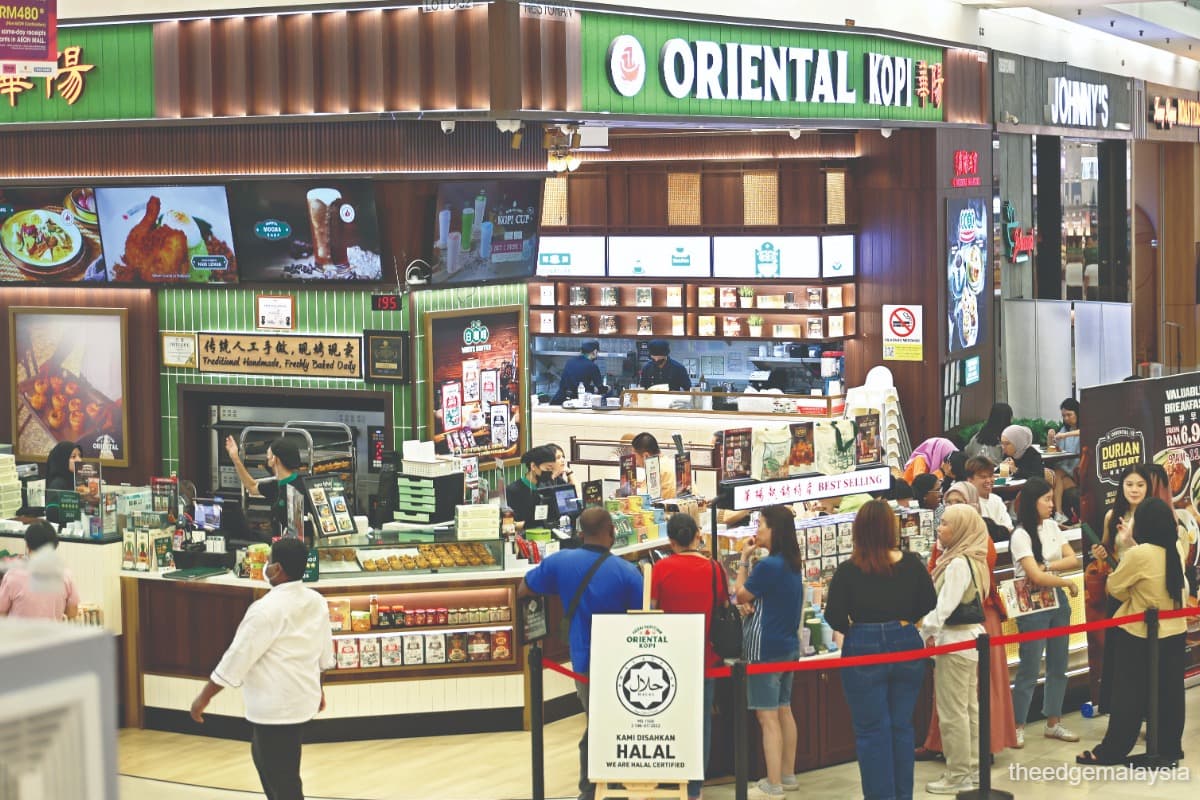
ORIENTAL Kopi Holdings Bhd’s (KL:KOPI) ACE Market listing, while it was at its peak late last year, was deemed widely successful — not only because it commanded a generous 20 times earnings multiple but also because it may have sparked off a wave of food and beverage (F&B) players exploring listing plans.
On the private market, deals in the F&B space have been aplenty as well in recent years — whether led by private equity firms or other F&B players looking to acquire for expansion or to consolidate. Farm Fresh Bhd’s (KL:FFB) RM83.9 million acquisition of Inside Scoop Sdn Bhd in February 2023, for instance, has since yielded its own ice cream line.
Yet, the story is not all upbeat for many other F&B companies that have debuted on Bursa Malaysia in recent times.
Since Oriental Kopi’s listing in January 2025, at least four other F&B-related companies have listed on the stock exchange — A1 AK Koh Group Bhd (KL:A1AKK), HSS Holdings Bhd (KL:HSSBAKERY), Empire Premium Food Bhd (KL:EMPIRE) and RT Pastry Holdings Bhd (KL:RT).

All four companies saw the public portion of their initial public offering (IPO) being oversubscribed but three of them closed either flat or below their IPO price on the first trading day. A1 AK Koh, RT and HSS had yet to rebound to their IPO price at the time of writing (July 15). A1 AK Koh was down 36% from its IPO price, RT’s share price was lower by 19% and HSS was at a 16% discount to its IPO price.
Only Main Market-listed Empire Premium closed higher on its first trading day, climbing 48.5% from its IPO price of 70 sen to RM1.04. The sushi takeaway chain operation’s IPO valuation rivalled that of Oriental Kopi’s at 20 times price-to-earnings ratio (PER).
So far, Empire Premium’s share price has been staying above its IPO price since its flotation. But it has only been about three months now.
Currently, the stock is at 98 sen, giving the company a market capitalisation of RM1.05 billion.
“I would say Oriental Kopi’s successful listing is an isolated case. As we can see, those that came after it did not see much success,” says a fund manager.
Indeed, within a year of its debut, Oriental Kopi’s share price weakened and earnings came in below investor expectations. In the second quarter ended March 31, 2026 (2Q2026), the company reported net profit of RM15.03 million against revenue of RM147.25 million. Net profit was higher by 8.7% y-o-y while revenue increased 42.7% y-o-y in 2QFY2026. On a cumulative six-month basis, 1HFY2026, net profit was higher by 19.1% at RM32.08 million from a year ago but it was below analysts’ full-year forecast by 39%.
Today, Oriental Kopi has given up much of the gains it made last year. On July 15, the stock closed at 90 sen, valuing the company at RM1.8 billion.
Despite the lukewarm performance of the F&B companies post-listing, more F&B companies are going for listing. Two upcoming ones are that of Bestari Food Bhd and Custom Food Bhd, which have filed their draft prospectus.
That being said, Bestari Food and Custom Food sit on a different tier of the F&B supply chain as they are in the food premix segment and could encounter different fates compared to the more retail-centric companies. Custom Food filed its draft prospectus in 4Q2025 while Bestari Food filed its copy this July.
Why the F&B IPO boom?
This is partly the effect of the success of the few early movers, which set the pace for others, says Fortress Capital Group CEO Datuk Thomas Yong.
“When consumer-facing companies with strong brand recognition and rapid store-rollout narratives debuted to exceptional market reception, it naturally drew the attention of other F&B operators and their advisers. Founders and private equity backers of similarly positioned businesses recognised that the window of investor appetite was open,” he explains.
Consultants also say that many of these businesses had grown to a size where public listing was the next natural step.
Nghia Nguyen of Capital Markets Centre at Ernst & Young PLT says many of these businesses have similarly developed strong brand recognition, expanded outlet networks and proven operating track records, making them attractive IPO candidates.
Listing on the ACE Market is well-suited for fast-growing F&B brands that have scale but have yet to achieve significant profits as listing on a secondary board does not require a profit record, according to Nghia.
Furthermore, it is undeniable that consumer-facing businesses are more relatable for the common investor, compared to companies in sectors like technology, thereby gaining the attention of retail investors.
“An F&B brand with 100 outlets that consumers visit daily is inherently more tangible and understandable than an industrial B2B business, and that relatability translates into retail investor participation and post-listing liquidity, both of which are critical for a successful listing on Bursa,” says Yong.
Going public is often one way for companies to raise funds to optimise business processes and to scale up their business. Listing also provides the company with a stronger brand credibility and visibility, along with an enhanced corporate profile that increases customer confidence.
For the F&B business, which requires a significant upfront capital investment, expansion is often fuelled by heavy bank borrowings to fund fit-outs and renovation, says Nghia.
“But an IPO injects equity capital and allows brands to wipe out high-interest debt and clean up their balance sheet,” he adds.
Apart from that, a listing would give the founding members of the company a chance to monetise their business.
One notable example among the recent F&B listing is Empire Premium. Its IPO raised RM254 million, of which RM101.5 million went to CEO Nicole Lim and her husband Jordan Tan from an offer for sale of their existing shares in the company. The amount is almost equal to the amount raised — RM152.6 million — for the company’s expansion and operations.
Be that as it may, can the momentum of F&B companies going public be sustained?
Nghia says while there remains a pipeline of companies seeking capital to achieve growth ambitions, investors are becoming more discerning today with greater emphasis on profitability, cash flow generation, scalability and execution rather than just brand recognition.
Companies that had courted investors with growth stories envisioned pre-IPO will now be tested, says Deloitte Malaysia capital markets and services partner Wong Kar Choon, as investors look at the sustainability of the financial performance of the companies.
Nghia also says: “In addition, recent proposals on stricter listing requirements in Malaysia may raise the expectations of companies seeking to list.”
What this essentially means, Nghia believes, is that future F&B IPOs may find it harder to command the valuation premiums seen in the earlier phase of the IPO cycle.
However, Wong believes the sector offers long-term growth potential, supported by rising consumer spending, urbanisation and changing lifestyle preferences with younger generations generally more inclined to dine out and spend on F&B experiences than previous generations.
Bargains are currently few and far between
While the IPO market has been hot for F&B companies, the consumer sector has turned out to be among the laggards year to date on Bursa. It has shed 6.3% since the start of the year, closing at 501.2 points on July 15.
Its underperformance is partly due to weaker consumer sentiment, says Areca Capital CEO Dany Wong, and also because the focus of investors this year is the technology sector.
Weaker consumer sentiment is certainly no surprise with the war in the Middle East this year resulting in higher costs in energy, petrochemicals and logistics, which translate into rising inflation. Inflation rose to 2% in May, the highest since mid-2024.
This has undoubtedly affected how consumers are spending their money. They are cutting back on non-essentials and apportioning more to essential items (see sidebar on next page).
When asked if a general election would provide the sector with a tailwind — the goodies that are usually doled out in the run-up to election day — Wong says it could have some effect on consumer sentiment.
“The effect will be short term. To get real consumption, what is needed is policies to drive it,” he explains.
Meanwhile, Fortress Capital’s Yong looks at the underperformance of the consumer sector through a different lens. He says while sentiment has played a part in the underperformance, he believes the bigger reason is that the sector is primarily undergoing a valuation correction or a de-rating of multiples, rather than an earnings collapse.
“Many consumer stocks, particularly those linked to the government’s SARA cash aid programme and the broader essentials-retail narrative, have experienced significant valuation re-ratings in the past couple of years as investors priced in optimistic growth trajectories.
“At those elevated valuations, the market became far less forgiving when companies missed same-store-sales growth guidance or when earnings growth decelerated from prior run-rates.
“What followed was a valuation unwind, earnings estimates were revised modestly but the de-rating in price-earnings multiples accounted for most of the share price decline,” says Yong.
To put it simply, it was a case of the higher the expectation, the greater the disappointment.
With the sector being a laggard so far this year, would it be a good opportunity to pick up some stocks trading at a cheaper price than before, especially the recent IPO counters that have fallen below their IPO valuations?
Yong warns against using IPO valuations as a yardstick for determining whether or not a stock is “cheap”.
“An IPO valuation reflects a point-in-time valuation, influenced by market conditions, book-building dynamics and issuer-specific considerations at the time of listing. It is not an intrinsic value anchor.
“A stock trading below its IPO price may still be expensive relative to its forward earnings, just as a stock trading well above its IPO price may still represent good value if earnings have grown materially,” he emphasises.
Instead, he suggests that investors look at metrics such as forward PER relative to the company’s earnings growth trajectory, its free cash flow yield and the return on invested capital.
He says that in the current environment, he would look for companies that demonstrate resilient or improving same-store-sales growth (SSSG) and the ability to defend or expand gross margins despite input cost inflation. He also likes companies that have disciplined capex management that generates positive free cash flow even during an expansion phase and a balance sheet that does not rely on external funding for day-to-day operations.
“Companies with strong brand loyalty and pricing power, particularly those serving the essentials or value segment, which is where the spending is gravitating, deserve a premium,” Yong adds.
Wong says that he is neutral on the F&B sector, given that while consumption is holding up, rising costs could prove to be a problem going forward.
“What we would look for, based on a bottom-up approach, are companies that are able to expand their business, can command some premium and protect most of their margins,” he says without naming stocks.
There is only a handful of F&B companies on Bursa whose focus is their eateries or takeaway food. Apart from this year’s listings of Empire Premium and RT Pastry, there are also Oriental Kopi, Berjaya Food Bhd (KL:BJFOOD), bakery group SDS Group Bhd (KL:SDS) and restaurant operator Oversea Enterprise Bhd (KL:OVERSEA).
Both Berjaya Food and Oversea are loss-making. There is no coverage of Oversea and only one analyst covers Berjaya Food.
Berjaya Food, the operator of Starbucks and Kenny Rogers in Malaysia, has certainly fallen from grace among investors in the last few years. It is now trading at 17.5 sen, with a market capitalisation of RM342.7 million. CIMB Research, which covers the stock, has a target price of 21 sen on the counter.
“Berjaya Food is cheap for a good reason. It has its own set of problems that began with the boycott of Starbucks in Malaysia a while back and it has not recovered from it. The market is pricing it on its turnaround plan, which has not borne fruit, rather than on the brand it carries,” says a fund manager who declines to be named. “It has limited pricing power, especially with the many new coffee chains in the market today.”
On the other hand, small-cap SDS Group’s revenue and net profit have been growing over the last five financial years. In its financial year ended March 31, 2026, the company reported a net profit of RM33.3 million on revenue of RM345.7 million. Net margin for the financial year was just a whisker below 10% at 9.6%.
The company’s share price shed 47% in one year to close at 38.5 sen on July 15. Based on Bloomberg data, its average 12-month target price sits at 52 sen and it has a forward PER of 7.81 times.
Oriental Kopi may have disappointed investors with its earnings, prompting a sell-off this year but it has continued to stay in favour with most analysts covering the stock. There are four “buy”, one “hold” and one “sell” calls with an average 12-month target price of RM1.14. Its share price of 94 sen at the time of writing implies a 21% upside potential.
Analysts like Oriental Kopi for its growth story of outlet expansion plans and efforts to scale up its higher margin fast-moving consumer good products, like its premixed coffee, white coffee, pineapple tarts and kaya spreads.
Investors would recall Main Market-listed OldTown Bhd that was taken private by Dutch company Jacobs Douwe Egbert Holdings Asia NL BV (JDE Asia) in 2018 after fewer than seven years on the stock exchange.
At RM1.47 billion, translating into RM3.18 per share and a multiple of 23.63 times the company’s FY2017, it was certainly a sweet deal for investors. But what is worth noting is that the deal came when OldTown was struggling with growing competition and a tough operating outlook.
Its financials before it was taken private were showing signs of strain, with net profit for the third quarter ended March 31, 2018, falling 52% to RM11.6 million as a result of higher foreign exchange losses and operational cost. Its cumulative nine-month profit declined 14.2% year on year.
As many owners in the F&B business would agree, it is a highly competitive industry with low barriers to entry coupled with ever-changing consumer preferences. It would be interesting to watch which F&B players continue to keep the consumers smacking their lips for more and which are considered as leftovers.
Save by subscribing to us for your print and/or digital copy.
P/S: The Edge is also available on Apple's App Store and Android's Google Play.