


This article first appeared in The Edge Malaysia Weekly on July 13, 2026 - July 19, 2026
THERE is active debate on whether Malaysia’s power sector can keep pace with the fast-growing electricity demand.
Attention has centred on data centres (DCs), which currently account for 7% of electricity demand in Peninsular Malaysia. This is expected to rise to 31% by 2035 on a power grid that also needs to cater to growing demand from other commercial and residential users.
Prime Minister Datuk Seri Anwar Ibrahim has said Malaysia is restricting new DC projects that are not linked to artificial intelligence to manage water and electricity consumption. As a medium-term measure, the government has conducted two tenders for new gas-fired power plants — last year and this year — to add to generation capacity.
However, actual DC consumption today is at a low base: it represents just 54% of approved capacity, with the remaining 948mw expected to largely come online only by 2028. That alone is equivalent to about 3% of grid-connected installed generation capacity, excluding other projects approved but not commissioned yet.
At the same time, a global gas turbine bottleneck suggests new power plants could take longer than the usual three years to commission. A plant awarded today may only come online in 2029 at the earliest — a year after the next major increase in DC power demand.
Furthermore, Energy Minister Datuk Seri Fadillah Yusof said in 2024 that the nation would not build new coal-fired power plants in line with the country’s net-zero emissions target.
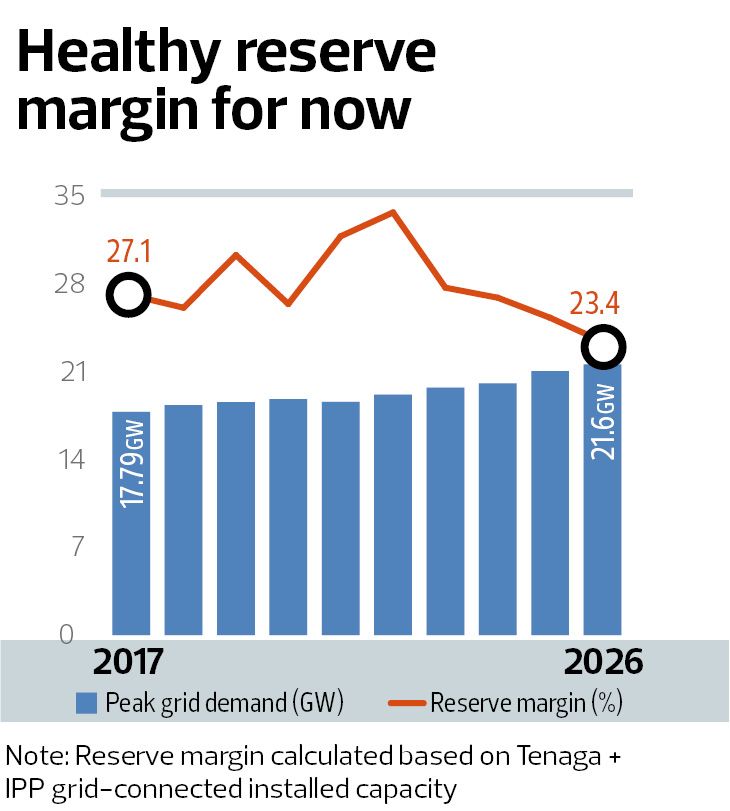
Based on the latest peak grid demand of 21,583mw on June 8 and grid-connected installed generation capacity of 28,192mw in 2025, Peninsular Malaysia has a seemingly comfortable reserve margin of 23.4%.
But a closer look shows available generation currently stands at just under 25,000mw, narrowing the margin to around 13%. The reduction is partly due to planned outages for maintenance works, including at the 2,242mw Edra Melaka Power Plant. It is the largest thermal power plant in the country.
Peninsular Malaysia also saw heightened electricity imports of 300mw from Thailand, mainly between September and November 2025 and throughout June this year, Grid System Operator (GSO) data shows.
Renewable energy generation, mainly from solar and hydro, is intermittent in nature and accounts for about 12% of peak demand, according to a snapshot of grid demand. On July 9. large-scale solar (LSS) supplied around 1,500mw during the day, while hydro generation exceeded 1,100mw at night. Hydro also supplied between 300mw and 600mw at other times of the day.
In terms of grid-connected installed generation capacity, LSS and hydro represent nearly 17% of the total. LSS totalled 2,237mw as at July 2025, compared with 2,526mw of hydro generation, according to Energy Commission and GSO data.
Another 2,400mw of solar capacity sits at the distribution network level and is therefore not counted as part of grid demand. Meanwhile, oil- and diesel-fired plants continue to supply between 360mw and 450mw.
Put to the test
Although Malaysia is focusing on AI-linked DCs for now, a substantial pipeline of projects remains. Beyond the 948mw of approved DC capacity yet to come online, another 1,800mw (6% of total generation capacity) is under construction and there are electricity supply agreements for 2,000mw, according to Tenaga Nasional Bhd (KL:TENAGA). More projects remain at the application stage and will be assessed by the Data Centre Task Force.
It is understood that in the second half of 2025, actual DC maximum power demand rose by over 100mw each quarter, followed by another record 200mw in the first quarter of 2026 alone.
Against this backdrop of rising DC demand and tighter generation availability, data centres have also seen more power sag incidents — temporary voltage drops — caused by trips at power lines and power plants, according to channel checks by The Edge.
While some sags last only tens of milliseconds, they can still be detected by top-tier DCs designed for extremely high reliability, where a typical threshold is around 20 milliseconds.
In some incidents, backup power systems kicked in. At other times, there were emerging concerns over whether loads would need to be transferred from the grid to backup generators to eliminate any risk of server shutdown.
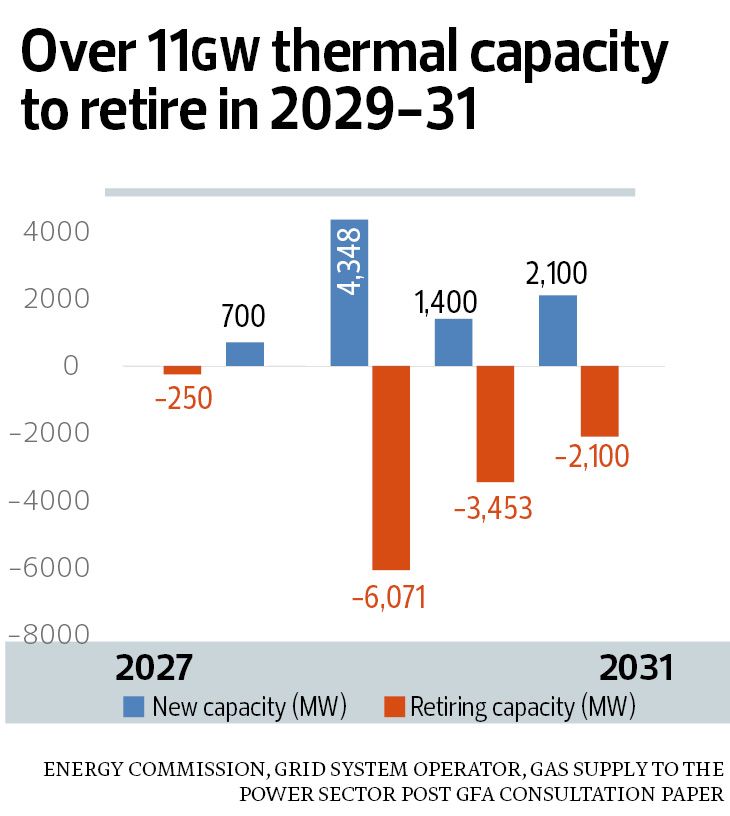
In the short term, the government has allowed several gas power plants to operate beyond their original commissioning periods. Will new gas plants be ready to offset the next coal power plant to be decommissioned — totalling 1,474mw — in 2029? The question is no longer whether Malaysia has enough power today, but whether new generation can come online fast enough or it has to play catch-up. Will the phasing-out of coal, which is the base load now for power generation, make it even more challenging?
Save by subscribing to us for your print and/or digital copy.
P/S: The Edge is also available on Apple's App Store and Android's Google Play.