

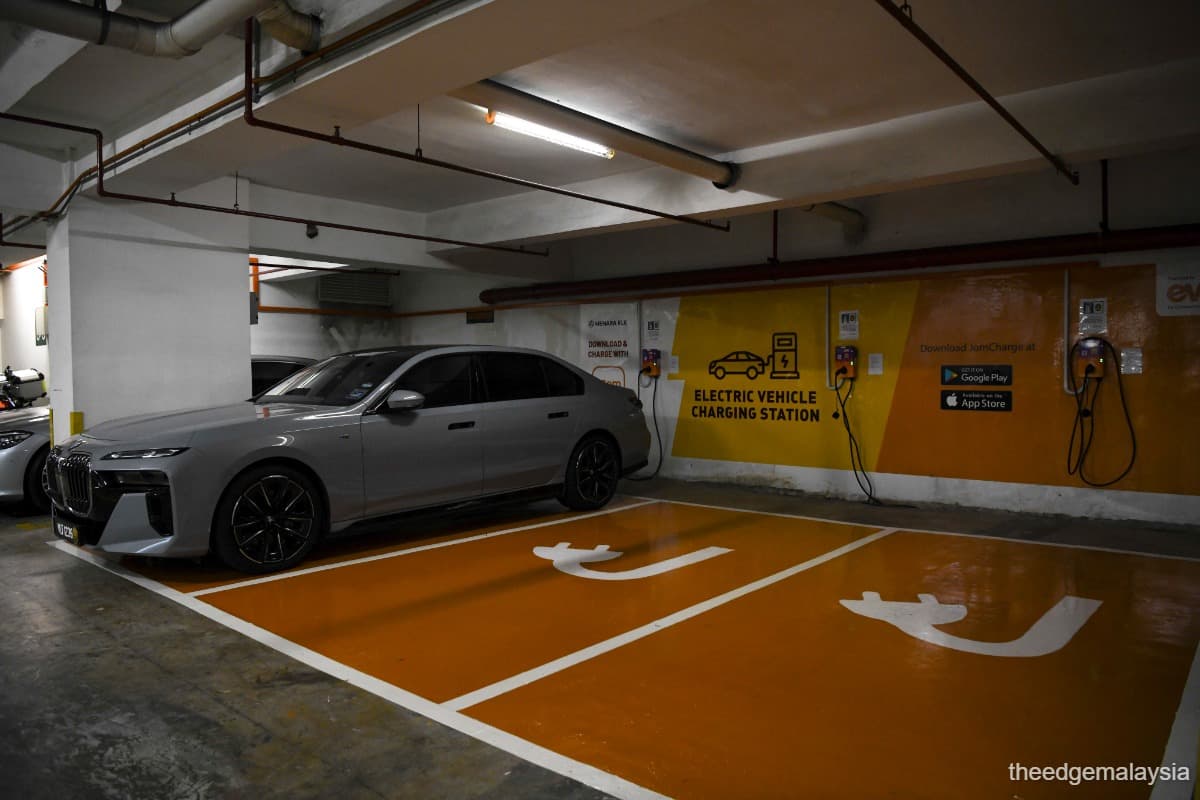
KUALA LUMPUR (July 8): Putrajaya’s revised stance on fully imported electric vehicles is necessary to protect the development of local industry, according to the Ministry of Investment, Trade and Industry (Miti).
The policy change on completely-built-up (CBU) electric vehicles is part of a strategy for adoption and ecosystem development, Deputy Minister Sim Tze Tzin told the Dewan Rakyat on Wednesday. The next step will be to encourage localisation to allow local vendors to benefit from the sector, he said.
“The government allows the importation of CBU vehicles — no problem — that is with the purpose of complementing the domestic market supply without undermining the development of the national automotive industry,” Sim said.
Malaysia officially started requiring minimum cost, insurance and freight value of RM200,000 as well as power output of 180kW for CBU electric vehicles this month.
The regulation follows the expiry of a four-year special exemption tax exemption and liberal import period for CBU electric vehicles, which ended on Dec 31, 2025.
The government wants to encourage local assembly “so that we can build our industrial base, enabling the country to benefit from industrial development rather than merely becoming a buyer”, he said. Malaysia should not be “just a market, but an industrial base”, he stressed.
The first phase comprised the excise duty exemption for imported electric vehicles to accelerate adoption. The revised import policy is the second phase of the government’s strategy, Sim noted.
“We have a very clear strategy, and we also have very clear targets,” he said, noting targets of 20% electric vehicle adoption by 2030, 50% by 2040 and 80% by 2050.
Sim was responding to Julau Member of Parliament Datuk Larry Soon @ Larry Sng Wei Shien on whether the government conducted an impact analysis on the revised import policy, and why the import requirements on such vehicles differ from those of their counterparts with internal combustion engines (ICE).
The two industries are at different stages of development, Sim said, noting that the local traditional internal combustion engine vehicle ecosystem has long been developed, while the government has to balance accelerating adoption and local assembly development of electric vehicles.
He highlighted different tax structures between the two vehicle types. The excise duty on EVs is at 10%, whereas for ICE vehicles it is significantly higher and depends on the vehicle’s engine capacity.
“With the lower excise duty rate, determining the import value of electric vehicles becomes more critical to ensure that the basis for taxation is accurate to reduce the risk of under-declaration of import values below their actual value,” Sim said.
Fully-imported ICE vehicle imports also have long had an import policy, being limited to those with engine capacities above 1,800cc, he added.
For more Parliament stories, click here.