

This article first appeared in The Edge Malaysia Weekly on June 8, 2026 - June 14, 2026

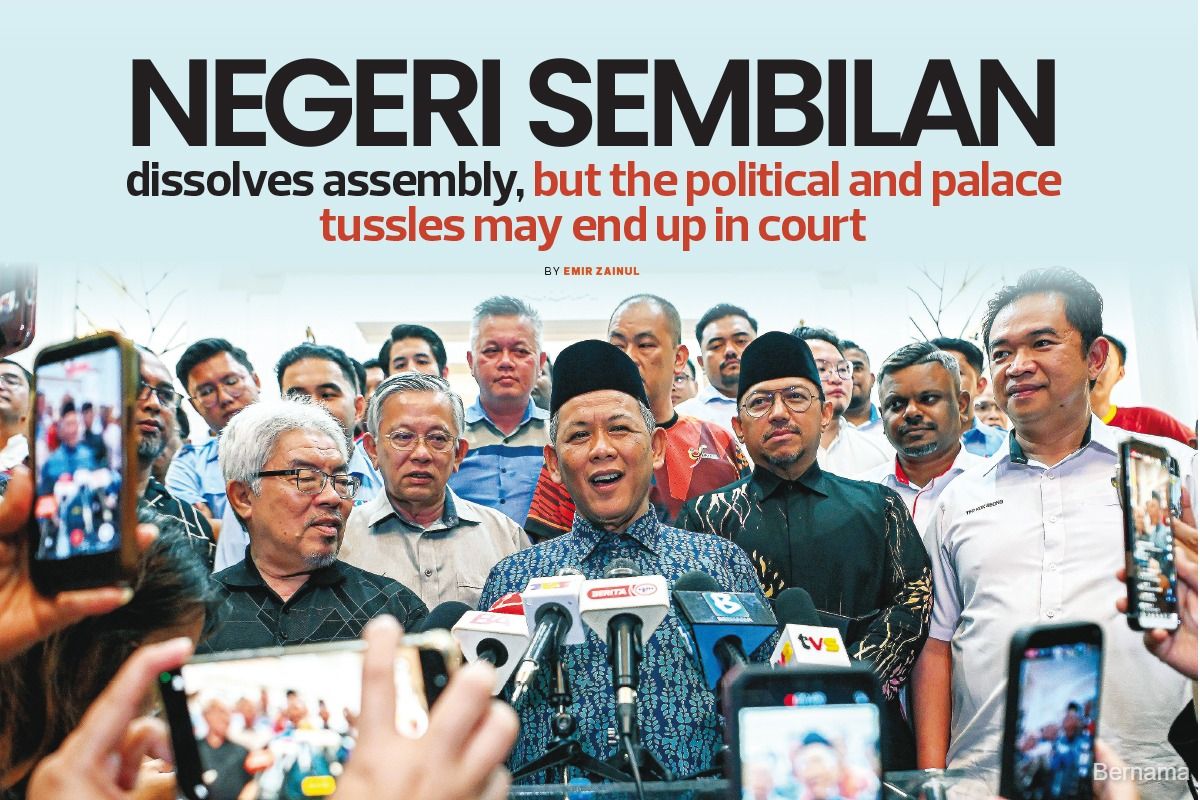
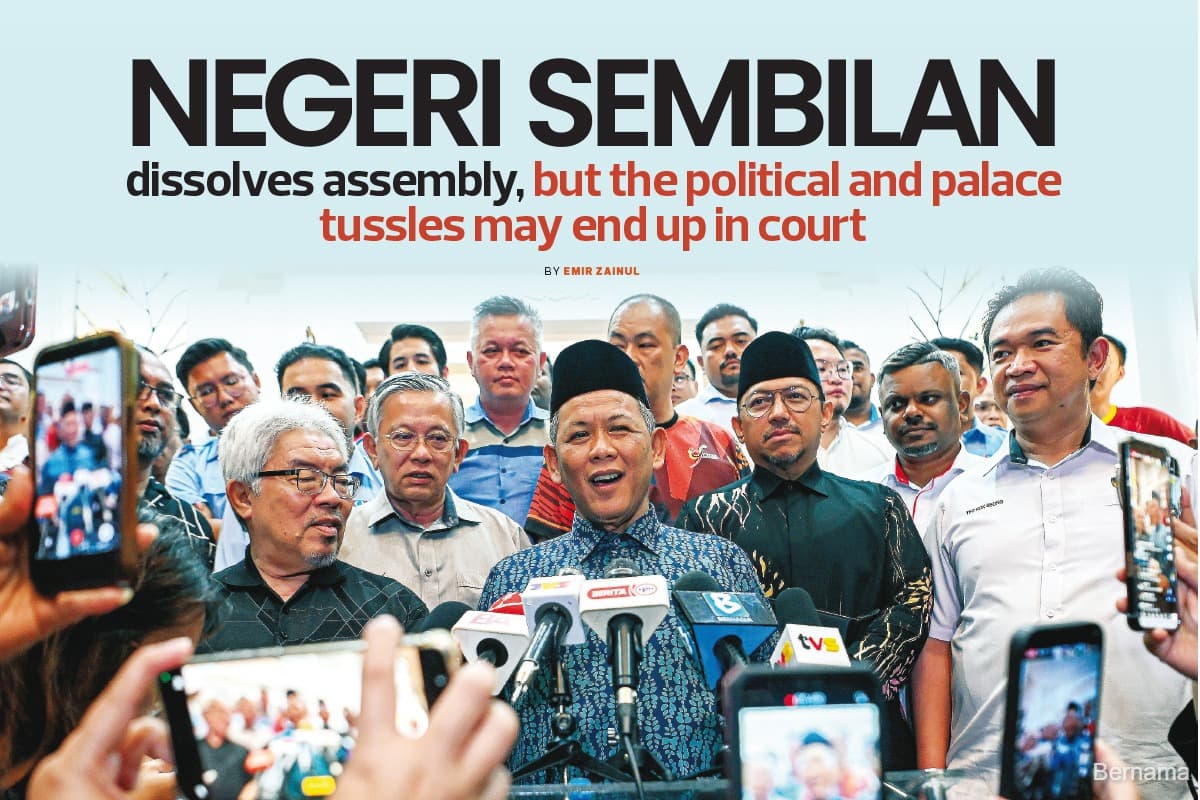
AFTER several days of speculation, Negeri Sembilan Menteri Besar Datuk Seri Aminuddin Harun announced at an 11pm press conference on Thursday (June 4) that he had sought and obtained consent from the state ruler to dissolve the state assembly the following day to pave the way for a state election.
But whether the election will proceed as planned remains uncertain.
Complicating matters is a palace tussle that has been unfolding since April, when the Undang Yang Empat — Negeri Sembilan’s traditional chieftains of Sungei Ujong, Jelebu, Johol and Rembau — announced that they had removed Tuanku Muhriz Tuanku Munawir, 78, as the Yang di-Pertuan Besar (Yamtuan).
After weeks of wrangling, including having the matter taken to court, the Undangs moved to proclaim Tuanku Muhriz’s 66-year-old cousin, Tunku Nadzaruddin Tuanku Ja’afar, as the new Yamtuan, coincidentally on the same day the state assembly was dissolved with Tuanku Muhriz’s consent.

(The proclamation was held at a hotel in Alor Gajah, Melaka, after police disallowed them access to one of the palaces in Negeri Sembilan.)
So, will the dissolution of the state assembly hold? How will the Election Commission react? Will the matter end up in court?
The near-midnight move by Menteri Besar Aminuddin to seek dissolution came against the backdrop of an extraordinary constitutional dispute involving the palace that observers say stemmed from tensions within the Pakatan Harapan (PH)-Barisan Nasional (BN) state government.
Aminuddin is from PKR/PH, which entered the 2023 state election in a pact with BN/Umno after the formation of the unity government in Putrajaya.
The rising tension between the two coalitions, which came to the forefront when BN/Umno declared it would go solo in the Johor state election, immediately spread to Negeri Sembilan.

Umno Negeri Sembilan chairman Datuk Seri Jalaluddin Alias had announced that the party, which has 14 seats in the state assembly, was withdrawing support for Aminuddin, and he called on the menteri besar to resign.
He was overruled, however, by Umno’s national leadership.
Sources say the state Umno leadership had the support of Perikatan Nasional (PN), whose five assemblymen would have given the bloc a simple majority of 19 seats when combined with Umno’s 14 in the 36-seat assembly, edging out PH.
PH currently holds 17 seats, comprising DAP (11), PKR (five) and Amanah (one).


Battle over constitutional interpretation
At the heart of the debate is the Negeri Sembilan Constitution, which contains provisions unique among Malaysian states due to the integration of constitutional monarchy and Adat Perpatih institutions.
“Negeri Sembilan is quite a unique situation compared to the other states,” constitutional lawyer Datuk Firoz Hussein Ahmad Jamaluddin tells The Edge. “It is not just a question of the constitution, but it is an interplay between the state constitution, the Federal Constitution and Adat Perpatih.”
The political crisis had escalated in late April after BN’s 14 assemblymen briefly withdrew support for Aminuddin, citing dissatisfaction with his handling of the palace dispute.
The state government refused to recognise the Undangs’ move to replace Tuanku Muhriz, arguing that Datuk Mubarak Thahak of Sungai Ujong had already been removed from office before the joint proclamation by the Undangs was made.
Although the PH-BN unity government later reaffirmed cooperation, questions remained over the functioning of the state’s constitutional framework and whether the assembly could continue to operate smoothly amid the dispute.
The timing of the dissolution also followed closely after Johor dissolved its state assembly on June 2, fuelling speculation that Negeri Sembilan would follow suit. Transport Minister and Chennah assemblyman Anthony Loke had previously said Negeri Sembilan would dissolve its assembly “tomorrow” if Johor proceeded with dissolution.
Six-month rule
Much of the constitutional debate in recent weeks centred on Article LVI of the Negeri Sembilan constitution, which states that the ruler “shall not allow six months to elapse between the last sitting in one session and the date appointed for its first sitting in the next session”.
Critics argued that the ceremonial opening of the state assembly on April 23 — which did not involve debates or substantive legislative business — did not constitute a proper sitting for constitutional purposes.
Some lawyers argue that, if that interpretation were accepted, the assembly risked breaching the six-month constitutional limit around June 10, potentially triggering an automatic dissolution.
Firoz says, however, that the constitution does not expressly state that breaching the six-month rule automatically dissolves the assembly.
“The automatic dissolution is only for the five years,” he says, referring to provisions expressly stating that the assembly “shall then stand dissolved” after completing its full term.
“There is no express provision that says what is the consequence of the failure to call [the assembly within six months].”
Still, he says the mandatory wording of the provision, particularly the use of the word “shall”, creates a strong argument that dissolution would be the natural constitutional consequence if the assembly failed to meet within six months.
“I would say that it is an absolute obligation for democratic purposes,” he says. “That means if it is unable to be called, then there should be dissolution.”
Role of the Undangs
While the dissolution may have settled the immediate debate over the six-month rule, another constitutional question remains over whether the Yamtuan could validly dissolve the assembly without the concurrence of the Undangs.
Unlike other Malaysian states, Negeri Sembilan’s constitution defines the “Ruler” in certain circumstances as not merely the Yamtuan acting alone, but together with at least three of the four Undangs.
Firoz points to provisions in the Negeri Sembilan constitution stating that for certain discretionary powers, including matters involving the dissolution of the legislative assembly, the term “Ruler” refers not only to the Yang di-Pertuan Besar but also requires the agreement of at least three of the four Undangs.
“The Yang di-Pertuan Besar cannot unilaterally dissolve the state assembly,” he argues, although other legal experts disagree and say the Yamtuan has total discretion.
The constitutional ambiguity was compounded by the broader dispute between Tuanku Muhriz and the Undangs themselves.
“There is a constitutional deadlock because, on the one hand, the Undangs have taken the step to sack the Yang di-Pertuan Besar,” Firoz says. “But on the other hand, for the Ruler to act, you require the Yang di-Pertuan Besar acting together with at least three of the four Undangs.”
As at the time of writing, it remains unclear whether the Undangs concurred with Friday’s dissolution.
Political reset or deeper instability?
Beyond the legal arguments, the dissolution reflects mounting strain within the PH-BN partnership in Negeri Sembilan and possibly the broader unity government at the federal level ahead of the next general election.
Tricia Yeoh, associate professor of practice at the University of Nottingham Malaysia, tells The Edge that the withdrawal of support by the 14 Umno assemblymen “signals a broader tension with the PH-BN relationship both within Negeri Sembilan and nationally”.
“At this moment, the nature of party politics in Malaysia is such that fractures within the coalition in one state affect that of another, as well as have natural ramifications well into the federal level.”
Although Aminuddin’s position remained constitutionally intact even during the brief withdrawal of support, Yeoh says his political authority had nevertheless been weakened.
“Realistically, the arrangement would not have been able to last for very long, especially since there would have been a ticking clock, anyway, till the budget tabling towards the end of this calendar year,” she says.
“Questions about the political legitimacy of the PH-BN state government in Negeri Sembilan would have arisen incessantly over the next few months had dissolution not taken place.”
While the state assembly has been dissolved by Tuanku Muhriz to — in the words of Aminuddin — “let the people decide”, questions remain over whether a state election will actually take place, given that the Undangs have purportedly sworn in a new Yamtuan on the same day as the dissolution.
If the dissolution is recognised as valid, the deadline for the next state election would fall on Aug 4.
Observers say BN/Umno would prefer for the new Yamtuan to appoint a new menteri besar without going through a state election, which is not due until 2028.
But will the new Yamtuan be recognised as legitimate? Prime Minister Datuk Seri Anwar Ibrahim has quickly come out to say that Putrajaya recognises Tuanku Muhriz as the Yamtuan.
Does the prime minister have a say in the matter? Or does the authority ultimately rest with the Undangs?
In all likelihood, the dispute may end up in court, even though some may argue that it is not a matter for judicial determination.
Read also:
Negeri Sembilan: Election War Drums Beating Amid Palace Tussle: PH faces test as BN/Umno seek to wrest power amid palace turmoil
Palace drama, cracks in PH/BN alliance set stage for Negeri Sembilan showdown
Politics, palace and power: The road to dissolution
Negeri Sembilan: Election War Drums Beating Amid Palace Tussle: Negeri Sembilan state seat composition over the years
Save by subscribing to us for your print and/or digital copy.
P/S: The Edge is also available on Apple's App Store and Android's Google Play.