

_ZHD-3_20260309121932_theedgemalaysia_1.jpg&w=1920&q=75)
This article first appeared in The Edge Malaysia Weekly on June 1, 2026 - June 7, 2026
SEMICONDUCTOR stocks have been on fire globally, with investors brushing aside concerns about geopolitical tensions surrounding the Strait of Hormuz, and instead riding the artificial intelligence (AI) capital expenditure (capex) wave.
The AI-driven rally has been pronounced on Wall Street, where the technology-heavy Nasdaq Composite Index has surged about 30% since April to a record high near 26,800 points. Even more striking has been the performance of semiconductor stocks, with the benchmark Philadelphia Semiconductor Index climbing more than 50% in less than two months.
The rally has also favoured semiconductor-heavy markets such as South Korea, Taiwan and Japan — all trading at near record highs — while Singapore has enjoyed spillover gains through its electronics and precision engineering ecosystem.
Taiwan’s weighting in the MSCI Emerging Markets Index has now overtaken that of China, while memory chip giants Samsung Electronics Co Ltd and SK Hynix Inc together carry a larger weighting than the entire Indian market in some Asia-focused benchmarks, underscoring how dominant the AI semiconductor trade has become.
US memory chipmaker Micron Technology Inc recently crossed the US$1 trillion market capitalisation mark after surging nearly 80% over the past month. The stock has rallied almost sevenfold since September last year amid growing optimism about AI-driven memory demand.
There are now at least five semiconductor-related companies globally with market caps exceeding US$1 trillion, including Nvidia Corp, Broadcom Inc, Taiwan Semiconductor Manufacturing Co (TSMC), Samsung Electronics and Micron.
Investor appetite for semiconductor exposure was further underscored by the blockbuster debut of AI chipmaker Cerebras Systems Inc — billed as the largest semiconductor initial public offering in history — whose share price surged as much as 89% above its IPO price on debut, valuing the company at US$68.6 billion and a trailing price-earnings ratio (PER) of 763 times.
Back home, Malaysia’s latest trade data suggests that the domestic electronics supply chain is already benefiting from the AI capex cycle.
April exports of electrical and electronic (E&E) products surged 46.4% year on year (y-o-y) to a record RM88.17 billion, while machinery and equipment exports rose 26.6% to RM8.19 billion. Optical and scientific equipment exports climbed 40.9% to RM7.11 billion.
Unsurprisingly, Bursa Malaysia’s Technology Index, heavily weighted towards large-cap semiconductor-related counters, has staged a strong rally since April.
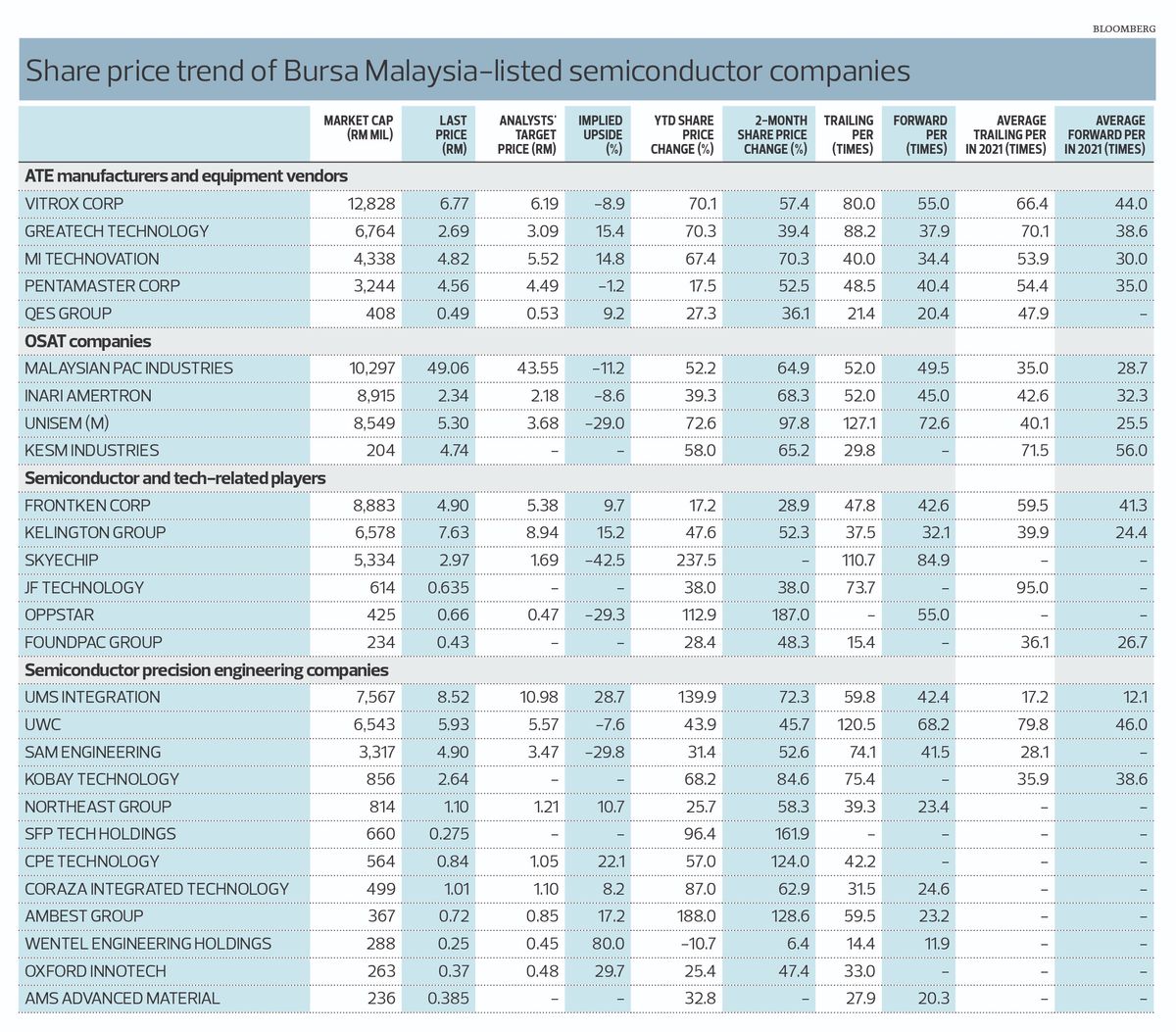
From outsourced semiconductor assembly and test (OSAT) players to automated test equipment (ATE) manufacturers and even smaller precision engineering firms, semiconductor-linked counters have surged since April, with many gaining more than 50% following earnings releases that pointed to stronger orders ahead.
Case in point, OSAT players such as Malaysian Pacific Industries Bhd (KL:MPI), Unisem (M) Bhd (KL:UNISEM) and Inari Amertron Bhd (KL:INARI) all reported weaker y-o-y earnings during the first-quarter results reporting season. However, investors appeared more focused on management guidance and future demand visibility than on backward-looking earnings numbers.
MPI and Unisem have highlighted stronger demand for power module packaging, which is increasingly crucial for next-generation high-voltage AI servers. Meanwhile, Inari guided stronger demand for photonics-related products used in AI-driven data centre interconnect solutions.
On the ATE front, ViTrox Corp Bhd (KL:VITROX) and MI Technovation Bhd (KL:MI) reported consecutive quarters of strong earnings growth, supported by greater exposure to front-end semiconductor processes tied to AI demand.
The sharp rise in semiconductor share prices has inevitably raised comparisons with the chip boom seen between late 2020 and early 2021, when pandemic-driven demand and electric vehicle adoption fuelled an industry up cycle before conditions eventually normalised.
Data compiled by The Edge shows valuations for many semiconductor counters have already exceeded their average 2021 levels, suggesting investors are pricing in a potentially stronger and more durable AI-driven growth cycle this time around.
For instance, ViTrox, whose share price has rallied 70% year to date (YTD) to an all-time high of RM6.76, is now trading at a trailing PER of 80.3 times and a forward PER of 55.2 times, above its 2021 average trailing and forward PERs of 66.4 times and 44 times respectively.
Meanwhile, the three major OSAT players — MPI, Inari and Unisem, whose share prices have gained between 40% and 70% YTD — are all trading above their average forward PERs seen during the 2021 semiconductor up cycle.
MPI is currently trading at 49 times forward earnings compared with 30 times in 2021, while Inari is trading at 45 times versus 32.3 times previously. Unisem’s forward PER has climbed to 67 times from 26 times in 2021.
This suggests investors are willing to pay higher valuations on expectations that AI-related demand will drive stronger long-term growth, while analysts may not have fully factored in the earnings upside potential.
Other companies seeing sharp valuation expansion include precision engineering firms UWC Bhd (KL:UWC) and UMS Integration Ltd (KL:UMSINT), whose share prices have surged 41% and 121% respectively YTD.
UWC is currently trading at trailing and forward PERs of 119 times and 67 times respectively, compared with 79 times and 46 times during the 2021 cycle. Meanwhile, UMS Integration is trading at 58 times trailing earnings and 41 times forward earnings, versus 17 times and 12 times respectively in 2021.
Commenting on the rally, Malacca Securities Sdn Bhd head of research Loui Low Ley Yee says the semiconductor sector’s earnings recovery despite a stronger ringgit suggests underlying demand remains resilient, particularly among companies exposed to the AI infrastructure buildout. “The earnings are coming back despite the stronger ringgit, which means demand is outpacing the foreign exchange impact,” he tells The Edge.
He adds that investors are increasingly gravitating towards large-cap semiconductor names with strong net cash positions and clearer exposure to AI-related demand trends. He also notes that the recent listing of chip design firm SkyeChip Bhd (KL:SKYECHIP) has further boosted optimism surrounding Malaysia’s semiconductor ecosystem and potential supply chain synergies. “These companies are potentially the ‘pick-and-shovel’ beneficiaries of AI investments flowing into the region,” he says.
NewParadigm Securities head of research Ben Shane Lim believes several macro and market factors are currently supporting the semiconductor sector’s outperformance.
“First, there are growing election-related uncertainties globally. Semiconductor stocks are viewed as relatively politically agnostic, which is driving sector rotation into the space. Second, there is potential for ringgit weakness, either arising from geopolitical developments or political uncertainty stemming from elections,” he says.
Lim notes that Bursa Malaysia’s semiconductor rally is moving in tandem with the strong momentum in global AI-linked semiconductor giants such as TSMC and Nvidia. Looking ahead, he expects semiconductor counters to continue outperforming in the near term as investors seem willing to look past short-term earnings weakness if the global AI-driven tech rally persists.
Read also:
MPI bets on next semiconductor wave as AI reshapes industry
Why OSAT will always be relevant
Save by subscribing to us for your print and/or digital copy.
P/S: The Edge is also available on Apple's App Store and Android's Google Play.