


This article first appeared in The Edge Malaysia Weekly on June 1, 2026 - June 7, 2026
AS Malaysian Pacific Industries Bhd (KL:MPI) enters its 54th year in business, the Hong Leong Group-controlled outsourced semiconductor assembly and test services (OSAT) player is already thinking one step ahead. It is positioning for the next wave of chip demand amid the artificial intelligence (AI) boom.
For decades, the semiconductor industry has evolved in cycles, with each wave defined by a dominant end market. First, there were personal computers, then came smartphones and servers. More recently, electric vehicles (EVs), AI-driven tools and next-generation data centres have emerged as the industry’s latest growth engines.
Each cycle has followed a familiar pattern — rapid demand growth, aggressive capacity buildout and eventually periods of correction. Yet, beneath these cyclical swings lies a longer-term secular upward trend driven by the increasing penetration of semiconductors across industries.
It is perhaps this structural trajectory that tycoon Tan Sri Quek Leng Chan anticipated early on.
In July 2020, Quek accumulated 7.28 million shares in MPI, a stake estimated to be worth nearly RM90 million at the time. Two decades earlier, during the dotcom boom in February 2000, he famously disposed of five million MPI shares at about RM46 apiece, fetching more than RM230 million.
Market observers noted that Quek had accumulated substantial blocks of MPI shares at about RM3 to RM5 each during the 1997/98 Asian financial crisis — a move widely regarded as one of his more astute investments.
With combined direct and indirect interest of 58.3% as at Sept 12, 2025, Quek has remained steadfast in his position as the largest controlling shareholder of MPI over the years as the company weathered multiple semiconductor booms and busts, and now stands at the cusp of the most disruptive technological transition yet — one where rapid shifts in chip architecture and manufacturing requirements can quickly render expensive investments obsolete.
Power management chips central to AI data centre buildout
In an exclusive interview with The Edge, MPI managing director Manuel Zarauza Brandulas says the OSAT player is benefiting directly from the rapid buildout of AI data centres.
“Everyone speaks about AI servers, but it has just started. Most of the business until now is still normal servers — not AI servers,” he points out.
The surge in demand is evident from the sense of urgency among MPI’s customers. Zarauza lets on that he has taken 22 flights over the past three weeks to meet clients globally. “They are now asking for more capacity,” he remarks.
The driver lies not only in AI processors themselves, but increasingly in the supporting power infrastructure required to run them. As computing intensity rises, the electricity consumption of AI systems is surging — driving stronger demand for chips that regulate, convert and manage power efficiently across AI servers and data centres.
Analog and power semiconductors are central to controlling electricity flow in these systems — in which MPI has built deep expertise over the years.
A major inflection point emerged in the industry last October when Nvidia Corp and Infineon Technologies AG announced a collaboration to implement an 800-volt direct current power architecture for Nvidia’s next-generation Vera Rubin AI computing platform.
The shift is significant because the existing 54-volt power architecture is increasingly struggling to support the rapidly rising energy requirements of next-generation AI processors as thermal loads and electricity consumption escalate sharply.
Central to this transition are wide-bandgap semiconductor materials such as silicon carbide (SiC) and gallium nitride (GaN) — technologies MPI began investing in seven years ago. These materials enable higher voltage operation, lower energy loss and improved thermal efficiency, making them increasingly critical in AI infrastructure.
Outside China, MPI is believed to be among the few OSAT players capable of handling advanced packaging involving these materials.
The strong demand environment is already translating into tangible financial results. For the three months ended March 31, 2026 (3QFY2026), MPI’s revenue rose 25.3% year on year to a record RM651.57 million. Revenue contribution from the US, Europe and Asia grew 44%, 22% and 10% respectively.

“If not for the ringgit’s strength, revenue would have grown more than 40% in US dollar terms,” says Zarauza. “When you grow at this level in OSAT, you see it maybe once every five or six years — typically during the start of a new cycle,” he adds, commenting on the top-line growth. AI-related products currently account for 13% of MPI’s revenue mix, up from 10% a quarter earlier. Management expects this contribution to eventually reach 20% — even assuming that other business segments will continue expanding concurrently.
While AI remains the primary growth driver, MPI’s automotive business has rebounded, supported by recovering EV demand in Europe amid fuel-price pressures and policy-driven electrification trends, says Zarauza. Rising semiconductor content per vehicle is also supporting the long-term demand structurally.
For the first nine months of FY2026, MPI’s profit after tax and minority interest (Patami) grew 30.44% to RM143.82 million from RM110.25 million a year earlier, despite rising input costs — including logistics, electricity and raw materials such as gold and copper — as well as a stronger ringgit and higher labour expenses, particularly in 3QFY2026. Total revenue for the nine-month period rose 22.08% to RM1.91 billion from RM1.57 billion previously, putting the group on track for another record full-year performance.
To support the next phase of growth in AI servers, MPI has invested about US$65 million (RM256.7 million) in the relevant equipment, with production expected to be ramped up in the coming months.
Shorter cycles ahead
When asked how long the current up cycle could last, Zarauza says the momentum could persist for another two years.
Drawing on more than 25 years of industry experience, he observes that semiconductor cycles are becoming increasingly compressed. Where it lasted six to seven years previously, the semiconductor cycle is now closer to three years, partly due to recurring structural shortages and faster technological transitions.
In MPI’s view, the period between 2026 and 2029 will represent “AI Wave 1”, characterised by rapid growth in AI servers, infrastructure deployment and deeper system integration. Beyond 2030, “AI Wave 2” is expected to focus increasingly on efficiency optimisation, an area where SiC- and GaN-enabled power architectures could become even more critical — directly benefiting MPI’s accumulated expertise in wide-bandgap technologies.
Zarauza believes that, within this framework, MPI is positioning itself for future end markets such as autonomous vehicles and humanoid robotics.
The group has also strengthened its positioning through the RM327.56 million acquisition of Infineon Technologies (Thailand) Ltd, which was completed in February and was subsequently renamed Carsem Semiconductor (Bangkok) Co Ltd. The acquisition adds automotive-grade memory capabilities to MPI’s predominantly analogue-focused portfolio, extending its reach into memory solutions relevant to AI applications.
“A humanoid robot could require more than 2,000 chips, spanning sensors, compute, memory and power management. We will be in full-stack positions and as a true one-stop solution,” says Zarauza.
MPI expects to progressively expand its technological capabilities across a broader semiconductor stack, from sensors and drivers to CPUs, timing devices and eventually memory applications that serve the automotive and AI markets.
“Give me all the parts … and we ship modules,” he says, describing the company’s long-term positioning strategy.
MPI’s transformation over the years
So how did MPI evolve into its current position?
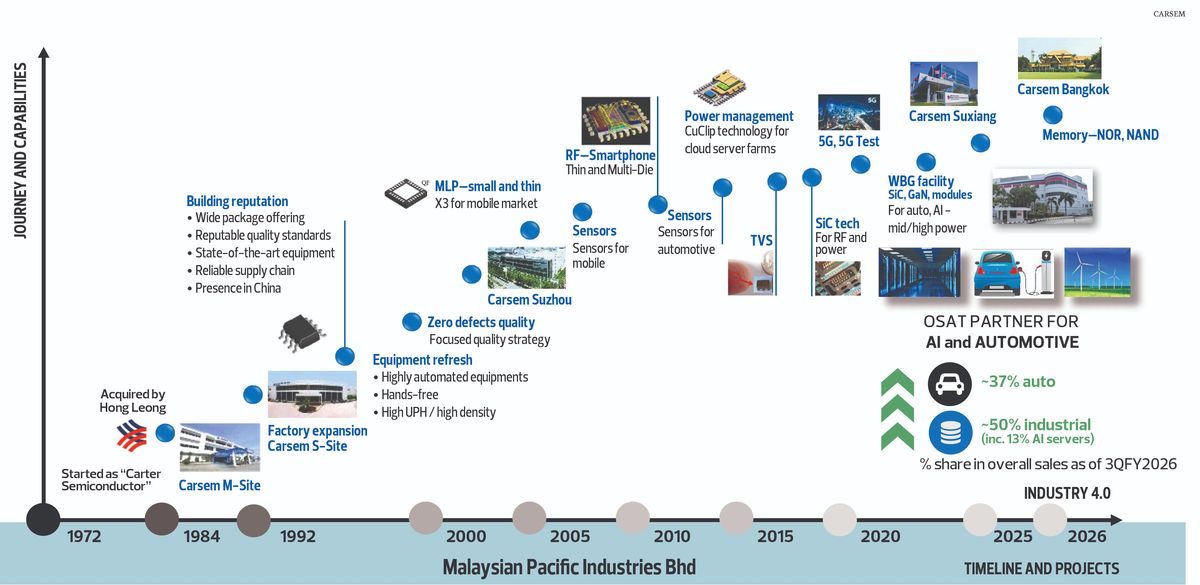
When Zarauza, 54, took at the helm at MPI in 2016, the company was heavily exposed to consumer mobile devices — a segment characterised by rapid product cycles, intense pricing pressure and heavy upfront investment requirements. “The problem with mobile is that everything changes every six months, and prices go down and down,” he says.
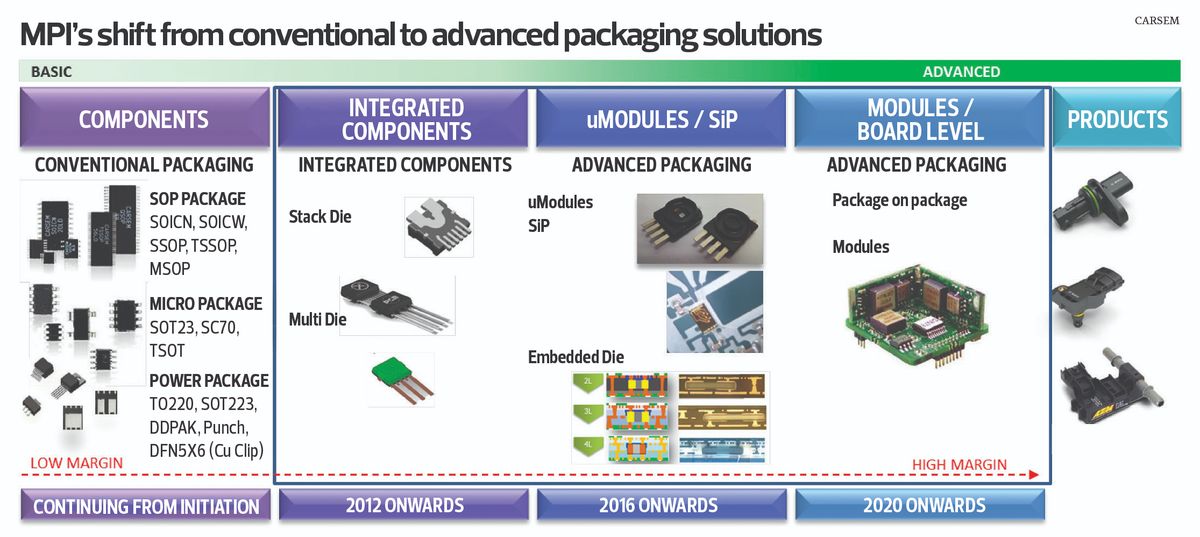
The pivot to automotive became a turning point for MPI. Longer product lifecycles, higher reliability requirements and more stable pricing created a stronger foundation for building technical capabilities. That transition drove the company’s early leadership in copper clip interconnects and sensor packaging — technologies that form the backbone of safety-critical electronics.
Between 2021 and 2025, MPI further expanded into server-related applications amid soaring cloud demand, while advancing capabilities in flip-chip, system-in-package (SiP), quad flat no-leads (QFN) and land grid array (LGA) packaging technologies — all important building blocks for modern power management systems.
Over the same period, MPI expanded its manufacturing footprint across Malaysia and China, including a dedicated wide-bandgap facility in Ipoh, Perak, and a new facility in Suxiang, China.
Today, MPI is regarded as a leader in copper clip and sensor packaging, while positioning itself among the early movers in advanced packaging for SiC applications. That positioning could place the group at the centre of emerging technologies such as AI infrastructure, autonomous vehicles and humanoid robotics.
Vision of the ship’s captain
Despite the growing excitement surrounding AI, Zarauza remains highly conscious of semiconductor cycles and says MPI deliberately avoids overbuilding capacity, even during periods of strong demand. The reason is simple: semiconductor cycles are inherently volatile.
“Everything that goes very fast up can also go very fast down,” he cautions. “We always have profitable growth. We do not expand for the sake of chasing headline growth.”
When asked whether MPI is taking advantage of the tight global capacity conditions to raise prices aggressively, Zarauza dismisses the idea. “The pay up is only short term. What will I do in two years when the premium is gone?”
Instead, MPI focuses on deepening customer relationships by broadening the range of products it supplies during negotiations.
“When one product goes down, I still have other products to shield the effects. I need to be responsible for 9,000 livelihoods that depend on MPI,” says Zarauza, referring to the company’s workforce.
The company is also careful to not become overly dependent on any single product category or customer. Its revenue mix currently comprises 50% industrial applications (of which 13% is tied to AI servers) 37% automotive, 9% 5G and Internet of Things (IoT), and 3% personal computers and laptops.
As for entering frontier product categories, Zarauza says there are no shortcuts. “You need to work hard on introducing new products. What is important when you decide something is that you need to have a vision as a CEO — what you think will be the future.
“What MPI is doing today is the result of planning made seven years ago. It is not just because you have money, you can immediately come into this game. There are a lot of processes involved with customers.”
Overseas operations and geopolitical tailwinds
The ongoing technology war between the US and China is also reshaping the semiconductor supply chain.
Zarauza notes there is a shortage of OSAT capacity globally, given the sheer amount of front-end semiconductor activity currently taking place. “There is no OSAT in Europe, so the orders need to come over to the neutral part of the world — Southeast Asia,” he adds.
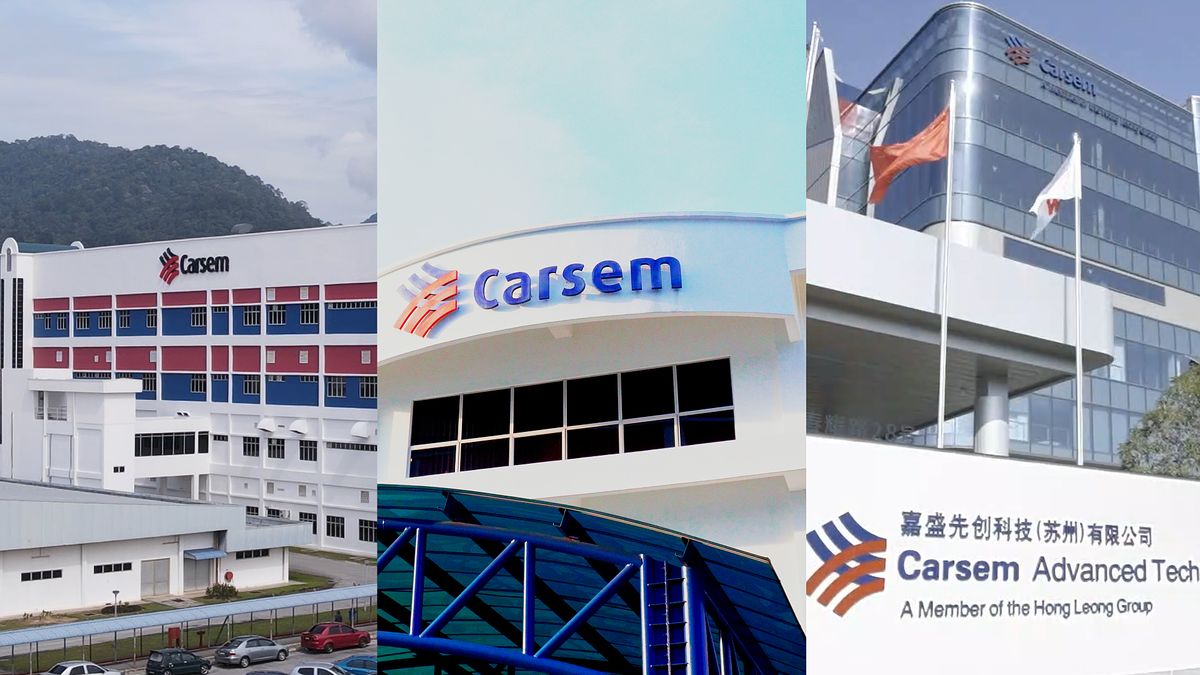
The strategic acquisition of Carsem Bangkok provides another geographical option for MPI’s customers seeking supply chain diversification. Furthermore, the facility benefits from its proximity to universities and technical schools, as well as mass rapid transit connectivity that supports worker recruitment.
Zarauza says the group managed to turn around the previously loss-making Thailand operation within six weeks. As for MPI’s China factories, he says they are increasingly onboarding Western customers, with the proportion expected to rise to 65% from about 30%.
Security concerns among multinational clients are also shaping customer behaviour. “We are very neutral. In China, I’m the only one there who is not Chinese,” says the Spaniard. “All the other OSAT players like ASE and Amkor have been sold to Chinese companies.
“Now the Europeans and Americans say, ‘If we go to China, it is better to go with Carsem even though it is more expensive than the Chinese companies’, because they are worried about the intellectual property (IP) and trade war issues. That puts us in a very nice position.”
When asked about the potential impact of strategic supply disruptions — such as helium gas shortages, which could create a bullwhip effect across the semiconductor industry — Zarauza says the situation is still manageable. According to him, the key lies in better planning and more proactive procurement strategies, including maintaining sufficient raw material inventories ahead of potential disruptions.
This is because the industry can still source critical materials from alternative regions globally even if certain supply routes become constrained. Having said that, Zarauza acknowledges that raw material costs have risen in recent months, particularly commodities such as copper and gold.
Ramp-up in production
Currently sitting on net cash of RM738 million, MPI is committing to significant capital expenditure (capex) over the next two years. The investments span multiple growth areas.
“I have the Suxiang factory opening — I need to invest for capacity. I have silicon carbide, I’m investing. I have AI servers, I’m investing. Sensor demand is strong, I’m investing. I have Bangkok for memory and I’m also investing there. But I only invest when it is profitable and when I already have the business,” says Zarauza.
Since 2020, MPI’s annual capex has consistently exceeded its reported net profit. However, the company recorded positive net cash inflow in five of the past six years, suggesting that its investments are generating returns alongside its business expansion.
The management’s conservative operating style is also reflected in the fact that MPI has paid dividends every year since its listing in 1987 despite operating in one of the world’s most cyclical industries.
When asked about MPI’s long-term revenue potential once all planned facilities are fully ramped up, Zarauza estimates that the group could eventually achieve RM3 billion in annual revenue — about 20% above the annualised RM2.5 billion revenue trajectory for the current year.
Beyond organic expansion, MPI is also open to mergers and acquisitions, particularly in areas such as advanced packaging, chip design, specialised materials, equipment as well as automation and robotics.
Still a low-margin business
One structural constraint shaping MPI’s outlook is the limited scope for automation in the OSAT industry. While certain processes can be optimised, the need for frequent changeovers and product customisation means human labour remains essential.
“You still need people, especially for complex products,” says Zarauza.
That reality reinforces the importance of workforce planning and geographic diversification. Nevertheless, he believes MPI can gradually carve out higher profitability through greater product complexity and by moving beyond component-level services towards integrated module solutions.
The company has set an internal goal of eventually achieving a net profit margin of 15%. Its average net profit margin has stood at about 8.3% in the past 36 years, with only four years — 1990, 1991, 2000 and 2001 — recording a margin of more than 15%. In the previous semiconductor up cycle in 2021 and 2022, it achieved a net profit margin of 13.7% and 13.6% respectively.
For all the optimism surrounding AI, Zarauza remains grounded. The AI cycle may be powerful, but it will not last forever. What matters is not merely riding a single wave, but positioning for the sequence of waves that follows, he says. “We are in this wave, but we are also preparing for the next.”
In that sense, MPI’s story is less about chasing growth and more about managing it carefully, deliberately, and with an eye on what comes after the hype.
Prioritising long-term value over share affordability
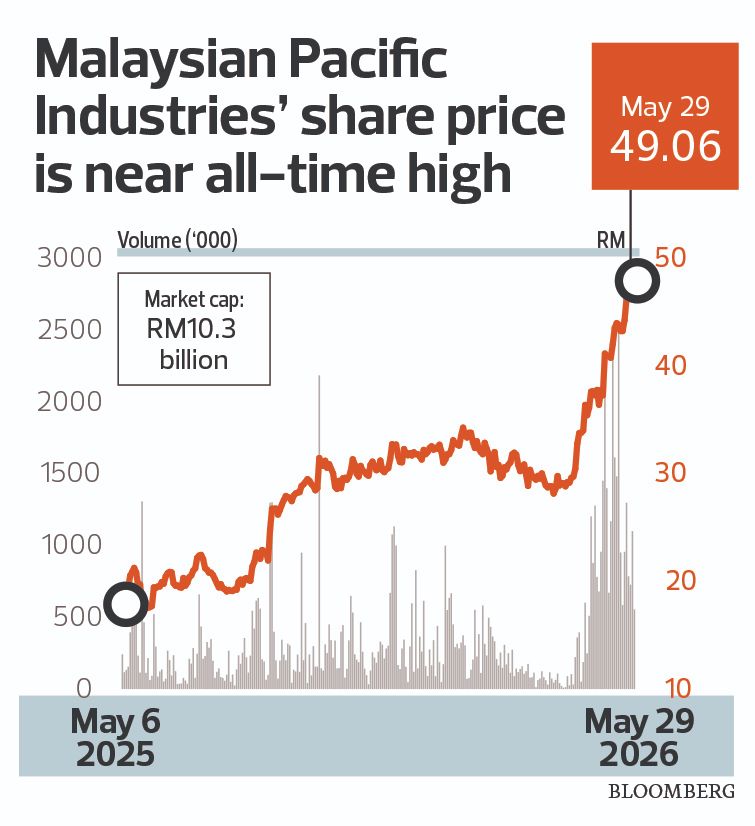
At about RM50, MPI’s share price may appear relatively inaccessible to some retail investors.
When asked whether the company would consider a share split to improve affordability and liquidity, Zarauza says there are currently no such plans, saying that a split would not fundamentally alter ownership structure or intrinsic value.
According to him, the value of a company ultimately depends on investors’ perception of its long-term prospects rather than its absolute share price. He notes that many high-quality global companies continue to see triple-digit share prices, while emphasising that MPI’s future growth proposition remains the more important consideration. “If we do a share split, the largest shareholder still owns 58%,” he points out.
Hong Leong Group currently owns 58.07% of MPI, while the Employees Provident Fund (EPF) holds 11.69%. Collectively, the company’s top 30 shareholders account for 84.38% of the total shareholding, with the list largely dominated by institutional investors, including Norway’s central Norges Bank, mutual funds and insurance funds.
Market expectations running high
Investors have begun pricing in the AI opportunity, driving Malaysian OSAT stocks to multi-year highs.
MPI’s share price climbed to a 52-week high of RM50 on May 26, just shy of its all-time high of RM51 on Dec 1, 2021. At its latest closing price of RM49.06, the stock had surged 57.2% year to date, giving the company a market capitalisation of RM10.3 billion and a forward price-earnings ratio (PER) of 49.4 times.
For Quek, the gains have been substantial. The 7.28 million shares he accumulated in July 2020 for about RM90 million are now worth roughly RM360 million.
However, analysts appear more cautious. The average target price of RM43.55 of eight research houses implies a downside potential of 11.2%, suggesting that much of the near-term optimism may already be reflected in the share price.
The same trend is evident across Malaysia’s major OSAT players.
Unisem (M) Bhd (KL:UNISEM) has rallied 75% year to date to a record high of RM5.30, valuing the group at RM8.55 billion and 72.8 times forward earnings. The consensus target price of RM3.68 among nine analysts implies a downside potential of 30.6%.
Meanwhile, Inari Amertron Bhd’s (KL:INARI) share price has gained 34.5% this year to RM2.38, giving the company a market capitalisation of RM8.92 billion and a forward PER of 44.8 times. Analysts’ average target price of RM2.18 points to a downside of about 7%.
The sharp rerating reflects investors’ growing conviction that AI-driven semiconductor demand is entering a multi-year expansion phase. Whether the earnings growth can ultimately justify the elevated valuations is the key question.
Bursa’s semiconductor rally raises the question: Boom or bubble?
Semiconductor stocks have been on fire globally, with investors brushing aside concerns about geopolitical tensions surrounding the Strait of Hormuz, and instead riding the artificial intelligence (AI) capital expenditure (capex) wave.
The AI-driven rally has been pronounced on Wall Street, where the technology-heavy Nasdaq Composite Index has surged about 30% since April to a record high near 26,800 points. Even more striking has been the performance of semiconductor stocks, with the benchmark Philadelphia Semiconductor Index climbing more than 50% in less than two months.
The rally has also favoured semiconductor-heavy markets such as South Korea, Taiwan and Japan — all trading at near record highs — while Singapore has enjoyed spillover gains through its electronics and precision engineering ecosystem.
Taiwan’s weighting in the MSCI Emerging Markets Index has now overtaken that of China, while memory chip giants Samsung Electronics Co Ltd and SK Hynix Inc together carry a larger weighting than the entire Indian market in some Asia-focused benchmarks, underscoring how dominant the AI semiconductor trade has become.
US memory chipmaker Micron Technology Inc recently crossed the US$1 trillion market capitalisation mark after surging nearly 80% over the past month. The stock has rallied almost sevenfold since September last year amid growing optimism about AI-driven memory demand.
There are now at least five semiconductor-related companies globally with market caps exceeding US$1 trillion, including Nvidia Corp, Broadcom Inc, Taiwan Semiconductor Manufacturing Co (TSMC), Samsung Electronics and Micron.
Investor appetite for semiconductor exposure was further underscored by the blockbuster debut of AI chipmaker Cerebras Systems Inc — billed as the largest semiconductor initial public offering in history — whose share price surged as much as 89% above its IPO price on debut, valuing the company at US$68.6 billion and a trailing price-earnings ratio (PER) of 763 times.
Back home, Malaysia’s latest trade data suggests that the domestic electronics supply chain is already benefiting from the AI capex cycle.
April exports of electrical and electronic (E&E) products surged 46.4% year on year (y-o-y) to a record RM88.17 billion, while machinery and equipment exports rose 26.6% to RM8.19 billion. Optical and scientific equipment exports climbed 40.9% to RM7.11 billion.
Unsurprisingly, Bursa Malaysia’s Technology Index, heavily weighted towards large-cap semiconductor-related counters, has staged a strong rally since April.
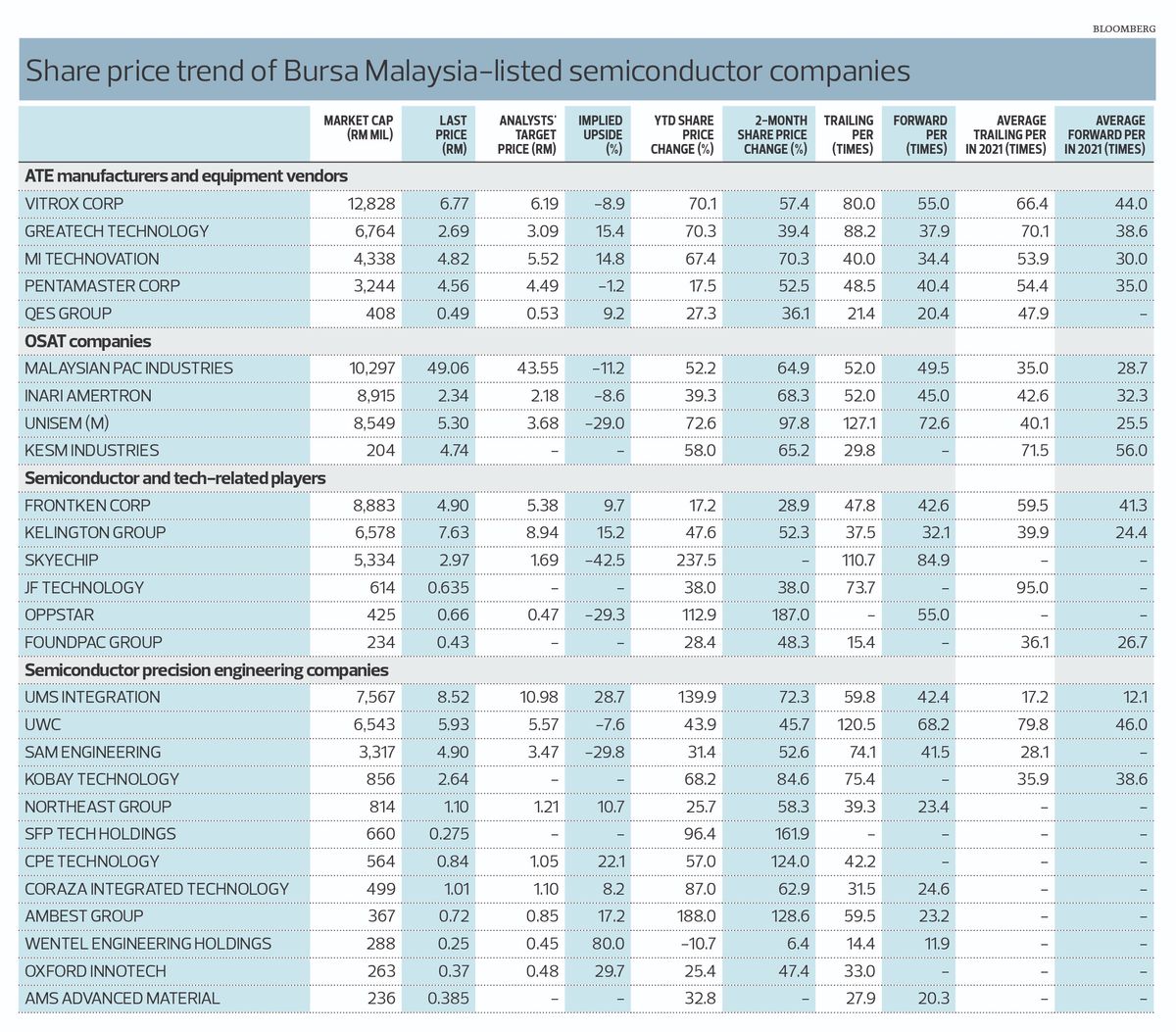
From outsourced semiconductor assembly and test (OSAT) players to automated test equipment (ATE) manufacturers and even smaller precision engineering firms, semiconductor-linked counters have surged since April, with many gaining more than 50% following earnings releases that pointed to stronger orders ahead.
Case in point, OSAT players such as Malaysian Pacific Industries Bhd (KL:MPI), Unisem (M) Bhd (KL:UNISEM) and Inari Amertron Bhd (KL:INARI) all reported weaker y-o-y earnings during the first-quarter results reporting season. However, investors appeared more focused on management guidance and future demand visibility than on backward-looking earnings numbers.
MPI and Unisem have highlighted stronger demand for power module packaging, which is increasingly crucial for next-generation high-voltage AI servers. Meanwhile, Inari guided stronger demand for photonics-related products used in AI-driven data centre interconnect solutions.
On the ATE front, ViTrox Corp Bhd (KL:VITROX) and MI Technovation Bhd (KL:MI) reported consecutive quarters of strong earnings growth, supported by greater exposure to front-end semiconductor processes tied to AI demand.
The sharp rise in semiconductor share prices has inevitably raised comparisons with the chip boom seen between late 2020 and early 2021, when pandemic-driven demand and electric vehicle adoption fuelled an industry up cycle before conditions eventually normalised.
Data compiled by The Edge shows valuations for many semiconductor counters have already exceeded their average 2021 levels, suggesting investors are pricing in a potentially stronger and more durable AI-driven growth cycle this time around.
For instance, ViTrox, whose share price has rallied 70% year to date (YTD) to an all-time high of RM6.76, is now trading at a trailing PER of 80.3 times and a forward PER of 55.2 times, above its 2021 average trailing and forward PERs of 66.4 times and 44 times respectively.
Meanwhile, the three major OSAT players — MPI, Inari and Unisem, whose share prices have gained between 40% and 70% YTD — are all trading above their average forward PERs seen during the 2021 semiconductor up cycle.
MPI is currently trading at 49 times forward earnings compared with 30 times in 2021, while Inari is trading at 45 times versus 32.3 times previously. Unisem’s forward PER has climbed to 67 times from 26 times in 2021.
This suggests investors are willing to pay higher valuations on expectations that AI-related demand will drive stronger long-term growth, while analysts may not have fully factored in the earnings upside potential.
Other companies seeing sharp valuation expansion include precision engineering firms UWC Bhd (KL:UWC) and UMS Integration Ltd (KL:UMSINT), whose share prices have surged 41% and 121% respectively YTD.
UWC is currently trading at trailing and forward PERs of 119 times and 67 times respectively, compared with 79 times and 46 times during the 2021 cycle. Meanwhile, UMS Integration is trading at 58 times trailing earnings and 41 times forward earnings, versus 17 times and 12 times respectively in 2021.
Commenting on the rally, Malacca Securities Sdn Bhd head of research Loui Low Ley Yee says the semiconductor sector’s earnings recovery despite a stronger ringgit suggests underlying demand remains resilient, particularly among companies exposed to the AI infrastructure buildout. “The earnings are coming back despite the stronger ringgit, which means demand is outpacing the foreign exchange impact,” he tells The Edge.
He adds that investors are increasingly gravitating towards large-cap semiconductor names with strong net cash positions and clearer exposure to AI-related demand trends. He also notes that the recent listing of chip design firm SkyeChip Bhd (KL:SKYECHIP) has further boosted optimism surrounding Malaysia’s semiconductor ecosystem and potential supply chain synergies. “These companies are potentially the ‘pick-and-shovel’ beneficiaries of AI investments flowing into the region,” he says.
NewParadigm Securities head of research Ben Shane Lim believes several macro and market factors are currently supporting the semiconductor sector’s outperformance.
“First, there are growing election-related uncertainties globally. Semiconductor stocks are viewed as relatively politically agnostic, which is driving sector rotation into the space. Second, there is potential for ringgit weakness, either arising from geopolitical developments or political uncertainty stemming from elections,” he says.
Lim notes that Bursa Malaysia’s semiconductor rally is moving in tandem with the strong momentum in global AI-linked semiconductor giants such as TSMC and Nvidia. Looking ahead, he expects semiconductor counters to continue outperforming in the near term as investors seem willing to look past short-term earnings weakness if the global AI-driven tech rally persists.
Save by subscribing to us for your print and/or digital copy.
P/S: The Edge is also available on Apple's App Store and Android's Google Play.