

This article first appeared in The Edge Malaysia Weekly on May 18, 2026 - May 24, 2026


EVERY major computing wave over the last few decades has given birth to a new generation of semiconductor giants. The personal computer and internet age was underpinned by the rise of Intel Corp, followed by the advent of smartphones that propelled the likes of US-based Broadcom Inc and Qualcomm Inc and Taiwan-based MediaTek Inc into fabless chip powerhouses.
Today, the global semiconductor industry is being reshaped again. This time by artificial intelligence (AI), which is driving a fresh wave of massive investments in advanced chips, memory architecture and computing infrastructure.
At the centre of the AI chip ecosystem sits a cluster of key players, including US-based chipmakers Nvidia Corp and Advanced Micro Devices Inc (AMD) and China-based Huawei Technologies Co Ltd. Beneath that layer, however, is a less visible but still critical segment of value creation: silicon intellectual property (IP) — the foundational building blocks embedded in AI accelerators, high-performance computing (HPC) processors and advanced data-centre chips.
This is the space that Main Market-bound SkyeChip Bhd (KL:SKYECHIP) is in. The Penang-based fabless integrated circuit (IC) designer is not building capital-intensive wafer fabrication plants nor is it competing in the highly competitive niche of contract chip design services.
Instead, SkyeChip is betting on developing and owning semiconductor IP — a business model that offers recurring licensing income, customer stickiness and potentially stronger scalability than traditional engineering services.
In many ways, silicon IP behaves more like software than a manufacturing process. Once an IP block is integrated into a customer’s chip architecture, customers are generally reluctant to redesign validated systems unless necessary, given the costs, engineering resources and qualification risks involved.
Successful IP providers are therefore able to monetise successive generations of the same core technology while deepening their relationship with chipmakers over time.

SkyeChip is poised to make its debut on Bursa Malaysia on May 20, after drawing overwhelming investor interest in what is shaping up to be one of the market’s hottest initial public offerings (IPOs) in recent years. The overall offering was oversubscribed by 95.03 times, outpacing a recent string of high-profile listings, such as those of TT Vision Holdings Bhd (KL:TTVHB) at 89.1 times, 3REN Bhd (KL:3REN) at 84.1 times, Oppstar Bhd (KL:OPPSTAR) at 77.1 times and Northeast Group Bhd (KL:NE) at 73.4 times.
While these are not strictly apple-to-apple comparisons, given the varying deal structures and market landscapes, the robust response to the IPOs underscores the public’s strong appetite for technology and semiconductor-related plays in the Malaysian equity market. The question is: Will SkyeChip be the next darling of the local semiconductor industry?
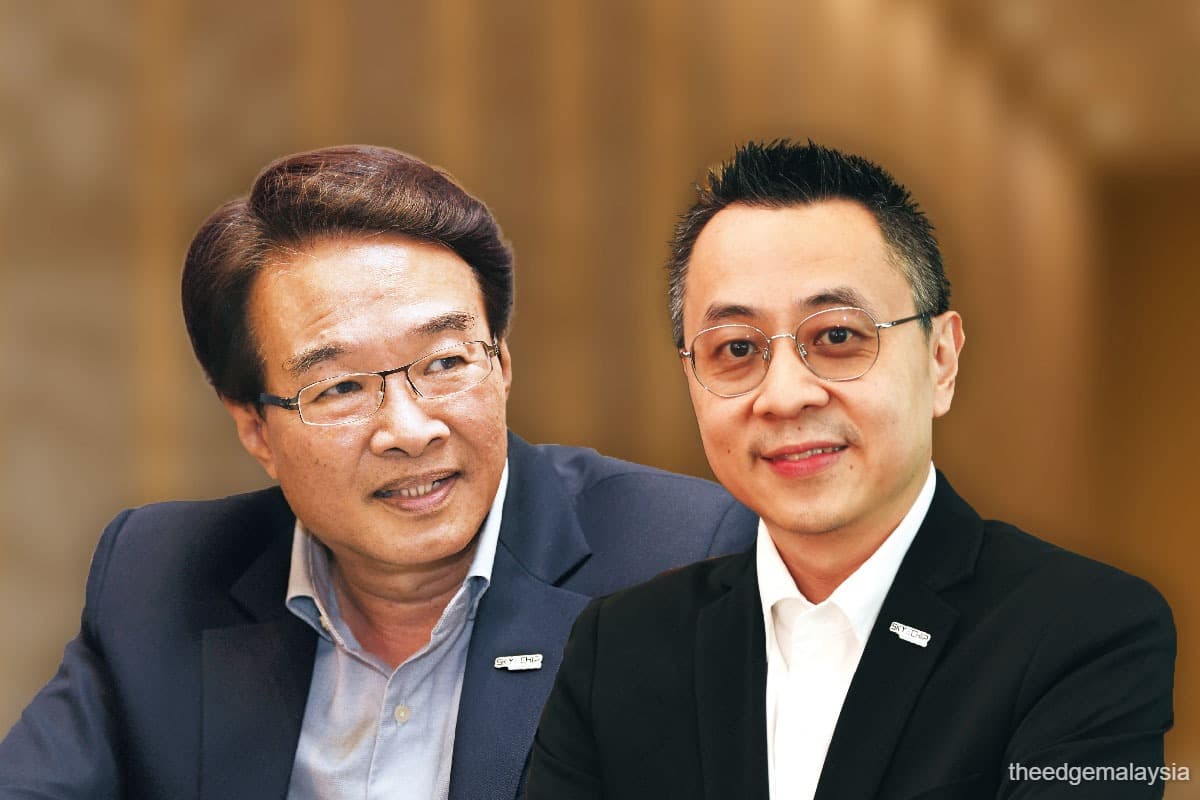
For executive director and CEO Datuk Fong Swee Kiang, the answer hinges on timing as the company enters the market at the beginning of the AI supercycle.
“The semiconductor industry has already experienced two supercycles. The first was that of the PC and internet from the 1980s to the 2000s. During that period, the demand for Intel’s products and its share price surged rapidly because everybody needed desktops and laptops for the first time,” he tells The Edge in an exclusive interview.
The second major computing wave, which spanned from the 2000s to the 2020s, was driven by mobile phones and smartphones, spurring companies like Broadcom, Qualcomm, MediaTek and Apple Inc.
Fong points out that the industry has continued to grow despite crises, recessions and wars.
“Now, we are entering the AI supercycle. People ask whether it is a bubble, but to me, this is a new phase of the industrial revolution. Once people experience the productivity gains of AI, there is no turning back,” he says, downplaying concerns about a potential bubble.
Fong notes that in the AI era, students use ChatGPT for homework, engineers use large language models to write code and even experienced software architects can now rely on the technology to generate much of their codebase.
“If AI can do that for a senior architect, imagine what it can do for younger engineers. This productivity improvement is irreversible. Companies that refuse to adopt AI will eventually lose competitiveness,” he warns.
His remarks come amid growing debate over whether the surge in AI investments is sustainable.
SkyeChip executive director and chief technology officer Teh Chee Hak says the company chooses to list at this juncture because the proceeds raised from the capital market will help it compete regionally and allow shareholders to enjoy the ride on the AI supercycle.
“With the Main Market status and growing IP portfolio, SkyeChip is demonstrating that we are beyond being just another IC design start-up. This allows us to approach tier-1 customers who often scrutinise suppliers’ financial credibility on top of their technical capabilities,” he adds.
Teh says SkyeChip is positioned at the forefront of the AI supercycle via its role in the front-end of the semiconductor industry, which involves the design and development of silicon IP and products.
In semiconductors, “positioning matters a lot”, says Fong.
“The back-end ecosystem is extremely price-sensitive. Some companies may own IP, but the market still assigns them low valuations because they operate in lower-margin segments. It’s like operating in a low-margin noodle business versus operating in a Michelin-star environment. The segment you are in determines your pricing power,” he explains.
“That is why SkyeChip is focused on AI and high-performance computing. You do not want to develop IP for a US$2 chip used in a voice recorder. We are targeting what will be the highest-growth segment over the next 20 years. If you are building IP for AI, deep learning and HPC, the market itself becomes much hotter.”
Strong institutional support, no offer-for-sale shares
Co-founded by Fong and Teh in 2019, SkyeChip is a home-grown chip design house specialising in silicon IP and custom application-specific integrated circuit (ASIC) design.

With its IPO at 88 sen per share, the company will raise RM352 million in fresh capital through the issuance of new shares. Upon listing, it is expected to have a market capitalisation of RM1.58 billion.
Notably, the IPO does not include offer-for-sale shares put up by the founders. They will continue to control the company with a direct stake of 24% each.
Key employees — via SKC Team Sdn Bhd, SKC Team 1 Sdn Bhd, SKC Team 2 Sdn Bhd and SKC Team 3 Sdn Bhd — collectively hold 14.1% equity interest. SkyeChip also has five pre-IPO investors, namely Areca Capital Sdn Bhd, Gobi Partners, Lion X, InterVest and IC Capital Management Sdn Bhd, which together have a 15.6% stake in the company.
The IPO has attracted 22 cornerstone investors, who will collectively own 8.6% equity interest. Among the notable names are abrdn, AHAM Asset Management Bhd, Eastspring Investments Bhd, UOB Asset Management (Malaysia) Bhd, CMY Capital Sdn Bhd, AIA Bhd and Great Eastern Life Assurance (Malaysia) Bhd.
SkyeChip has also garnered strong interest from government-linked investment companies (GLICs), including Khazanah Nasional Bhd’s wholly-owned unit Pantai Feringgi Ventures Sdn Bhd, as well as the Employees Provident Fund (EPF), the Armed Forces Fund Board (LTAT) and the Pilgrims’ Fund Board (TH).
The company has delivered rapid earnings growth. Its revenue more than doubled to RM119.5 million in the financial year ended March 31, 2025 (FY2025) from RM57.1 million in FY2023, while net profit rose to RM35.9 million from RM28.6 million. Earnings per share (EPS) increased to two sen from 1.59 sen during the period.
The company’s greatest challenge, however, lies not in market demand but in the execution of its plans, says Fong.
“The market is there. AI demand is there. Our technology is aligned with AI and high-performance computing. The question is whether we can continue executing with the same quality and speed.”

That makes talent acquisition and retention mission-critical, he adds.
“Engineers want exposure to exciting technologies, career growth opportunities and competitive rewards. That’s why we work on cutting-edge nodes and advanced AI technologies,” he explains.
According to Fong, some of SkyeChip’s younger engineers are already filing US patents within just a few years of joining the company — an achievement he says helps foster both pride and ambition internally.
“We have to remain competitive on compensation, but we also balance that with stock options. The equity component aligns employees with the shareholders. If the company succeeds, everyone benefits together,” he says.
Teh concurs, noting that SkyeChip’s business is fundamentally driven by engineering talent. Therefore, it wants to adopt the Silicon Valley mindset of sharing the company’s success with its employees through equity ownership.
The co-founders’ decision to not put up their shares for the IPO reflects their long-term conviction in the business, he adds. “We are not selling any shares in the IPO because we genuinely believe the company will continue growing. If we believe in the future of the business, why should we sell now?”
Fong says the move is also aimed at sending a strong signal to employees and investors.
“We want our employees to know that we are still fully invested in this journey together. We are not cashing out and leaving them to do the hard work. In fact, employees are allowed to sell before we do,” he adds.
“If the founders cashed out hundreds of millions immediately, people would naturally question their long-term commitment. We want the market to know we are still fully committed to building the business.”
Harry Potter analogy
To explain the concept of silicon IP, the SkyeChip executives often turn to analogies far removed from the semiconductor industry, from J K Rowling’s Harry Potter franchise to Broadcom’s business model. The idea is to show how value can build over time, whether through a popular book series or chip technologies that are reused and upgraded across generations.
“J K Rowling built multiple Harry Potter series on top of the success of the first book. For us, it’s the same,” says Fong.
“We developed HBM3 and then evolved it into HBM3E. It’s an incremental upgrade built on the same foundation. Different generations, different series. The one big element here is continuity.”
HBM, or high bandwidth memory, refers to a class of high-performance memory chips widely used in AI accelerators, supercomputers and graphics processors.
Then, there is the customer stickiness of the Harry Potter franchise.
“If readers like your first book, they are likely to buy the second and the third. It is the same thing with silicon IP. Once customers learn how to use our IP and integrate it into their system, they are very likely to continue using the next generation of our IP,” says Teh.
Using the J K Rowling analogy, the semiconductor ecosystem positions outsourced semiconductor assembly and test (OSAT) players as the “printing companies” — for instance, Rowling writes the book, but relies on the printer to produce it, with the printer earning fees for materials such as paper and ink, along with a service margin.
“When Harry Potter becomes a blockbuster, the printer benefits because it prints more copies and collects more money. It’s the same with OSAT players. When our product succeeds, they test more chips and generate more volume,” says Fong.
Meanwhile, the contract IC design service providers are akin to typists.
“You can type a professor’s or J K Rowling’s book — your fee is based on the number of words typed. Whether the book sells 50 copies or 50 million copies, it has nothing to do with you. That’s the nature of contract chip designers,” he notes.
Fong observes that contract design revenue is lumpy and one-off, whereas SkyeChip’s IP licensing revenue offers predictability in recurring and compound earnings.
“Contract designers compete on cost while IP creators like us compete on providing the world-class IP that stands out among its competitors. Besides, contract designers have customer concentration risk, whereas we diversify across many customers who choose to subscribe to one or more IPs, depending on the project requirement and duration,” he says.
Oppstar, SkyeChip’s closest local peer, was the first pure-play IC design house listed on Bursa. The company was valued at a price-earnings ratio (PER) of 24.14 times when it made its debut on the ACE Market in March 2023.
Fong recalls that when SkyeChip started its operation, few believed a Malaysian company could develop semiconductor IP capable of competing with global giants such as Synopsys Inc or Cadence Design Systems Inc.
“If a procurement director used our IP and succeeded, people would say he was lucky. If it failed, he would be blamed,” he says.
But the US-China technology conflict created an unexpected opening.
“Suddenly, Chinese customers realised they needed neutral or alternative suppliers for business continuity. If they depended entirely on US IP and got sanctioned, their entire investment could be stranded. That opened the door for companies like us,” says Fong.
Broadcom’s strategy also serves as an important reference point for SkyeChip, he adds. “Broadcom has selective IP licensing and custom silicon design. It uses its IP to win customers and then design chips specifically for them. That’s the model we are using.”
With a market capitalisation of US$1.97 trillion (RM7.75 trillion), California-headquartered Broadcom — led by Penang-born American business executive Tan Hock Eng — is a global chip giant known for designing, developing and supplying a wide range of semiconductors, enterprise software and security solutions.
“We want to create the building blocks and supporting infrastructure that make AI systems work better. That’s what we want to do. If customers want to use our network-on-chip (NoC) IP, we can help build the chip for them. The IP becomes the entry point into a larger custom silicon business,” says Fong.
Looking ahead, SkyeChip plans to expand aggressively into advanced automotive technologies, particularly through the development of automotive-grade NoC IP and memory interface IP qualified for functional safety standards.
“These IPs will be used for in-vehicle networks and vision systems, which are essentials for autonomous driving. We target to commercialise these IP by 2027,” says Fong.
The company also plans to continue investing heavily in next-generation NoC and memory interface technologies, which are increasingly critical components in AI and HPC applications.
As for AI silicon products, the group will continue to tap into its partners’ system architecture and software expertise that complement its silicon IP design and development capabilities to design custom ASIC for AI applications and to handle large-scale data workloads.
“The success rate in commercialising our IPs and customs ASIC solutions will indicate whether the company is on track and follows closely with the technology development in the global IC design space,” says Teh.
Over the past six years, SkyeChip has steadily built its customer base across China and Taiwan. Moving forward, however, the company aims to further diversify geographically into the US, Europe, South Korea and Japan.
“Our IPs have been recently listed on the Samsung CONNECT IP platform and also Intel Foundry IP Alliance. This will put us in the ecosystem of these foundries and that will open the doors for us to work with many of the fabless companies,” he says.
Bullish sentiment
Research houses are generally positive on SkyeChip, with target prices in a relatively tight band. PublicInvest Research is the most bullish at RM1.68, followed by Malacca Securities and RHB Research at RM1.48 and RM1.41 respectively.
Berjaya Research has assigned a target price of RM1.25, while BIMB Securities values the shares at RM1.18 each. At the more conservative end of the spectrum, Mercury Securities has a target price of 99 sen.
In a May 5 report, Tradeview Research analyst Tan Jia Hui has a “subscribe” recommendation and a target price of RM1.38, implying an upside potential of 57% from the IPO price. She highlights SkyeChip’s strategic exposure to forced memory IP upgrade cycles, which could support highly visible recurring revenue growth until FY2028.
“Backed by 16% of IPO proceeds earmarked for next-generation IP development and access to advanced foundry tools, the group is scaling its proprietary and patentable silicon IP portfolio, supporting recurring licensing revenue,” she writes.
Meanwhile, in a separate report, TA Securities research manager and technology analyst Tony Chan Mun Chun values SkyeChip at 35 times its 2027 EPS, arriving at a fair value of RM1.18 per share.
“We estimate the group to record earnings growth of 24.8%, 16.6% and 16% to RM46.3 million, RM54 million and RM62.7 million for FY2026, FY2027 and FY2028 respectively, backed by an unbilled order book of RM130.3 million, its business expansion plan and a healthy industry outlook,” he says.
Maybank Investment Bank is the principal adviser, lead bookrunner, managing underwriter and joint underwriter for SkyeChip’s IPO, while CIMB Investment Bank is joint underwriter and joint bookrunner for the exercise.
Read also:
Cover Story: SkyeChip’s philosophy and strategy explained
Cover Story: Within Arm’s reach
Save by subscribing to us for your print and/or digital copy.
P/S: The Edge is also available on Apple's App Store and Android's Google Play.