

KUALA LUMPUR (April 9): Malaysia’s trade outlook is tied to the uncertainty of US tariff policies as the current exemption offers only temporary relief, according to the World Bank.
Malaysia’s relative position in global trade has improved in the near term, as the US' shift from country-specific reciprocal tariffs to uniform surcharge has reduced the country’s disadvantages, the bank noted.
“However, this short-term advantage...may not form the basis for long-term growth strategy, as it relies heavily on exemptions for key E&E (electrical and electronics) products, which remain highly uncertain,” the World Bank said in a report.
Its analysis shows that 27% of Malaysia’s domestic value added (DVA) in the E&E sector — the highest in Asean — could be exposed to future US tariffs, leaving the country more vulnerable than regional peers if exemptions are rolled back.
DVA, or sometimes more informally known as ‘local content’, usually captures the portion of exports created in the country.

While Malaysia is able to create DVA within its exports, which has improved over the past decade, this somehow also puts a risk to the country as it indicates Malaysia’s deep integration into global semiconductor and electronics supply chains, the bank noted.
“As of now, E&E seems to be doing well…but again it could change depending on whether it remains exempt or not from future tariffs,” World Bank lead economist for Malaysia Apurva Sanghi said during the release of its April 2026 Malaysia Economic Monitor (MEM) report.
The view comes after the Supreme Court of the US invalidated the earlier IEEPA-based reciprocal tariff regime under President Donald Trump's administration.
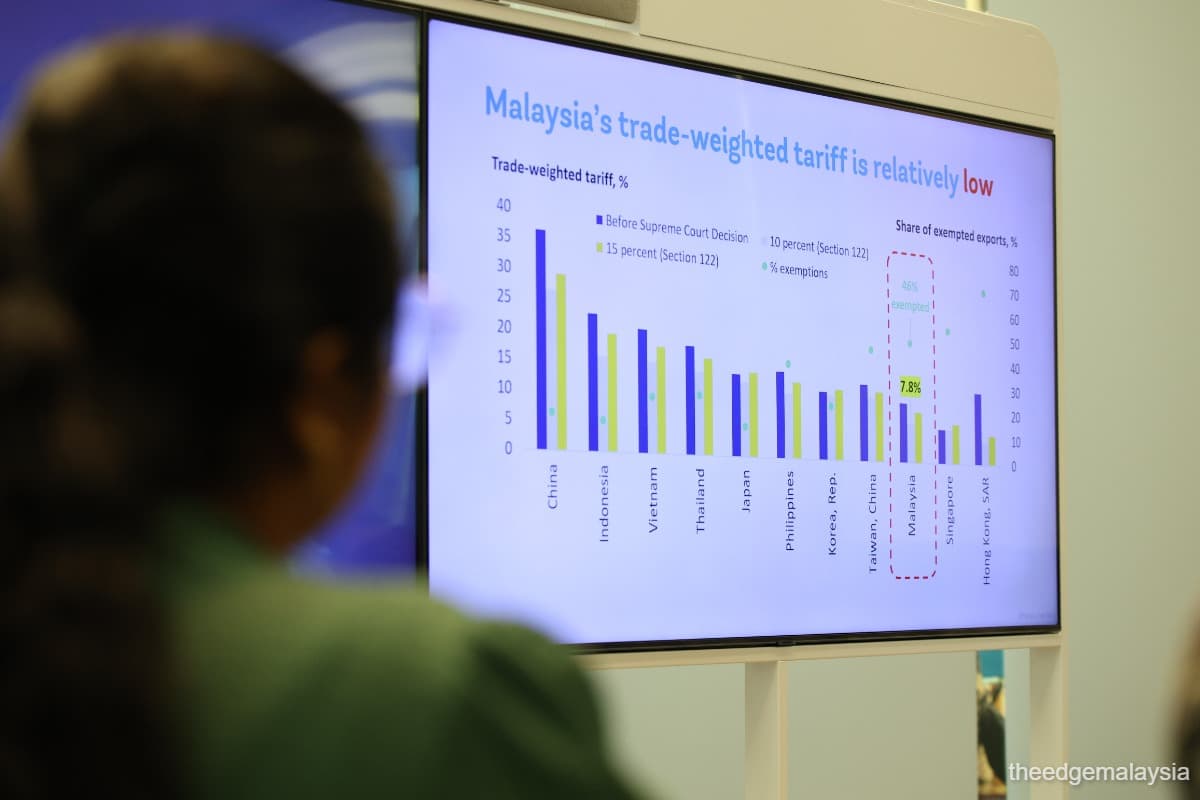
In its place, the US introduced a temporary import surcharge under Section 122 of the Trade Act of 1974 instead, setting tariffs at 10% from Feb 24, with the possibility of an increase to 15%.
As a result, Malaysia’s trade-weighted tariff is estimated at 7.8%, down from 11.6% under the previous tariff threat.
As it stands, a wide range of goods remain exempted including key Malaysian exports such as electronics, machinery, and certain industrial inputs. About 46% of Malaysia’s exports to the US by value are exempt, with 92% of these falling under E&E and machinery categories, the World Bank noted.
Moving up the value chain
Moving forward, the World Bank stressed that Malaysia should priorities building up a long-term competitiveness that depends less on tariff advantages and more on technological capability and innovation.
Currently, only 13% to 18% of patents filed in Malaysia are by residents, while the country's research and development progress still lags behind regional innovation leaders such as China and Taiwan.
“The more complex and set of goods and services an economy produces, the better off the country's citizens are in terms of their developmental outcomes,” Apurva said.
Sectors such as complex machinery, chemicals and optical products were identified as areas where Malaysia could build on existing capabilities.
“Malaysia has done remarkably well moving from a very basic commodity oil producer and exporter decades ago into more and more high-value, more complex, more refined goods,” the economist added.