

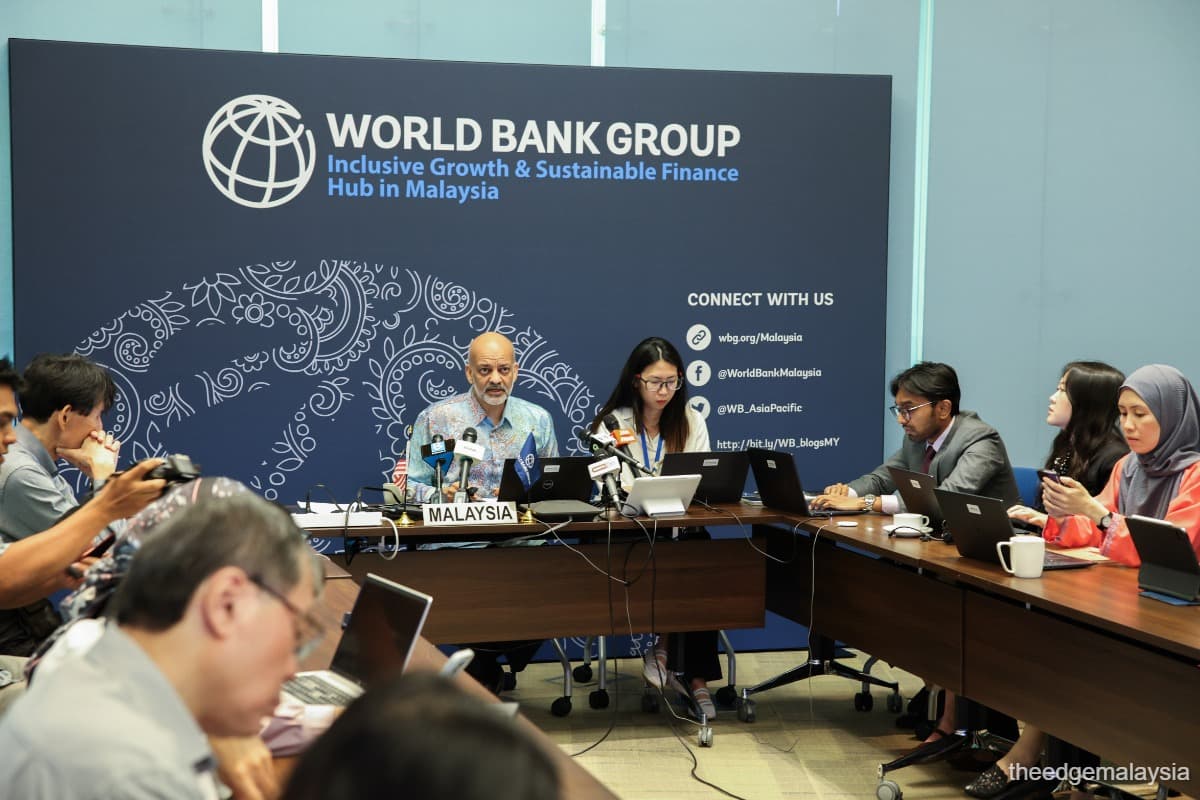
KUALA LUMPUR (April 9): The World Bank has suggested that Malaysia could raise subsidised RON95 petrol from RM1.99 back to RM2.05, the pre-Budi95 price, to help reduce government subsidy costs amid rising oil prices caused by Middle-East tensions.
World Bank lead economist for Malaysia Apurva Sanghi made the remarks at a briefing on Part 1 of the April 2026 Malaysia Economic Monitor (MEM) report.
Malaysia currently caps RON95 prices at RM1.99 per litre for most consumers, despite Brent crude surpassing US$100 per barrel — well above the US$65 assumption in Budget 2026. The RON95 and diesel subsidy bill has jumped from RM700 million a month in January 2026 to RM4 billion in April.
To manage costs, the government has cut the monthly subsidised fuel quota under the Budi95 scheme from 300 litres to 200 litres.
Apurva described the quota cut as “a step in the right direction” but noted that fuel subsidies remain regressive, with higher-income groups (top 10% and top 20%) consuming disproportionately more than 200 litres.
He added that adjusting petrol prices could serve as an alternative or complementary policy tool, especially as the US-Israel and Iran conflict shows no sign of ending.
“If the situation continues to worsen, there has to be some adjustment,” Apurva said. “Given how the system is set up, it would be relatively easy [for the government] to tweak [the policy] — whether through quotas or prices.”
He added that the government has kept fuel prices low partly to avoid “demand destruction”, unlike Thailand and the Philippines, where higher prices have visibly reduced consumption.
“The question is, how long can the government continue protecting demand destruction...and that is an open-ended question as of now,” he said.
WATCH: World Bank suggests hiking RON95 hike price
No need for broad stimulus
Apurva also argued that broad fiscal stimulus — including large-scale subsidies — may not be appropriate in the current environment.
“As of now, there should be no stimulus. If anything, providing stimulus could add to inflationary pressures,” he said, noting that Malaysia is currently in a “sweet spot” of relatively strong growth and contained inflation.
He warned that Malaysia’s fuel subsidy bill is “growing exponentially” due to the gap between domestic prices and global fuel costs.
While the country benefits as a net energy exporter, higher global oil prices have broader spillover effects on food, transport, and input costs.
“[The current] oil crisis is not just an oil crisis anymore. It spills over to food, fertilisers, refined products, and so forth,” Sanghi said. These second-round effects, including higher logistics and transport costs, could feed into inflation and weigh on household consumption over time.