

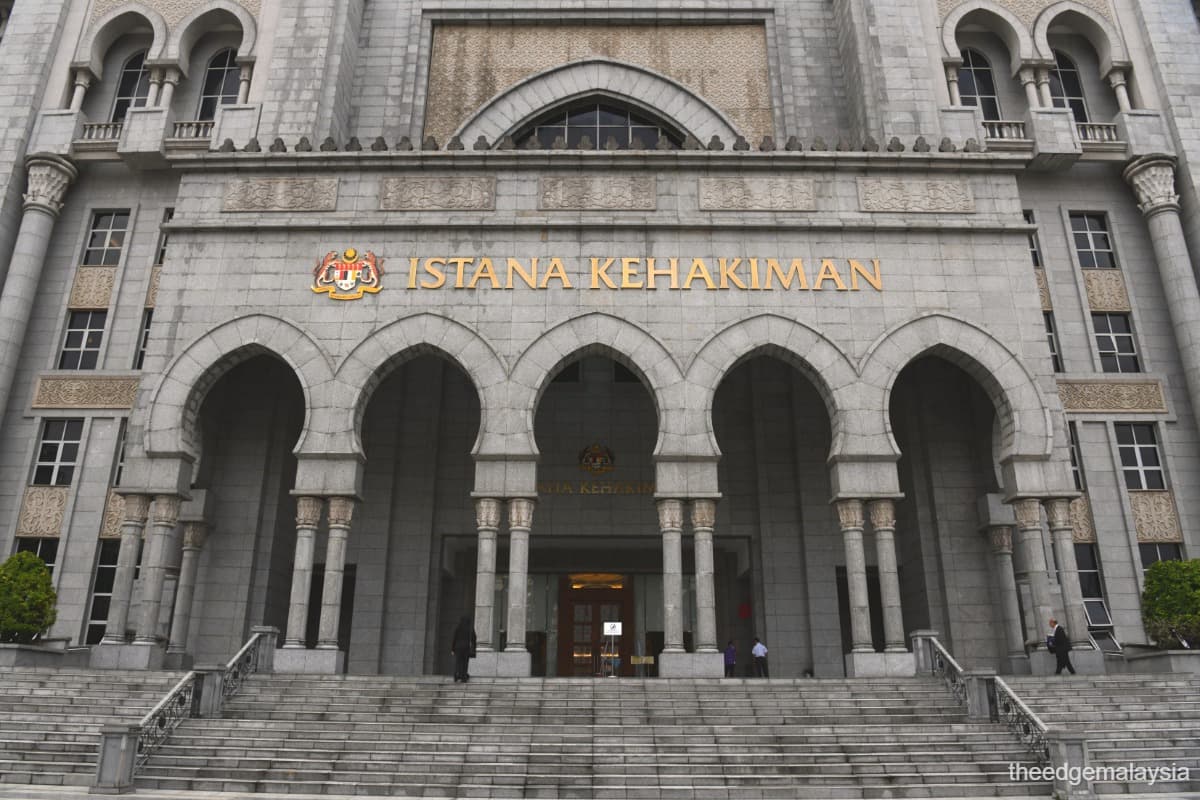
From corporate liability to civil liberties, we highlight here selected pivotal judgements that set new precedents and clarify complex rules.
1. Sabah’s 40% revenue share: Putrajaya acted unlawfully, judge says
On Oct 17, the High Court in Kota Kinabalu ruled that the federal government had acted unlawfully by failing to fulfil Sabah’s rights to a 40% share of federal revenue derived from the state for the years 1974 to 2021. The court declared that the special grants offered to the state in lieu of the 40% entitlement during the period were invalid.

Judge Celestina Stuel Galid delivered the decision after hearing an application for judicial review filed by the Sabah Law Society against the federal and Sabah governments. SLS sought, among others, a declaration that Putrajaya breached the Federal Constitution by failing to conduct a mandatory revenue review every five years since 1974.
Celestina found that the federal government had conducted a review for the years 1969 to 1973 but failed to perform a review in 1974. She noted that Putrajaya paid Sabah RM26.7 million in 1973, and just continued paying the same amount every year from 1974 to 2021. The second review order was only made in 2022.
The court also issued a mandamus order sought by SLS, requiring the federal government to hold another review with the Sabah government to give effect to the state’s 40% entitlement for each financial year from 1974 to 2021.
The federal government subsequently said it accepted the constitutional basis of the 40% entitlement and would begin negotiations with the Sabah government immediately to implement it.
The Attorney-General’s Chambers, however, filed a notice of appeal on Nov 13 at the Court of Appeal against several “flawed allegations” in the High Court judgment, including the claim that the federal and state governments had “abused their powers and breached constitutional duties” since 1974. It is also appealing against the ruling that the special grant review orders after 2021 are “unlawful, irrational, procedurally flawed and disproportionate”. — by S. Kanagaraju
2. Duta Enclave saga ends: Compensation, not return of land, for unlawful state takeovers
The decades-long legal battle between Semantan Estate (1952) Sdn Bhd and the government of Malaysia over the 263-acre Duta Enclave land in Kuala Lumpur was conclusively put to rest on Nov 13, 2025, nearly 70 years since the saga began, when the Federal Court dismissed Semantan Estate’s final appeal application.
This ruling effectively upheld the Court of Appeal’s decision in June 2025, and set a crucial precedent — that the appropriate remedy for unlawful land acquisition, especially where public development has occurred, is monetary compensation, not the return of the land. Notably, compensation was ordered to be assessed based on its market value when the government took possession in 1956, plus 6% annual interest and mesne profits, rather than the current estimated market value of RM12 billion.

The apex court’s decision confirmed the COA’s interpretation that the Government Proceedings Act 1956 serves as a statutory bar that prevents the courts from ordering the physical recovery of land from the government when it is being used for public purposes. This protects public administration and avoids the “horrendous” consequences of undoing decades of public infrastructure that has been built on the site, such as the Federal Territory mosque and the Inland Revenue Board complex.
This legal outcome also clarifies the relationship between constitutional property rights, as provided under Article 13, and statutory protection of the state under GPA.
The saga began soon after the government acquired the land in 1956, which was later found to be procedurally flawed, with the final compensation not properly determined. This led to years of legal skirmishes between them. In 2009, following a fresh suit filed by the company in 2023, the High Court ruled that the government had unlawfully trespassed, and that Semantan Estate retained beneficial ownership of the land. This decision was upheld by both the COA and Federal Court in 2012.
Despite the government losing all subsequent appeals and reviews, a High Court order to compel the transfer of the land title back to Semantan Estate in August 2024 was overturned by the COA in June 2025, which led to the final apex court decision in November. — by Tan Choe Choe
3. Govt not required to offer acquired land back to former owners
In a decision that clarifies the finality of government land deals, a three-member Federal Court bench reaffirmed in August 2025 that the government cannot be compelled to sell or lease land that was acquired for public use back to its former owners even if the land is no longer needed for its intended purpose.
The ruling was made as the court dismissed Power Cellular Accessories Sdn Bhd’s final bid to reclaim a leftover plot of land in Kuala Lumpur. The land was part of a larger area acquired by the government in 2001 for the Old Klang Road upgrade. While much of the area was used for the road, the company claimed it had the right to buy or rent the remaining portion, which was later designated for public housing.
The company first sought to buy back the unused land in 2015, but was rejected by the government. It had then gone to court in 2018 to challenge the government’s decision, arguing that the government’s refusal was unfair, illegal and violated its constitutional rights to property, and that they had a “legitimate expectation” to get the land back.
Both the High Court and the Court of Appeal dismissed the case, leading to this final attempt at the Federal Court.
The apex court bench — led by Chief Judge of Sabah and Sarawak Datuk Azizah Nawawi — refused to hear the appeal as it held that the company’s legal questions failed to meet the threshold for a full appeal.
The ruling effectively upholds the principle that once land is acquired and compensation is paid, the original owner’s rights and interests are legally terminated. The court also made it clear that the government has absolute discretion to repurpose any surplus land it acquired for other public needs, and that it is under no obligation to offer it back to the former owner. — by Tan Choe Choe
4. Failing to notify police before a rally is no longer a crime
On July 1, 2025, in one of her final acts before retiring the following day, Chief Justice Tun Tengku Maimun Tuan Mat led a five-member Federal Court bench to unanimously strike down Section 9(5) of the Peaceful Assembly Act 2012 (PAA) as unconstitutional. The ruling ends a long-standing legal debate by declaring that while organisers should still notify the police of a gathering, failing to do so can no longer be treated as a criminal offence.

The challenge was brought by Amir Hadi, the former secretary-general of MUDA, who had been charged for failing to give the required five days’ notice for a “#ManaKapalLCS” rally held in front of the Sogo shopping complex in August 2022. Facing a maximum fine of RM10,000, Amir referred constitutional questions to the apex court, arguing that criminalising a procedural lapse effectively turned a fundamental right into a crime.
The court ruled that Section 9(5) was disproportionate and violated the constitutional right to assemble under Article 10. The judges clarified that the notice requirement is a tool for facilitation — allowing police to manage traffic and public safety — rather than “permission”. By removing the criminal penalty, the court ensured that a peaceful assembly does not become “illegal” simply because of a paperwork error. Following the decision, Amir Hadi was acquitted in August 2025. — by Tan Choe Choe
5. No benefit of doubt for companies seeking sales tax exemptions
In a major win for the Customs Department, the apex court has ruled that tax exemptions for manufacturers must be interpreted “strictly and narrowly.” This clarifies that if there is any doubt about a company’s eligibility for a tax break, the law must favor the government, and the claim must be rejected.
The landmark decision was delivered by a five-member bench in two separate tax dispute cases, one involving motorcycle manufacturer Hong Leong Yamaha and another involving edible oil trader Wintercorn Malaysia.
In the Hong Leong Yamaha case, the court in August 2025 allowed an appeal by the Customs Department to impose a RM27.96 million tax bill on Hong Leong Yamaha. The company had argued that the components used to build its motorcycles should be exempt from sales tax. However, the court — led by the now-retired Datuk Zabariah Mohd Yusof — ruled that because the final motorcycles were already tax-exempt, the company could not claim a second exemption at the production stage. Allowing this would contradict the principle of sales tax being a single-stage tax, the court said.
In the Wintercorn case, which the court concluded in July, the company failed to overturn a RM3.69 million bill for unpaid sales tax on packaging materials. The company argued that the containers and bottles used for the packaging of edible oil products should be exempted from tax. The court disagreed, saying there is no ambiguity regarding packaging materials for traders and that Wintercorn had failed to prove its eligibility for exemptions.
“In cases of ambiguity, a taxing statute should be construed in favour of a taxpayer. This, however, does not apply to a provision giving a taxpayer relief in certain cases from a section clearly imposing liability,” Zabariah said.
The court’s rulings affirmed that the “onus” or burden of proof sits squarely on companies. If they cannot prove their eligibility for exemption beyond doubt, then they must pay in full. — by Tarani Palani
6. Banks are liable for confidential information leaks

Malaysia’s highest court held Public Bank Bhd (KL:PBBANK) liable for leaking sensitive account information to the public, including details of a planned KL Eco City property purchase. The leak, revealed at a 2012 press conference by then-Parti Keadilan Rakyat director of strategy Datuk Seri Rafizi Ramli, caused major national controversy (“cows-in-condos” scandal). The Federal Court ruled that the bank itself — not just individual employees — is directly responsible for maintaining confidentiality under Section 97(1) of the (repealed) Banking and Financial Institutions Act 1989. Public Bank argued the leak was the fault of two staff members acting outside their duties, but the court rejected this, confirming the bank cannot avoid liability. Exceptions under Banking and Financial Institutions Act (Bafia) 1989 or foreign law did not apply; the breach was unjustified. The Federal Court upheld the Court of Appeal’s 2023 ruling, which reversed the High Court’s original decision. Public Bank was ordered to pay RM90 million in equitable, exemplary, and aggravated damages to NFCorp, its chairman, and related companies. The leaked documents involved loan assessments for KL Eco City condos. No loan was executed, but the disclosure caused major public fallout. NFCorp had originally sought RM560 million in damages, citing serious financial and reputational loss. This is a landmark ruling in Malaysia for banking confidentiality and data protection, emphasising that banks are fully responsible for protecting client information. — by Presenna Nambiar
7. Tenaga should claim tax relief as a utility company, not manufacturer
In early July, the Federal Court’s decision on Tenaga Nasional Bhd’s (KL:TENAGA) tax treatment drew significant attention from the corporate sector. The case was landmark not just for the billion-ringgits amount at stake, but for establishing a clear, binding precedent on how utilities and large-scale infrastructure providers are classified under the Income Tax Act for the purposes of claiming reinvestment or investment tax allowances. Tenaga and the Inland Revenue Board have been locked in disputes since 2015 over multiple tax assessments, with RM5.05 billion in disputed sums still outstanding, according to TNB’s latest annual report.
A five-member Federal Court bench ruled that Tenaga should be classified as a utility company, not a manufacturer of electricity, under Schedule 7B of the Income Tax Act 1967 (ITA). Tenaga had claimed a reinvestment allowance (RA) under Schedule 7A (for manufacturers), but the court said it should have applied under Schedule 7B, which covers utilities and approved service-sector investments. The court acknowledged that while electricity generation involves technical processes, electricity is still considered a utility, not a manufactured product. Tenaga’s choice to claim under Schedule 7A does not force the tax authorities to approve it. Approval is at the discretion of the Inland Revenue Board (IRB).
On July 23, Tenaga applied to the Ministry of Finance (MoF) for Investment Allowance covering YAs 2003 to 2024. The MoF approved the Investment Allowance for Tenaga’s capital expenditure, which can be deducted from future income on Nov 26, 2025. TNB is currently assessing the impact on its financial statements. — by Presenna Nambiar
8. Malaysia makes it easier and faster to enforce foreign arbitration wins
In August, the Federal Court set a precedent when it ruled that parties who win overseas arbitration cases can use either the Malaysian Arbitration Act 2005 or the Reciprocal Enforcement of Judgements Act 1958 (REJA) to enforce their awards in the country.
The ruling settled a decade-long dispute where ING Bank NV and O.W. Bunker Far East sought to recover US$935,000 (RM4.3 million) from Johor-based Tumpuan Megah Development for marine fuel supplied in 2014. After winning a London arbitration and converting that award into an English High Court judgment, the creditors tried to register it in Malaysia via REJA. Tumpuan Megah blocked this move at the Court of Appeal, which labeled the use of REJA as “judgment laundering” and insisted that MAA was the only valid route for arbitration matters. The appeals court further allowed Tumpuan Megah to re-argue the entire case — including allegations of fraud and lack of jurisdiction — effectively granting a fresh trial for a matter already decided in London.
By affirming that REJA is a valid alternative, the apex court clarifies that REJA offers a streamlined enforcement pathway for awards from reciprocating countries — such as the UK, Singapore and Hong Kong — with the court’s role limited to “minimal curial review” or a procedural check rather than a re-evaluation of the case. The ruling signals to the global community that foreign awards are respected, and that Malaysia will not allow procedural technicalities to be used as a shield to delay enforcement of valid awards. — by Tan Choe Choe
9. Federal Court clarifies insider trading law for civil actions
The Federal Court on April 8 upheld the liability of lawyer Datuk Sreesanthan Eliathamby for insider trading. In affirming the decisions of the High Court and Court of Appeal, the apex court confirmed three significant principles in relation to civil actions for disgorgement of profits from insider trading in Malaysia.
First, insider trading is not a strict liability offence, and a mental element must be proved. The insider is liable if he knew or ought reasonably to have known that the information is non-public. But there is no need to prove “intention to use” the information.
Second, in determining the materiality of the information, the court is not confined to the facts and circumstances at the time of the trade. It may also take into consideration facts and circumstances after that, such as share price movements.
Third, the attorney general’s power to institute proceedings for an offence under Article 145(3) of the Federal Constitution does not extend to civil actions brought by the Securities Commission Malaysia (SC) for insider trading.
The High Court had in 2020 found Sreesanthan to have engaged in insider trading of Worldwide Holdings Bhd shares in 2006. The case involved material non-public information and significant financial gain. Sreesanthan, then a senior partner in a law firm, was engaged by CIMB Investment Bank to act as its legal adviser for the corporate exercise.
Sreesanthan was ordered to pay RM1.99 million to the SC (being an amount equal to three times the profits gained as a result of the insider trading) and a civil penalty of RM1 million. He was also barred from being a director of any public listed company for 10 years. — by S. Kanagaraju
10. Regulatory approval a must for put and call option deals in insurance shares
The long-running legal dispute between Detik Ria Sdn Bhd and Prudential Corporation Holdings Ltd reached- a pivotal moment with the Federal Court’s judgment this year where the court ruled that Detik Ria, a company holding a 49% stake in Sri Han Suria Sdn Bhd (SHS) — the holding company of Prudential Assurance Malaysia Berhad (PAMB) — had no obligation to sell its stake despite put and call option agreements with Prudential which would have allowed them to compel Detik Ria to sell its shares.
Initially, the High Court and the Court of Appeal had upheld the enforceability of put and call option agreements, which would have facilitated Prudential’s acquisition of Detik Ria’s equity.
However, the Federal Court overturned these decisions, ruling that the parties failed to obtain prior Finance Ministry approval under Section 67 of the now-repealed Insurance Act 1996, a mandatory requirement for share transactions involving more than 5% of a licensed insurer’s equity.
In doing so, the apex court determined that the agreements, though contractual and conditional, had been effectively performed without the requisite approval, rendering them void.
As a result, both parties were ordered to restore benefits received under the agreements and to resolve remaining disputes over dividends in the High Court.
Following this landmark ruling, Detik Ria pursued claims for unpaid dividends. This culminated in a full and final out-of-court settlement in July 2025, in which Prudential agreed to pay the equivalent of US$83 million in dividends to Detik Ria and waive about US$33 million in receivables owed by Detik Ria to a Prudential subsidiary.
All proceedings relating to the dispute were withdrawn, and both parties mutually released liability for ongoing claims. This landmark case underscored the importance of regulatory approval in insurance-related share transactions, and reaffirmed Detik Ria’s rights as a minority shareholder. — by Timothy Achariam
11. Court clarifies strata law: Different maintenance rates only allowed for truly different uses
At the end of November the Federal Court had struck out Phileo Damansara 1 (PD1) management corporations’ application to appeal against different maintenance charges for units in the development.
In a unanimous decision on Nov 25, the Federal Court bench, led by Federal Court judge Datuk Rhodzariah Bujang and flanked by Datuk Seri Vazeer Alam Mydin Meera and Datuk Mohd Nazlan Mohd Ghazali, had quashed PD1’s bid to appeal against the High Court and Court of Appeal (COA) decision which had not allowed PD1’s management corporation to impose the different rates of maintenance charges.
The respondent, SCP Assets Sdn Bhd, who owns all the car parks in PD1, had successfully challenged PD1’s bid to appeal at the Federal Court.
In dismissing the application, the Federal Court bench held that the issues raised by PD1’s management corporation were neither novel nor of public importance such that they would warrant further scrutiny; thus, the COA’s decision stood.
In the COA decision on July 2 this year, the appellate court held that PD1 is a purely commercial development. The management corporation’s attempt to categorise offices, shops, and carparks into separate usage classes to justify different rates lacked factual or legal foundation.
The COA held that the management corporation’s basis to allocate cost was found to be “hypothetical”, “arbitrary”, and unsupported by actual, historical maintenance expenditure.
Central to the appellate court’s decision was Section 60(3)(b) of the Strata Management Act 2013, which allows a management corporation to impose different rates of charges only where parcels are used for “significantly different purposes”. The COA ruled that this legal requirement was not met. — by Timothy Achariam
Read also:
Top 10 corporate stories of 2025