

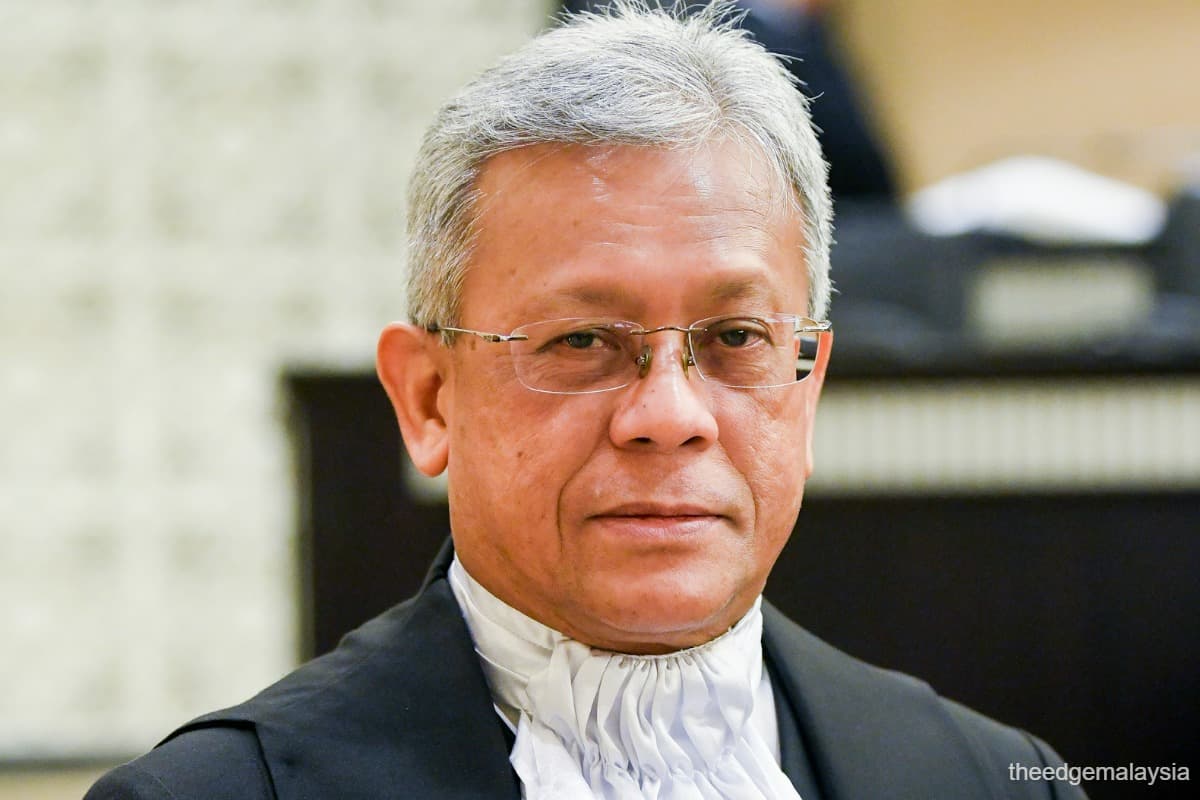
PUTRAJAYA (Dec 26): Former prime minister Datuk Seri Najib Razak's defence that the funds in his private account were Saudi donations has no merit.
In delivering his final verdict in the 1Malaysia Development Bhd (1MDB)-Tanore criminal trial, presiding judge Datuk Collin Lawrence Sequerah found that the origins of the funds were indeed from the troubled strategic development firm.
Sequerah also ruled that the subsequent donation letters tendered as evidence were forged.
"The evidence, when viewed as a whole, showed that there is no credible, contemporaneous or reliable documentary evidence that directly connects the large sums deposited into the accused’s personal accounts to King Abdullah or any member of the Saudi royal family [...]
"The ultimate finding of this court, therefore, and the irresistible conclusion is that the Arab donation narrative is not meritorious, donation letters were forgeries, and that the evidence pointed unmistakably to the fact that the monies were in fact derived from 1MDB funds [...]” the judge said.
Similar to the defence mounted in the SRC International Sdn Bhd case — for which Najib is serving jail time — Najib claims that the monies in his accounts were donations promised to him personally by the late Saudi Arabian monarch, King Abdullah.
Najib claims that this was the result of a private meeting he had with King Abdullah in Saudi Arabia in 2010, where Najib claims he was specifically told that he would be given financial assistance in the upcoming 2013 general elections to ensure stability and his return to power.
To back this claim, the defence had argued that the meeting had also been attended by the then-foreign affairs minister Datuk Seri Anifah Aman, the then-Malaysian ambassador to Saudi Arabia Professor Datuk Syed Omar Alsagoff, and the then-minister in the Prime Minister's Department Datuk Seri Jamil Khir Baharom. Syed Omar and Jamil were witnesses for the defence in this trial.
The defence also argued that the Saudi monarch's pledge was further solidified via the four donation letters allegedly from the then-governor of Madinah Province, Saud Abdulaziz Majid Al Saud, dated between 2011 and 2014.
'Guilty mind'
Sequerah added that there was a "wilful blindness" on Najib's part because he deliberately refused to inquire into the authenticity and legitimacy of the fund's source, despite having "all the necessary resources and machinery at his disposal”.
Moreover, Sequerah said that Najib continued to use the funds, even after being told that the remittances originated from obscure offshore entities and the donations were not disclosed in any official declaration or Cabinet minutes.
The judge also added that Najib had opened a private bank account without disclosing his name and could not be "readily discernible" as linked to him.
"[...] He is taken to show a guilty mind," the judge said.
"The letters and statements relied upon were therefore unverified, pre-prepared, and obtained in circumstances which were at best highly questionable, thereby considerably reducing the evidential utility and reliability," Sequerah said.
He also referred to the testimonies of the Malaysian Anti-Corruption Commission investigators on their fact-finding mission to verify the letters and donation source.
He said that there was no profiling done on the Arab personnel present during the mission and further elaborated on his findings.
"The upshot of this is that there was no conclusive evidence that these three individuals at the venue [were] indeed Prince Faizal, Prince Saud, and Prince Turki as they were portrayed to be," he said.
These three princes are the Saudi royalty Najib claims made deposits into his personal account.
No acknowledgement expressed, Najib's contradictory evidence
Sequerah said that the fact that there was no acknowledgement — written or formal — to the late King or his Al-Saud family ran contradictory to the "normal behaviour of a reasonable person", let alone a leader of a country.
The judge said that the lack of acknowledgement or expression of appreciation ran contrary to Najib’s earlier testimony that he adhered to Malay customs and tradition.
Najib had said this when addressing questions regarding the testimony by a prosecution witness, The Edge Media Group’s chairman Tan Sri Tong Kooi Ong.
Tong had testified that he had met the then-PM at Najib's private residence on March 5, 2015, to warn Najib about the wrongdoings in 1MDB. However, Tong was met with silence and was walked to the door.
When confronted about this on the stand, Najib had replied that he was merely being courteous.
"Once again, at the risk of repetition, the conduct of the accused was not in keeping with usual norms of human behaviour, especially given the enormous sums received.
"The failure of the accused to acknowledge the four donation letters, whether on a formal or informal basis, places into question the credibility of his testimony, especially when he said that the matter was sensitive and so must proceed through proper channels like the Foreign Ministry," the judge said.
No verification that funds were from Saudi King
Sequerah, who is now an apex court judge, also noted that Najib's version of events had evolved, which was "almost unnoticeable, but nonetheless significant".
He highlighted that Najib's version "vacillated" from saying that the funds came directly from King Abdullah and later expanding to the funds coming from the wider circle of the Saudi royal family.
"The plain fact of the matter is that there was no verification done by the accused, and neither did he cause any verification to be carried out to confirm the funds were indeed from the said King Abdullah," he said.
No indication that 'donations' would be made in instalments
Sequerah also said that there was no indication in any of the donation letters produced by the defence to show that the monies would be deposited in instalments.
"There was no indication within the four Arab letters that the funds were to be transmitted in such a manner.
"The accused nevertheless maintained that it was not feasible for the entire US$100 million to be transferred in a single lump sum, and that it would therefore be dispersed in instalments.
"This assertion, however, is entirely based on the accused’s own assumption and it is not supported by any corroborative evidence," the judge said.
Sequerah read this portion of the judgement alone for about an hour.
The court broke for Friday prayers and is set to resume at 3.15pm with the judge continuing to deliver his judgement.
The Edge is covering the trial live here.
Read also:
1MDB-Tanore: Najib sentenced to 15 years’ imprisonment, hit with RM11.38b fine
1MDB: Return of ‘unused donations’ was to hide illicit origin of funds, court says
Najib guilty on all 25 charges in 1MDB trial
1MDB: Najib was apex decision maker and Jho Low his proxy, court rules
'Glaring evidence' 1MDB funds siphoned as court rejects Najib's defence that charges were politically motivated
Sequerah: Najib no country bumpkin to be misled on 1MDB
High Court: Umno not a ‘rookie’ political party, lack of ‘donation’ record raises questions
Jho Low's central role with Najib ‘significant’, judge says, citing vacations
Najib and MCA's Wee have short chat before court proceedings
Light crowd turns out for Najib's 1MDB-Tanore verdict