







Quick Facts
Presiding judge:
Justice Datuk Collin Lawrence Sequerah
No. of prosecution witnesses:
50 persons
No. of defence witnesses:
26 persons including Najib
Prosecuting team:
Datuk Ahmad Akram Gharib, Datuk Kamal Baharin Omar, Mohamad Mustaffa P Kunyalam, Deepa Nair Thevaharan, Nadia Mohd Izhar, Najwa Bistamam, Hazmida Harris Lee, Siti Aina Rodhiah Shikh Md Saud
Defence counsels:
Tan Sri Muhammad Shafee Abdullah, Datuk Tania Scivetti, Wan Azwan Aiman Wan Fakhruddin, Muhammad Farhan Muhammad Shafee, Wan Mohammad Arfan Wan Othman, Hartrisha Kaur Sandhu, Muhammad Alif Lamra, Naresh Mayachandran, Lim Zun Kang, Sarah Abishegam
The charges:
4 counts of abuse of power for using his position as PM, finance minister & 1MDB board of advisers chairman to receive gratification worth RM2.27 billion
21 counts of money laundering involving over RM4.3 billion

Presiding judge Datuk Collin Lawrence Sequerah (Photo by Shahrill Basri/The Edge)
9.15pm: Sequerah orders the return of the bail money to Najib. The prosecution does not object as there is no application for a stay of execution of the sentence.
Shafee goes on record to state that the non-objection is with liberty to apply for a stay of execution of the sentence. Sequerah takes note of this.
Shafee asks for the court order by Monday to appeal against the judgement to a higher court.
“We will endeavour to get it ready. Thanks to all parties. The court is adjourned,” Sequerah says.

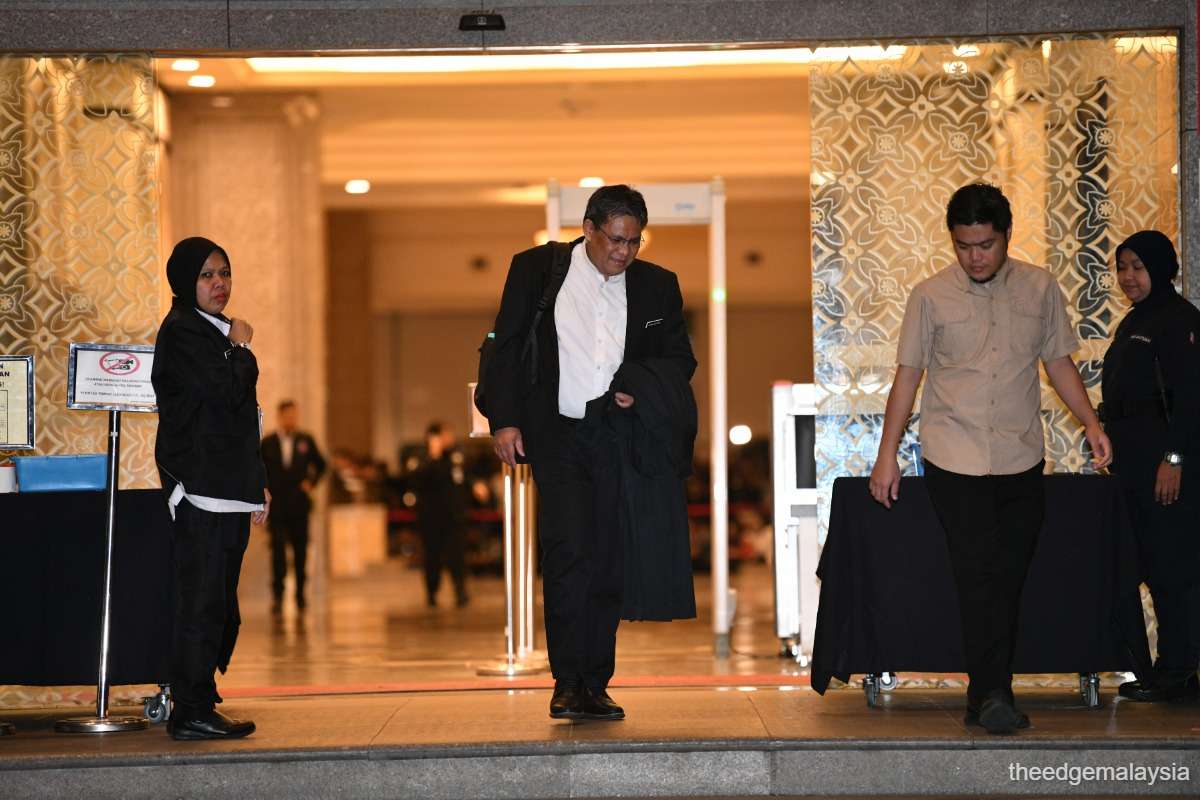
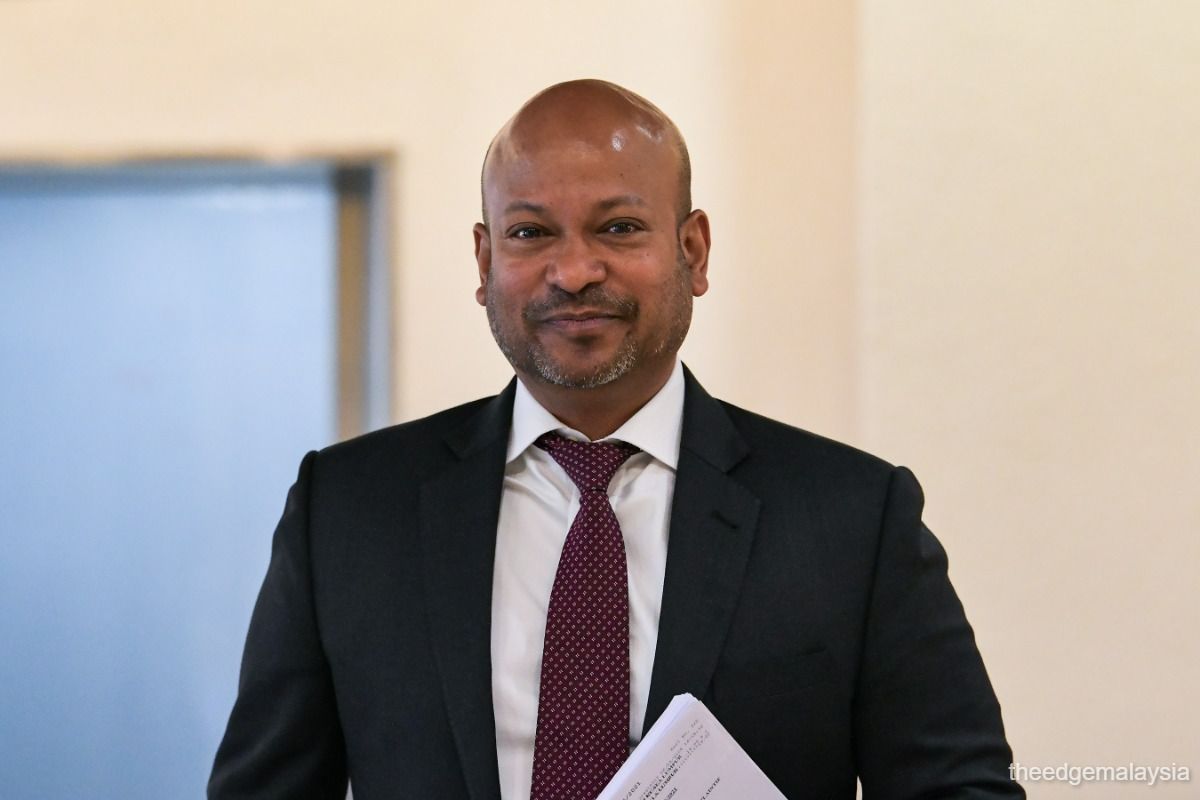
Deputy public prosecutors Datuk Ahmad Akram Gharib (top) and Datuk Kamal Baharin Omar (bottom) leaving the Palace of Justice at night. (Photos by Shahrin Yahya/The Edge)
9.10pm: Sequerah begins reading his sentence. He says he has considered mitigating factors for the accused and aggravating factors from the prosecution.
He says he will not elaborate his reasoning today, though it will be available in full grounds. The judge notes that he has taken into account Najib’s rank and all other factors.
For the main abuse of power charges, Najib is sentenced to 15 years of jail for the four charges and a fine of RM11.38 billion. Failure to pay the fine will result in 10 years in prison.
The judge is also imposing five years of jail for the 21 money laundering charges and orders Najib to pay RM2 billion.
“All the sentences are to run concurrently with each other and shall only commence at the expiration of the prison sentence in the SRC case,” Sequerah says.
All in all, Najib is facing a 15-year jail term, which will begin in 2028, and fines totalling over RM11 billion. He is also ordered to fork out about RM2 billion as the sum recoverable, of which failure to pay will result in an additional two and a half years of imprisonment.
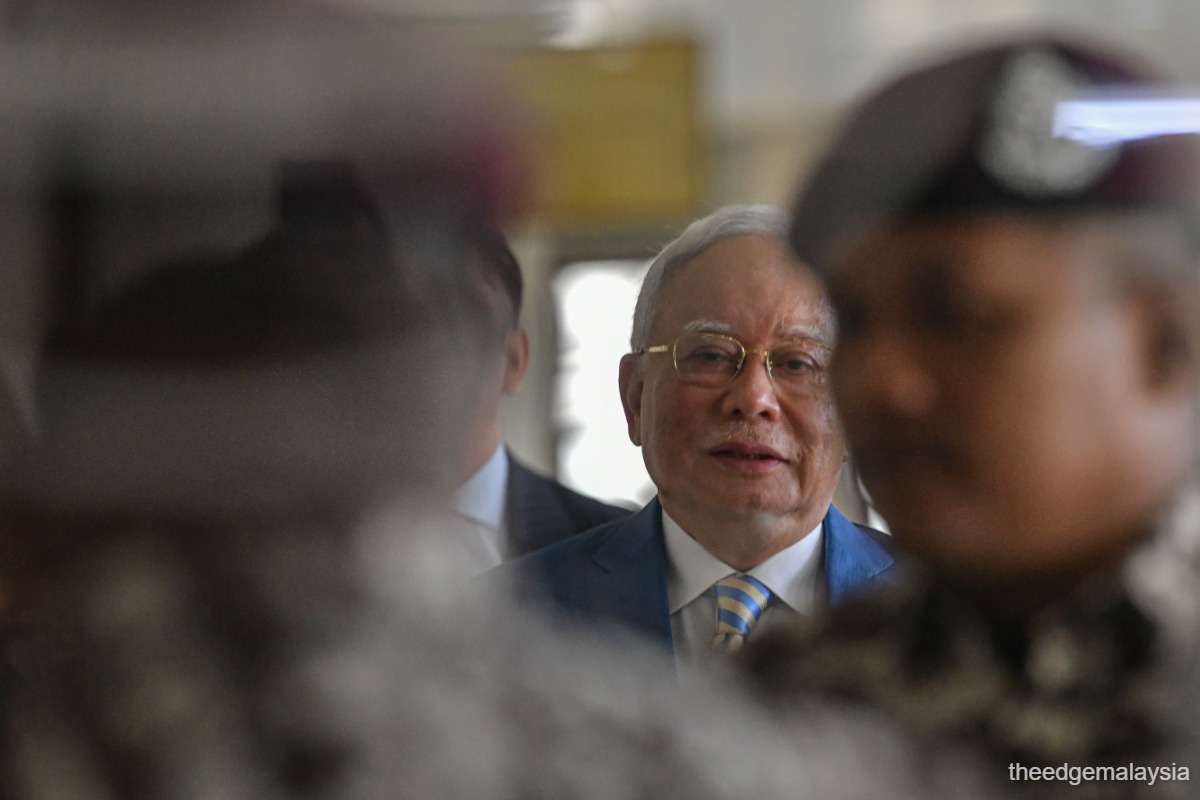
Former prime minister Datuk Seri Najib Razak (Photo by Zahid Izzani/The Edge)
9pm: Sequerah enters the courtroom.
8.30pm: Najib returns to the courtroom as everyone takes their places for Sequerah to give his sentence.
8.00pm: Shafee ends his submissions. Akram has a short reply.
Sequerah asks for the court to stand down while he deliberates on the sentence.
7.30pm: Shafee replies to the prosecution’s submissions.
Sequerah can order the sentences to run concurrently, Shafee says while insisting that any sentence must at least run partly simultaneously with that in the SRC case.
He also contends that the sentence in the SRC case by Justice Datuk Mohd Nazlan Mohd Ghazali was wrong, as the judge was not familiar with criminal cases then.
“I doubt Justice Nazlan got it wrong. He would have studied the authorities,” Sequerah counters.
Shafee fires back, saying that it was Nazlan’s first criminal case.
“Yes, but he would have known and studied the sentencing,” Sequerah replies.
7.20pm: Deputy public prosecutor Datuk Kamal Baharin Omar begins his submissions.
He says that each of the 21 money laundering charges carries a fine of up to RM5 million, or a maximum of five years' imprisonment, or both.
The fines on the first nine money laundering charges alone amount to more than RM2 billion. Kamal says in default of the payment, the sentence will be 270 months to run concurrently, or two years and six months.
“Therefore, we pray for a deterrent sentence,” he says and ends his submissions.
Shafee now addresses Sequerah.
7.10pm: Akram is seeking fines totalling as much as RM11 billion, or five times the value of graft involved, for the four abuse of power charges.
Sequerah queries him about the consequence of not being able to pay the fines, and Akram replies that Najib can serve prison time in lieu.
The maximum amount of jail time Najib would have to serve is 10 years' imprisonment for each of the charges in default of the payment of the fines.
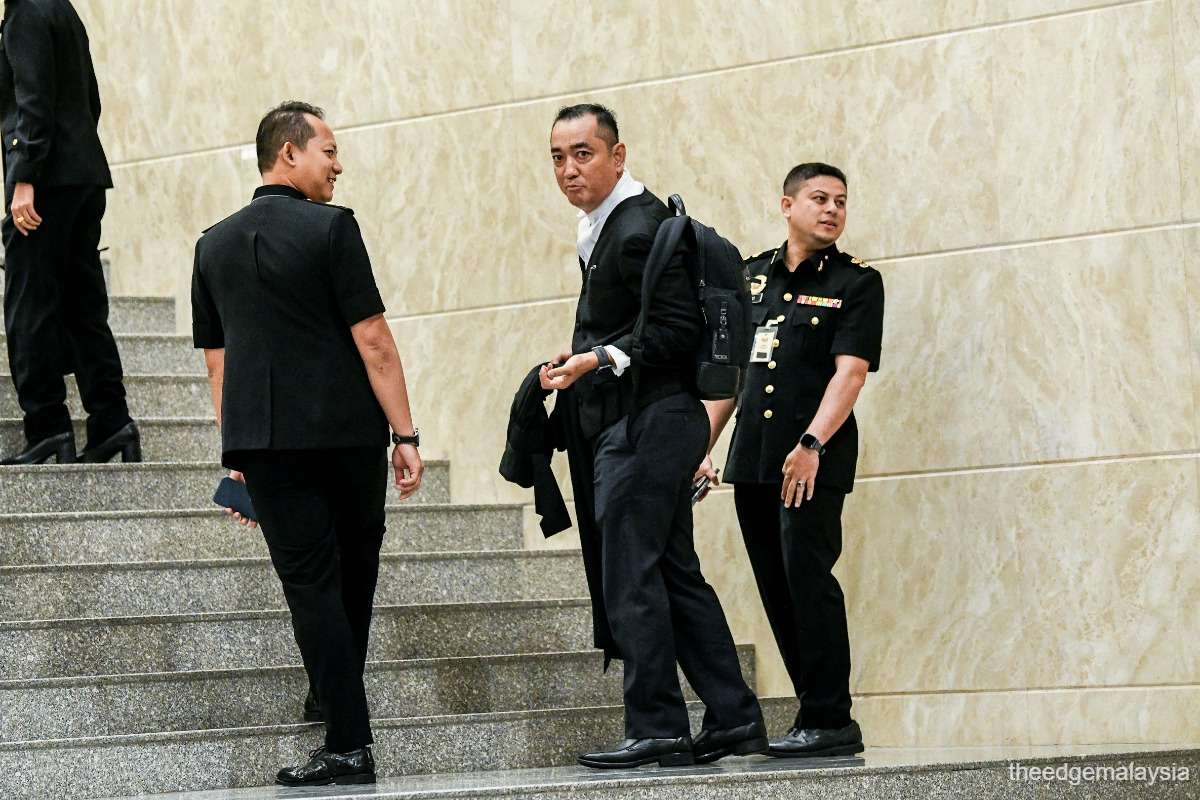
Deputy public prosecutor Datuk Ahmad Akram Gharib (centre). (Photo by Shahrill Basri/The Edge)
7.05pm: Akram is seeking the maximum sentences for all charges.
“We move this Honorable Court to impose the maximum 20 years' imprisonment for each and every count, and fine the accused accordingly,” he says.
He asks that the court imposes a severe custodial sentence commensurate with the gravity of the offences, order that the sentence to run consecutively to the accused’s existing term of imprisonment, and decline any application for a stay of execution pending appeal.
7.00pm: Akram, meanwhile, emphasises that public interest should be the paramount consideration.
“The offences involved the misappropriation of public funds, resulting in severe and lasting reputational damage to Malaysia on the international stage. More critically, the financial burden continues to be borne by the government,” he notes.
He brings up Anwar's statement that 1MDB’s total liabilities amount to nearly RM50 billion, of which about RM42 billion has already been paid by the government, inclusive of principal and interest.
Despite recovery efforts yielding RM29 billion, Malaysia is still facing a shortfall of around RM13 billion, Akram notes.
“These facts underscore the profound and enduring harm caused by the offences, thereby necessitating a sentence that fully reflects the gravity of the crimes and upholds the public interest through strong elements of deterrence,” he stresses.
6.45pm: Shafee raises the point that offences that arise from the same “factual matrix” warrant concurrent sentences and moderated punishment.
“The offences are interrelated, the conduct part of a continuous transaction, and the punishment should therefore reflect that unity. To impose consecutive terms would be to punish the same factual complex multiple times.”
Shafee reaches the end of mitigation and asks for mercy. “We ask for leniency and any fine to be imposed to take place concurrently.”
Overall, he is asking for his client the minimum permitted by law for any custodial term imposed, all terms of imprisonment to run concurrently, and fines limited to his present means and personal circumstances.
It’s now lead prosecutor Datuk Ahmad Akram Gharib’s turn.
6.30pm: Shafee asks for Najib’s sentences to run concurrently, similar to his punishment in the SRC case where he was sentenced to 72 years in prison but would only serve 12 years.
The lawyer is also seeking for any sentence to be backdated to run alongside the SRC sentence.
6.10pm: Shafee says Najib has not been involved in corporate management and this should be a strong ground in this case. "He was the prime minister and ultimate figure in the Ministry of Finance."
Shafee reiterates that if the 1MDB board of directors had been doing their job, the 1MDB scandal would not have taken place. He also raises that Jho Low, Shahrol, Hazem and Azmi have yet to face equal accountability.
There has not been much effort to bring Jho Low back, Shafee says, flagging that the Interpol Red Notice system had not been utilised.
“In a civilised system we want a judicial system to be respected,” the lawyer says, pointing out that “there are others who are truly guilty and have not seen action taken against them".
He adds that the prosecution could also not explain where the US$620 million returned funds went with only about US$60 million being used by Najib.
Shafee now moves on to Najib's health condition, and says punishment as a deterrent should not be taken into account for a person who is already above 70 years old. "The imprisonment would make the period more arduous," he says.
Najib, he says, suffers serious ulcers and bleeding that may lead to a serious stroke or heart attack as well as having a knee problem.
Shafee points out that "my client has given full cooperation to the authorities since 2015” and even allowed a bipartisan Public Accounts Committee to be formed to investigate 1MDB.
The lawyer also asserts that unlike other leaders who had interfered in investigations themselves, Najib has not interfered in any investigations. Shafee also accuses Prime Minister Datuk Seri Anwar Ibrahim of interfering in investigations that led to Najib's conviction.
"We have a complaint against the investigation. He (Najib) has never been given the time or day to rebut as by the time he had taken his statement, he was immediately charged," the lawyer adds.
6.00pm: Shafee says Najib has led to major reforms, including at 70 government-linked entities.
The senior lawyer says that Najib has not been convicted of any wrongdoing, including driving offences, if his conviction in the SRC International Sdn Bhd case is excluded.
Najib, he says, has been charged in five criminal cases and faces a great deal of oppression.
The lawyer goes on to describe that Najib was originally sentenced to 12 years and fined RM210 million in the SRC case before the punishments were reduced to six years' jail and a fine of RM50 million or in default of another year's jail.
Shafee mentions that Najib is also appealing against Monday's addendum decision, where the High Court dismissed his bid to serve the remainder of his sentence under house arrest.
"The only ground provided in the pardon petition was that he was not provided a fair trial (in the SRC) case all the way until the Federal Court," the lawyer adds.
Shafee stresses the 16th Yang di-Pertuan Agong initially wanted to give a full pardon but faced objection by the majority of the members of the Pardons Board.
The defence has also yet to receive a response from the Arbitration Committee of Geneva on Najib's claim of unfair trial, he notes.
The senior lawyer says Najib has been acquitted in the 1MDB audit report tampering trial and was also granted a discharge not amounting to an acquittal (DNAA) on the six counts of criminal breach of trust with regard to the IPIC case as granted by judge Datuk Muhammad Jamil Hussin.
Shafee says there has not been any updates on the IPIC case, while Najib was discharged but not acquitted by judge K Muniandy in another case involving three charges of money laundering at SRC.
"The accused had been subject to prosecution and judicial scrutiny in both civil and criminal [cases]. The reduced sentence was a result of proportionality of sentencing and this was due to (Najib's) claim of a lack of fair trial."
The lawyer also points to the RM1.69 billion tax claim by the Internal Revenue Board.
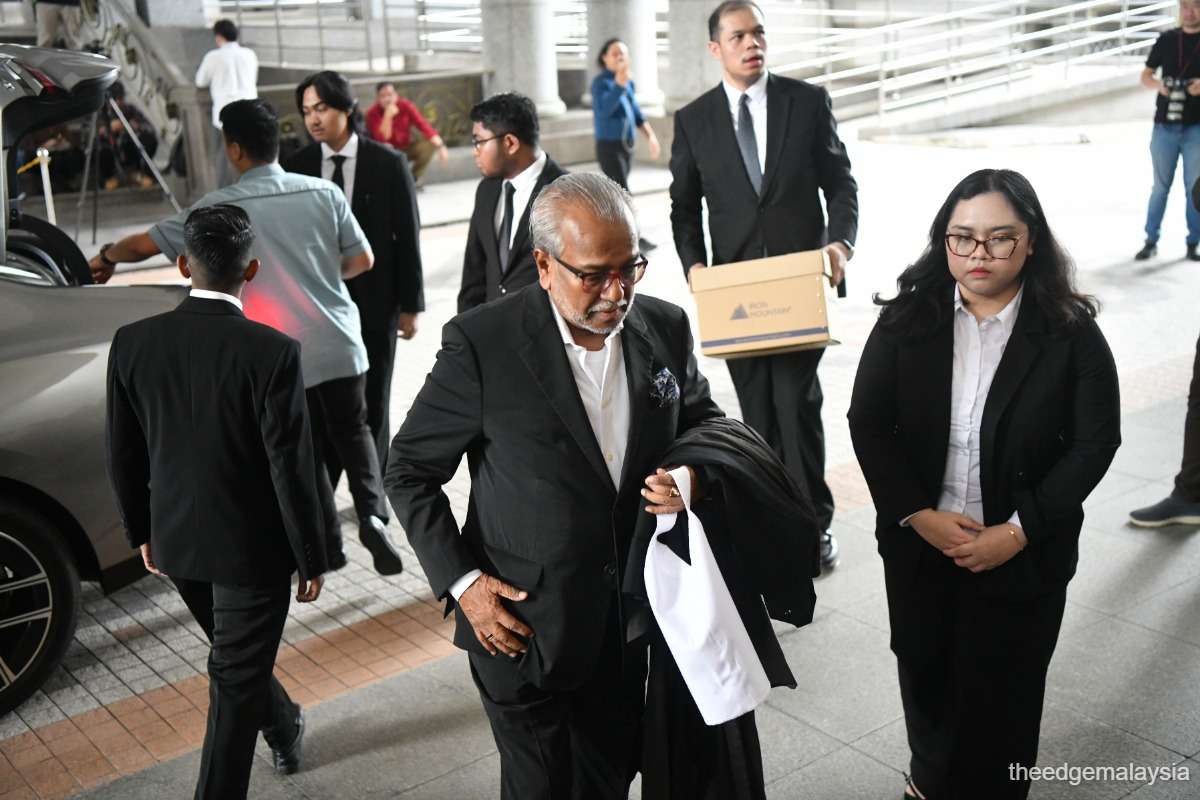
Najib's lead defence counsel, Tan Sri Muhammad Shafee Abdullah (centre). (Photo by Shahrin Yahya/The Edge)
5.50pm: Shafee says that Najib will appeal against the ruling and the final mitigation would be made at the last stage.
Born on July 23, 1953, Najib is now 72 years old. He received early education from St John's Institution and graduated from Nottingham University. He is also pursuing a PhD on economic transformation of Malaysia and is expected to finish his studies in 2026.
"This shows that he is interested in the economy of Malaysia and communicating what is the best way for the economy," Shafee says, adding that Najib is also one of the four highest Pahang Orang Kaya nobility.
Now, Shafee goes to Najib's political career.

Apparel donned by Najib's supporters on Friday morning. (Photo by Shahrin Yahya/The Edge)
5.47pm: Najib's supporters present in the morning are nowhere to be seen outside of the court complex following heavy downpour.
5.43pm: Court proceedings resume.
Najib's youngest son Norashman Najib is also spotted in court.
4.50pm: Shafee asks for the broad grounds and Sequerah replies he is unable to provide it, telling the parties to confer with the court's recording system.
Shafee requests for a short break to consult with Najib but Sequerah seems to decline the request.
Shafee then points to a judgement from the late judge Datuk Seri Augustine Paul and said a mitigation should not be given a ritualistic fact.
Sequerah says he thought that the defence was seeking another date but Shafee reiterates that he is only looking for a short 30-minute breather.
The court decides to allow the break.
4.45pm: MACC chief commissioner Tan Sri Azam Baki congratulates investigating officers and the prosecution team who worked tirelessly from the very beginning of the 1MDB investigation, which commenced in July 2015, until its completion in the court’s decision delivered today.
4.40pm: Sequerah says the court considered Najib’s reliance on banking institutions, Jho Low and Nik Faisal to ensure that the funds were not tainted. Najib had claimed that no alarm was raised by BNM over the two bank accounts at AmBank, of which he was the sole signatory.
"Najib testified that he had transferred back the US$620 million and gave instructions to close one of the AmBank accounts. This showed that Najib was in control of his bank accounts. Despite this, he did not verify the sum received from Tanore. Najib also did not verify the origins of the money."
Sequerah observes that the explanation given by Najib appears hollow as he possessed knowledge of the funds.
"The enormous scale of the evidence” points to Najib’s failure to conduct an inquiry into the huge inflow of funds and his “willful blindness and reliance on various banking institutions to distance himself from responsibility is without merit", Sequerah says.
The judge rules the actus reus and mens rea over knowledge of the money laundering activity under Section 4(1) of the Anti-Money Laundering, Anti-Terrorism Financing and Proceeds of Unlawful Activities Act were both proven.
"This did not raise doubt to the prosecution's case. There is cogent evidence, direct and indirect, and that the defence is incapable of belief."
The judge finds Najib guilty of the first nine charges of money laundering after failing to raise reasonable doubt over the case. Sequerah also rules against Najib on five charges of using the proceeds as the defence was meritless as the accused did not deny issuing the cheques.
The court also finds the various entities that received the payments were ultimately for the benefit of the accused either in a direct or indirect manner. “It did not raise reasonable doubt and [the court] finds Najib guilty of the five charges of utilising the funds,” Sequerah rules.
Further, Sequerah convicts Najib of the seven charges of transferring the funds to and from Tanore, which illustrated the process of layering, finding his defence lacking merit.
4.30pm: The court accepts the evidence by an official from BNM that the funds originated from 1MDB as it is supported by contemporaneous documents.
The funds are considered proceeds of unlawful activities under Section 3 of the Anti-Money Laundering, Anti-Terrorism Financing and Proceeds of Unlawful Activities Act.
In the final analysis of BNM’s evidence, the court finds that an overdraft facility granted to Najib also failed to be fully accounted for.
Given Najib's position, he would have no difficulty to verify the documents on the purported Arab donation but had failed to do so, Sequerah says and highlights that the MACC delegation sent to Riyadh had failed to confirm the authenticity of the donation letters.
"However, he obtained the specific remittance to return the remaining US$620 million from his accounts. The money went back to the Tanore account. This is not chicken feed as the sum was a lot. The money trail showed that the funds came from 1MDB bond entities and went into Tanore and then into Najib's accounts in March 2013. The Arab donation claim cannot hold through," the judge says.
4.00pm: The fourth abuse of power charge is with regard to the US$330 million loan from Deutsche Bank.
Sequerah says Najib admitted he had knowledge of the refinancing of the loan that same year.
"The accused's knowledge is evidence and he was aware of the US$250 million initially and had seized the opportunity to claim of missing SRC documents” even though no police report was lodged on the purportedly lost documents, Sequerah notes.
Evidence shows Najib signed the two documents, while the defence claimed that this should be blamed on 1MDB's management. However, “the fingerprints of Jho Low cannot hide the involvement of the accused. The accused benefited behind it as Jho Low was involved in the option", Sequerah says.
Sequerah points to the fact that Jho Low was asked to negotiate on 1MDB's behalf with Abu Dhabi's International Petroleum Investment Company (IPIC).
Jho Low's involvement shows he was in the thick of the transaction and that he had the backing of the most powerful man at that time, the judge says. There was no police report lodged to refute his role in the deal, the judge notes.
While Najib disputed the signature on some of the documents, and the court noted a variation to the signature, “there was no conclusion that the signature was not that of the accused”, Sequerah finds.
“The accused had not rebutted the fourth charge of abuse of power and the prosecution had proven the case on the fourth abuse of power charge," the judge says, convicting the former prime minister of the fourth charge.
3.50pm: The judge now turns to the third abuse of power charge centred on the issuance of a US$3 billion bond backed by a government letter of support.
Najib had argued that the issuance was done without his knowledge even as he personally attended the signing ceremony with Aabar Investments PJS Ltd.
"It is inconceivable” that Shahrol acted independently. The submission done by the prosecution has merit as Shahrol cannot act on his own in reference to Article 117 of the Articles of Association, the judge says. “For the wrongdoings pointed to Shahrol, he had not benefited in any form.”
Jasmine Loo may have also benefited “but it is not devoid of her credibility. The instruction was from Jho low and this was on the instruction of the accused. This was done for the benefit of the accused”, Sequerah says.
The “cold-hearted evidence” paints a different picture, the judge says.
A letter from Shahrol to Najib showed there was a notification from Najib to former Treasury secretary general Tan Sri Dr Mohd Irwan Serigar Abdullah asking him to take measures compelling Ministry of Finance officials to take immediate actions, resulting in non-compliance with the due diligence process.
Sequerah takes note that Tan Sri Ismee Ismail, a former director of 1MDB, said there was no discretion by the board as it was considered a binding directive. Funds totalling over RM2 billion were eventually traced to Najib's accounts from the Tanore fund.
The judge adds that Tanore, controlled by Jho Low’s associate Eric Tan, had received the funds and nine tranches of payment were paid to Najib's accounts. "No sum of the US$3 billion was transferred to the TRX project," the judge says.
He says all evidence taken as a whole showed Najib had an interest and that he had received gratification and has not rebutted the third charge and did not raise a reasonable doubt to the third charge.
"I therefore convict the accused of the third charge," the judge rules.
3.40pm: The court is now focusing on 1MDB's energy asset acquisition.
Sequerah notes that Jho Low was involved in the discussions and participation in the negotiations with the presence of then-Goldman Sachs CEO Lloyd Blankfein. The judge emphasises that the acquisition of Mastika Lagenda and Tanjong Energy Holdings could not have taken place without Najib's approval.
The prosecution pointed to the acquisition’s non-transparent manner in which Ministry of Finance officials were kept in the dark. The judge says Najib had approved the transaction ahead of the 1MDB board.
"It was evident that Najib played a pivotal part in Mastika Lagenda and Genting Sanyen and the written approvals. It is pivotal in the issuance of the US1.75 billion bond to 1MDB," Sequerah says, noting that the defence did not dispute the authenticity of the documents.
This is construed as an afterthought, the judge says, adding that Najib’s dispute over the signatures on the documents hinges on mere probabilities and did not dispel the assumption he had willfully used his position in acquiring the plants.
"The accused had not rebutted the abuse of power charge in respect of the second charge and [the court] convicts the accused of the second charge," the judge concludes.
3.30pm: The court finds that Najib failed to create doubt with regard to the first charge of abuse of power under Section 23 of the Malaysian Anti-Corruption Commission (MACC) Act and convicts the former prime minister of the first charge of abuse of power.
3.25pm: The court finds the 1MDB investment in a joint venture with PetroSaudi was illegal as there was no genuine investment made with funds transferred into Good Star, a company controlled by Jho Low.
The claim made by Najib that he had no control of 1MDB's transfer of funds to PetroSaudi later traced to his AmBank accounts is without merit, Sequerah rules.
Najib claimed he had no executive role when in fact, the judge notes, he was the minister of finance and the de facto decision maker in 1MDB being the chairman of the board of advisers.
The judge says even if the instruction was given to former 1MDB chief executive officer Datuk Shahrol Azral Ibrahim Halmi, the inference is that it was based on instructions given to him by Jho Low who was considered an agent of Najib.
“The instruction came from Jho Low in Najib's interests," Sequerah finds, adding Najib did not dispute nor query the massive amount of funds that entered into his accounts and went ahead to spend it.
3.12pm: Outside the court, Najib’s supporters have yet to reconvene after Friday prayers and lunch while dark clouds loom in the sky.
3.10pm: Sequerah rules Najib’s claim — that the meeting minutes of the 1MDB board of advisers were forged — is clearly an afterthought, as handwriting analysis of Najib's signature was inconclusive.
The judge says this shows that Najib had personal knowledge, control and vested interests in the affairs of 1MDB.
The judge is now asking the prosecution on whether there are amendments to the money laundering charges.
3.03pm: Judge Sequerah comes out from his chambers and continues to read his findings on the board of directors of 1MDB.
3.00pm: Najib walks in, accompanied by the prison guards, and goes straight to the accused dock.
The proceedings are being held at the Court of Appeal 1.
2.40pm: Shafee and his defence team, along with the prosecution, have entered the courtroom.
The court is still awaiting Najib who went for Friday prayers at the Kajang Prison.

Photo by Shahrin Yahya/The Edge
12.29pm: Najib is seen leaving the court complex in the same silver Proton X70 for Friday prayers.
The small crowd of supporters gathered around the barricades at the rear exit of the complex begin to disperse.
12.15pm: Sequerah has been reading out his judgement for nearly three hours. Save for a 10-minute toilet break earlier, the judge had also only taken minimal water breaks.
12.10pm: Sequerah notes there were no reports lodged with regard to the embezzlement of 1MDB's funds or any reports lodged against Jho Low.
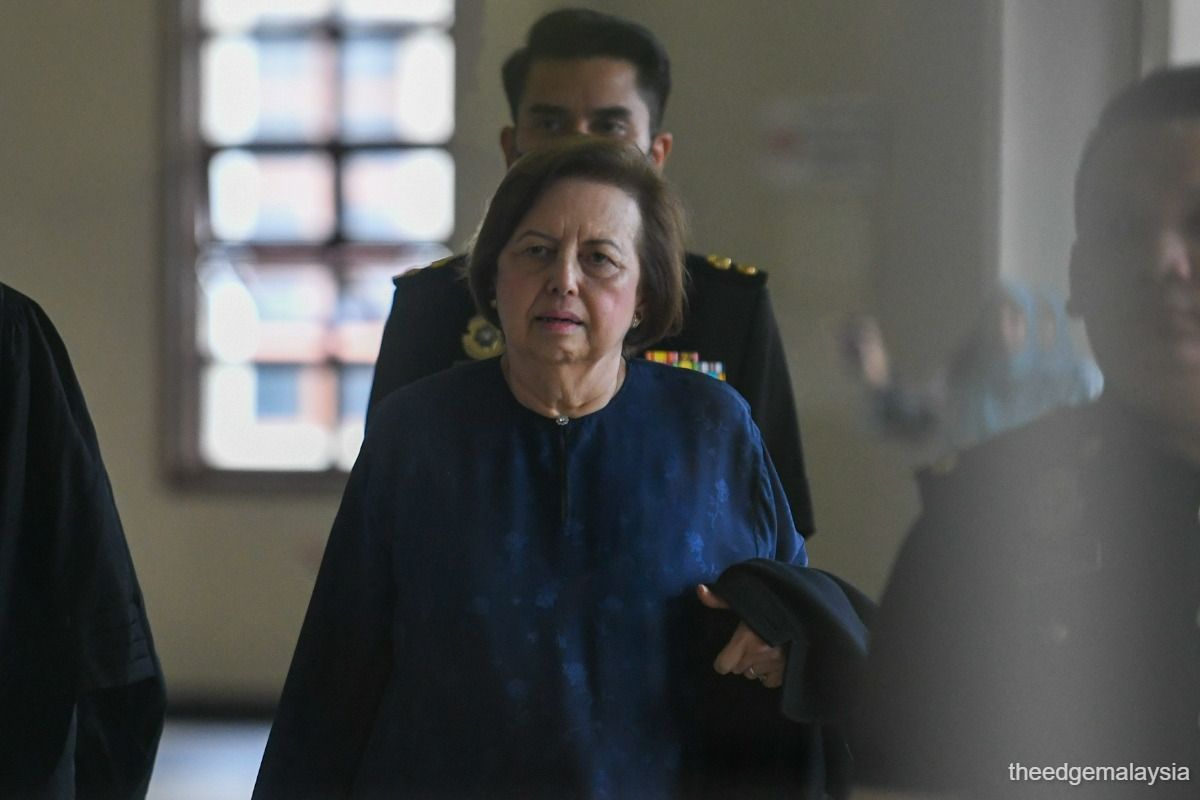
Najib disbanded a task force investigating 1MDB, pushed then-Bank Negara Malaysia (BNM) governor Tan Sri Dr Zeti Akhtar Aziz to clarify funds in his accounts, and sacked Tan Sri Abdul Gani Patail as the attorney general and Tan Sri Muhyiddin Yassin as the deputy prime minister.
These were consistent and, at times, drastic actions related to a company that Najib had an interest in, Sequerah finds.
Proceedings are halted for Friday prayers.
12.00pm: Sequerah says Najib was no country bumpkin in rejecting Tong's advice with regard to 1MDB's dealings by Jho Low, as he was the finance minister and 1MDB board of advisers chairman.
The attempt by the defence to claim Najib was focusing on the country's management does not hold water, the judge says, as Najib had asked Jho Low to accompany his former aide Datuk Amhari Effendi Nazaruddin to his trip in Abu Dhabi and also China.
The inference here, the judge says, is that Jho Low had acted as Najib's proxy or conduit and agent for the accused. "The argument by the defence that Najib was misled by the 1MDB management is unmeritorious," Sequerah stresses.
The judge also points to former finance minister II Datuk Seri Ahmad Husni Hanadzlah, who had spoken to Najib about his worries over 1MDB, only to be told by the then-prime minister that he need not concern himself with 1MDB.
11.55am: Proceedings resume.
Sequerah deals with Tan Sri Tong Kooi Ong's evidence.
Tong is the chairman of The Edge Media Group.
11.40am: Sequerah grants a 10-minute break. The judge indicates he has another one and a half hours to read the judgement.
He also orders Najib to be brought back at 3pm, as the former prime minister would have his Friday prayers at the Kajang Prison.
11.30am: Jho Low was on a yacht on Aug 11, 2009, and it was the now-fugitive businessman that arranged the holiday with Tarek Obaid. Sequerah notes that Article 117 of the 1MDB's Articles of Association was also formulated at about the same time.
On Sept 26, 2009, Jho Low was also present as an adviser to Najib when former 1MDB chairman Tan Sri Mohd Bakke Salleh was told to firm a decision with PetroSaudi. Instead, US$700 million had gone to Good Star Ltd, an issue that was raised by Bakke but no action was taken on Jho Low, Sequerah notes.
Sequerah also recognises Jho Low's role in helping secure the International Petroleum Investment Company (IPIC) guarantee.
"The central role of Jho Low with Najib is significant," the judge says, citing their frequent presence together that showed Najib's active role in all the deals.
11.15am: Citing the SRC International Sdn Bhd case where the finding of the Arab donation was not accepted by the court, Sequerah agrees that Najib should be barred from raising similar defence.
"The Arab donation defence was incapable of belief. The accused is estopped from bringing it up again, as this was raised before a superior court where the decision was upheld by the Court of Appeal and Federal Court. This is an unbelievable tale and a tale that surpassed even those from the Arabian Nights and a concoction bereft of any credibility."
In order to dispel the notion, the court had also done an independent finding and found the claim of Arab donations to be unbelievable, Sequerah says, ruling that the gratification received by Najib has not been rebutted and the defence “failed to raise reasonable doubt of the charges of abuse of power”.
The judge is now addressing the defence’s claim of forgery of Najib's signatures.
11.00am: The judge rules the Arab donation letters were fake, supported by testimonies of former AmBank relationship manager Joanna Yu Ging Ping as well as that of former 1MDB general counsel Jasmine Loo Ai Swan who had seen a draft copy of the written Arab donation letters in London on a computer screen at an overseas hotel.
"The original letters had not been produced," the judge says.
Sequerah has already been reading his grounds for one and a half hours.
Datin Seri Rosmah Mansor, Najib's wife who is wearing a pink baju kurung and matching pink selendang, is seen at the court.
10.30am: In analysing the Arab donation defence, Sequerah says there was no verification done by Najib to ensure the funds originated from the family of King Abdullah.
"The accused anchored his belief to a wider circle of the royal family,” Sequerah says, noting that there is also no evidence that the funds were to be transmitted in instalments.
The assertion that the manner of the fund transfer "was entirely up to King Abdullah... does not further the cause of the defence,” the judge says.
Tracing shows it was done through third-party private companies Vista Equity, Blackstone, and Tanore, which were entities owned by Eric Tan.
There was also no written acknowledgement sent to the Arab monarch's family to express gratitude, which was unusual, the judge highlights.
"There was no formal acknowledgement (to the Saudi ruler). This cannot be considered as a private donation nor an official donation," the judge says.
The letters “are considered an attempt to legitimise the accused's claim of donation”, Sequerah finds. “What they said does not advance Najib's claim of the narrative that they were donations.”
Defence witness Jamil also testified that he did not hear directly that King Abdullah wanted to make financial contributions directly to Najib.
"The reliability of the defence witness did not advance the defence case," Sequerah says.
The judge also sees issues with evidence from the MACC delegation, noting that the statement recorded from Eric Tan was from a prepared statement and the absence of a proper question-and-answer session with the Arabian party in the meeting was pre-arranged before the delegation’s arrival.
Sequerah also does not accept Najib's contention that he was receiving a political donation on behalf of Umno.
"Umno is not any flyby night, rookie political party. The claim that the money is a political donation doesn't hold water as the funds went straight to Najib's account,” he says.
The donation was also not declared in the Cabinet minutes... Najib had the resources to find out the legitimacy of the funds. He acted in wilful blindness and hence the funds are considered highly questionable," the judge stresses.
The judge rules that the Arab donation narrative is not meritorious and the funds were derived from 1MDB.
10.15am: The judge also rules that Jho Low and Najib had known each other as evidenced by photographs of them in a vacation together.
"In the final analysis, the witnesses were not on trial and they acted capable of belief (with their testimonies). There is no reason not to give weightage to the prosecution witnesses’ testimonies," Sequerah says.
On Najib's defence that the funds received were donations, the judge takes note of the defence’s claim that Najib's defence was corroborated with other evidence as tendered by the four letters from Prince Saud.
The defence had called witnesses in Najib's defence of the Arab donation claim, including former minister Datuk Seri Jamil Khir Baharom and Malaysia's ambassador to Saudi Arabia.
A Malaysian Anti-Corruption Commission (MACC) delegation to Riyadh on Nov 29, 2013 to verify the donation letters was only met by Prince Saud's attorney and Jho Low's aide Eric Tan Kim Loong, rather than Prince Saud himself. The delegation admitted there was no proper profiling of the individuals and came back unsatisfied with the interview itself, the judge says.
10.05am: Sequerah says he accepts the prosecution's witnesses, including from 1MDB and including former BSI banker Kevin Swampillai, and rules that they are admissible. The court is not revisiting the defence's argument that they are hearsay evidence, noting supporting documentary evidence.
"All the witnesses testified that the instructions emanated from the accused himself. All these communications are considered admissible," he says.
This is despite the fact that the said witnesses — Jho Low, Geh and Nik Faisal — could not be found, and Azlin had died.
The defence had claimed that the prosecution witnesses’ testimonies of receiving instructions from Jho Low on 1MDB on behalf of Najib was hearsay evidence.
The judge says there is no reason for him to review his finding after the called-for-defence stage.
Sequerah finds that the credibility of the prosecution witnesses remains intact even after the cross-examination made by the defence in challenging Jho Low's involvement.
9.55am: Witness testimonies, including that by former 1MDB general counsel Jasmine Loo Ai Swan, show that Jho Low acted as the go-between person between Najib and 1MDB.
"Jho Low had maintained communications with 1MDB officers and issued instructions from the accused in 1MDB. Directions from Jho Low emanated from the accused. Jho Low was the agent of the accused," the judge says.
Looking at the talking points issued by Jho Low to 1MDB officers, Sequerah says they were instructions issued by Jho Low and formed official guidance from the minister of finance.
"These are not frivolous remarks and fell squarely within the business limb as they were routinely transmitted between the witnesses. The evidence shows the relationship that Jho Low acted as the proxy of the accused," the judge notes.
9.50am: The court rules that the absence of key witnesses Low Taek Jho (Jho Low), Nik Faisal Ariff Kamil and Terence Geh Choh Heng met the requirements under Section 32(1)(b) of the Evidence Act and accepts the evidence given by the other prosecution witnesses.
Authorities had done their part to locate the trio, and the defence’s contention of hearsay evidence from prosecution witnesses could not be accepted by the court.
The judge rules that Datuk Azlin Alias, who was Najib's principal private secretary and passed away following a helicopter crash, received the emails that were also sent to others.
Sequerah also takes note that prosecution witnesses like former 1MDB chief executive officers Datuk Shahrol Azral Ibrahim Halmi and Mohd Hazem Abdul Rahman as well as former chief financial officer Azmi Tahir testified that Jho Low had acted as the unofficial voice of Najib in 1MDB and acted as an adviser to the accused.
He highlights that former 1MDB chairman Tan Sri Mohd Bakke Salleh had also testified that based on his recount of events, Jho Low acted as a conduit for Najib.
"The phone call with Najib wanting to conclude the PetroSaudi International deal....to conclude a government-to-government project. Jho Low acted as a conduit for Najib and he acted under the instructions of the accused," the judge says.
9.30am: The defence, Sequerah says, is not prejudiced in the trial. Apart from being represented by a team of lawyers, Najib has been able to understand the manner and acknowledge all components of all the charges.
During cross-examination, Najib understood the charges that accused him of abusing his position. The charges are in line with the Criminal Procedure Code where it clearly identifies the offence, and applicable under Section 4(1)(a) of the Anti-Money Laundering, Anti-Terrorism Financing and Proceeds of Unlawful Activities Act 2001.
The defence’s argument that the four charges were a conflation has also been rejected by the court.
9.25am: The judge says that the court had decided to call Najib to enter his defence on Oct 30, 2024 and the former prime minister had elected to testify from the witness stand.
Sequerah notes the trial court considers all evidence at the end of the defence stage under Section 182 A (1) of the Criminal Procedure Code and decides whether it is proven beyond reasonable doubt.
The defence had raised issues of hearsay and credibility of the prosecution witnesses and asked the court to revisit the earlier findings of calling Najib to enter his defence.
Sequerah says the duty of the court is to weigh whether the defence had raised reasonable doubt in the case while the money laundering case’s burden is on a balance of probabilities. There was no merit to the defence argument on the duplicity of charges, he rules.
9.17am: Sequerah says he will be reading the broad grounds in this case and the full grounds will be given later.
He begins reading his decision.

Deputy public prosecutors Datuk Kamal Baharin Omar (centre) and Mohamad Mustaffa P Kunyalam (right). (Photo by Shahrill Basri/The Edge)
9.13am: Court proceedings start, presided by Justice Datuk Collin Lawrence Sequerah.
Najib is seated in the accused dock. There are 10 prison guards in the courtroom.
Prosecutor Kamal introduces parties.

Lead defence counsel Tan Sri Muhammad Shafee Abdullah (centre). (Photo by Shahrill Basri/The Edge)
8.58am: Lead defence counsel Tan Sri Muhammad Shafee Abdullah arrives with Datuk Tania Scivetti. Shafee is seen talking to Najib before taking his seat.
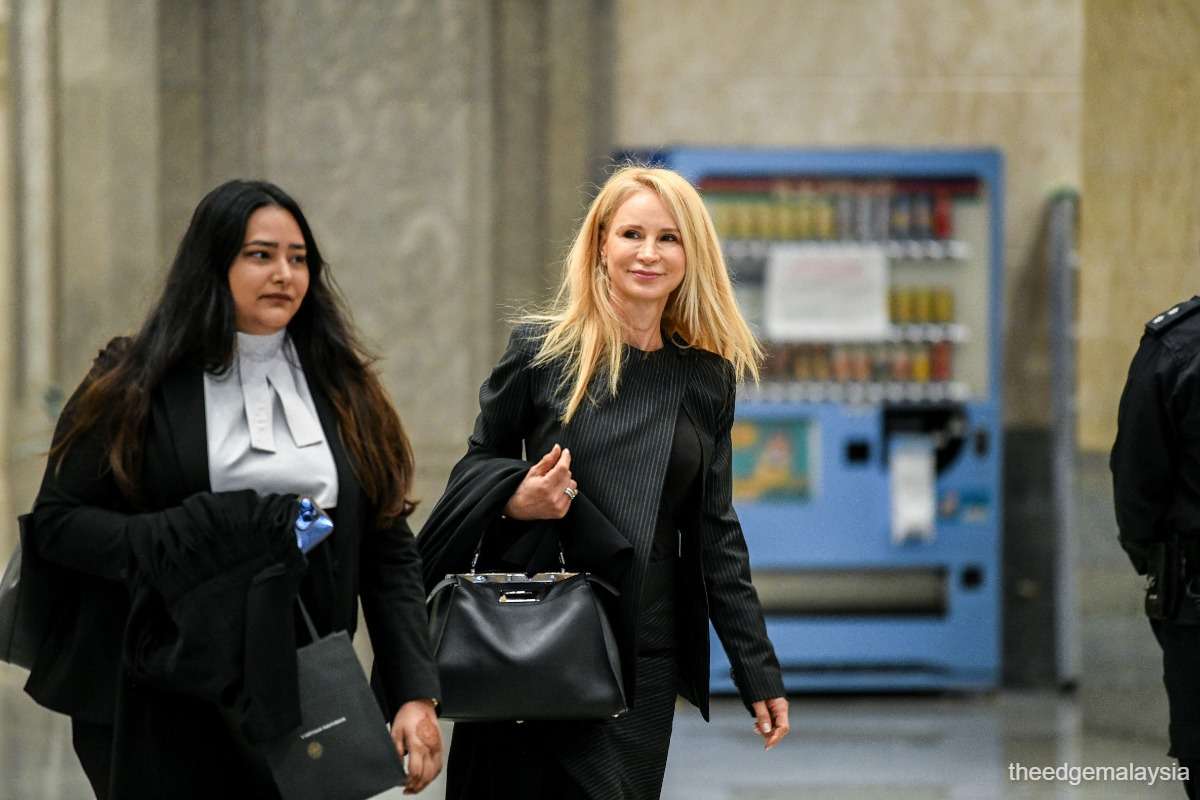
Lawyer Datuk Tania Scivetti (right). (Photo by Shahrill Basri/The Edge)
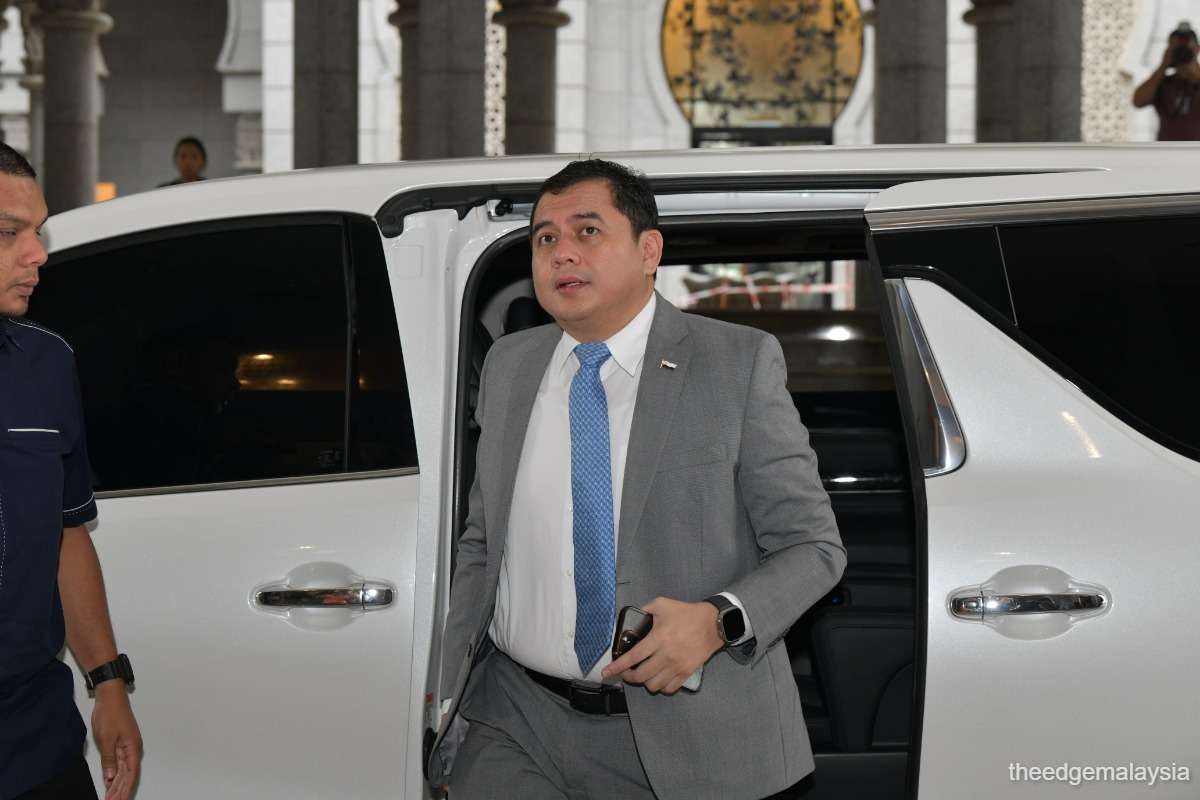
Najib’s son, Datuk Mohamad Nizar Najib. (Photo by Suhaimi Yusuf/The Edge)
8.50am: Najib’s children Datuk Mohamad Nizar Najib, Datuk Mohd Nazifuddin Najib, and Datin Nooryana Najwa Najib arrive.
The ex-PM's family members are seated in the middle of the public gallery. Supporters, meanwhile, are seated on the right and left side of the public gallery.
8.52am: Najib walks into the courtroom escorted by the prison guards.

MCA president Datuk Seri Dr Wee Ka Siong made a brief appearance on Friday morning. (Photo by Shahrill Basri/The Edge)

Photo by Shahrin Yahya/The Edge
8.41am: Outside the court building, supporters now number fewer than 100.
They remain behind the barricaded perimeter leading towards the rear entrance of the court, occasionally chanting "bebas, bebas, Bossku".

Deputy public prosecutor Mohamad Mustaffa P Kunyalam (Photo by Suhaimi Yusuf/The Edge)
8.34am: Deputy public prosecutors Datuk Kamal Baharin Omar and Datuk Ahmad Akram Gharib walk in with other prosecutors.
The defence team has also trickled in earlier with Tan Sri Muhammad Shafee Abdullah's juniors.
Former Dewan Rakyat Speaker Tan Sri Azhar Azizan Harun, who is also a practising lawyer, is in court possibly for holding a watching brief.
Among the VIPs present include former Terengganu menteri besar Datuk Seri Ahmad Said. 1MDB's precursor Terengganu Investment Authority was formed during his time. Pahang State Assembly Speaker Datuk Seri Mohd Sharkar Shamsudin is also seen. Najib is from Pahang and represented Pekan at the Parliament for nearly four decades.

Former Terengganu menteri besar Datuk Seri Ahmad Said (centre). (Photo by Suhaimi Yusuf/The Edge)

Photo by Shahrin Yahya/The Edge
8.22am: Najib’s son, Datuk Mohamad Nizar Najib, arrives at the court complex.
8.25am: Najib arrives in a silver Proton X70 escorted by police vehicles and enters the court via the underground entrance.
7.02am: A handful of supporters and media are gathering at the court's rear parking lot.
7.22am: Crowds are slowly trickling in.
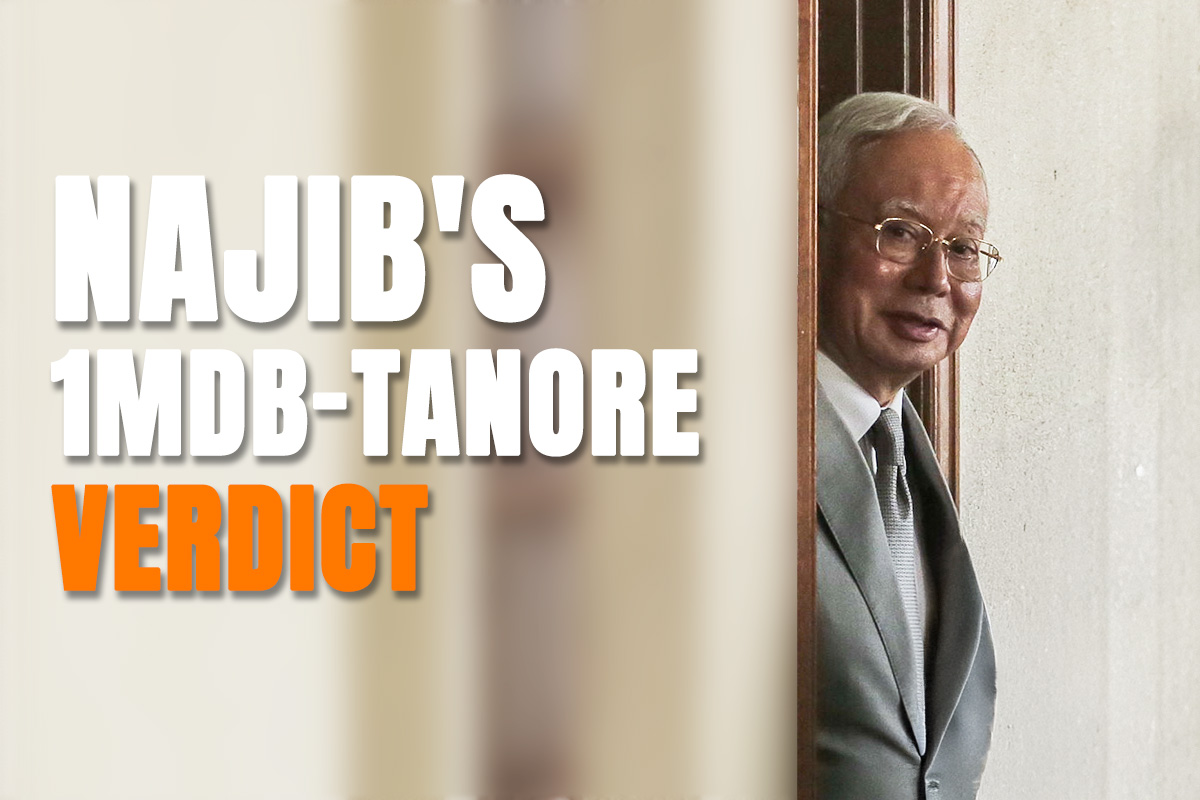
PUTRAJAYA (Dec 26): As the world's biggest public-corruption trial involving Datuk Seri Najib Razak comes to a conclusion on Friday, The Edge is bringing the much awaited proceedings live.
Federal Court judge Datuk Collin Lawrence Sequerah, who has been presiding over the trial at the High Court since 2019, is expected to deliver his decision beginning at 9am at the Palace of Justice.
The former prime minister is charged with four counts of abuse of power and 21 money laundering charges with regard to RM2.27 billion of 1Malaysia Development Bhd (1MDB) funds.
Najib is represented by a team of lawyers led by Tan Sri Muhammad Shafee Abdullah and Datuk Tania Scivetti.
The late Datuk Seri Gopal Sri Ram, a former Federal Court judge, led the prosecution at the start of the trial before his death in 2023. The team is now led by deputy public prosecutors Datuk Kamal Baharin Omar, Datuk Ahmad Akram Gharib and Mohamad Mustaffa P Kunyalam.