

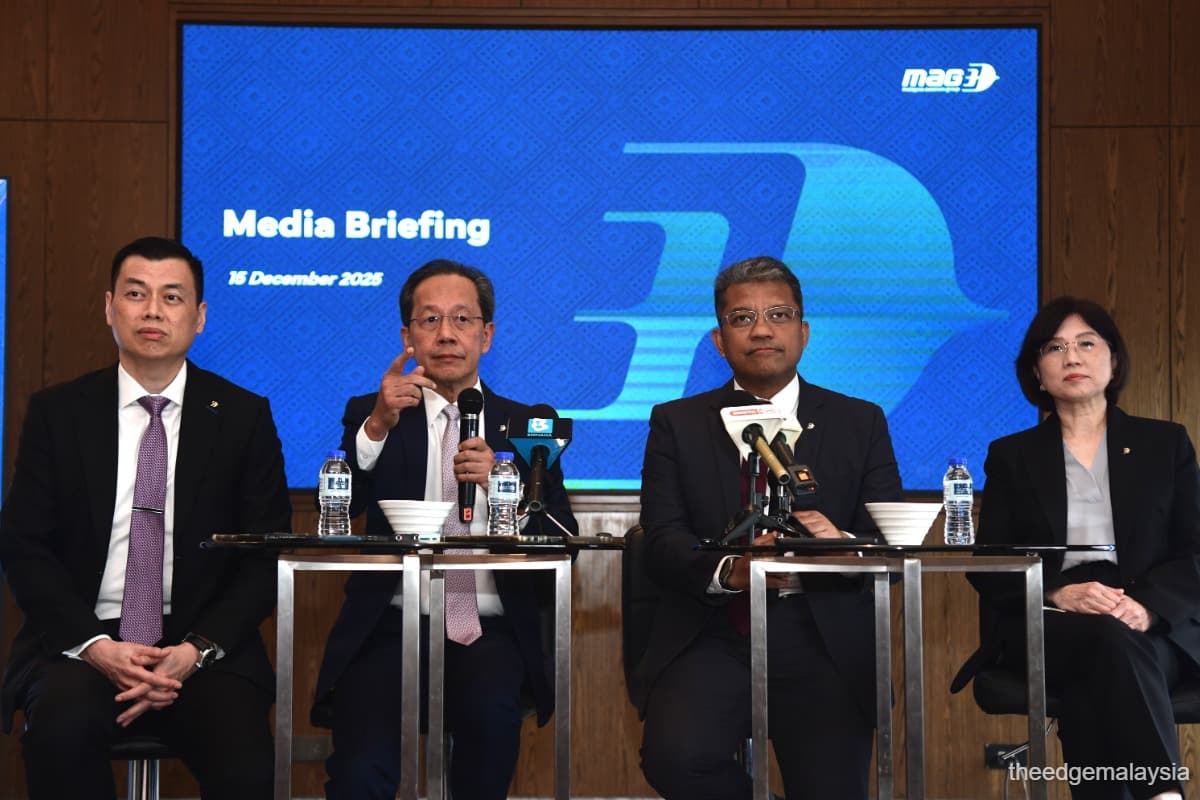
KUALA LUMPUR (Dec 15): Malaysia Aviation Group Bhd (MAG) is targeting to double its revenue to RM24.6 billion by 2030, from RM13.8 billion last year, and lift its operating profit margin to 9% from 1% now as it repositions Malaysia Airlines Bhd as a premium Asia-Pacific carrier with greater international focus post-financial restructuring phase.
The premium Asia-Pacific strategy centres on expanding capacity by more than 50% at an average annual growth rate of 8.5%, supported by fleet renewal and product upgrades to compete more effectively with full-service peers in the region.
This includes investment in 40 Airbus A330neos, 43 Boeing 737-8s and 12 Boeing 737-10s, supporting the ambition to operate a mainline fleet of 116 aircraft by 2035, up from about 90 aircraft in 2026.
Its fleet plan includes increasing narrowbody aircraft to 60 by 2032, mid-range widebody aircraft to 40 by 2031 and long-range widebody aircraft to 16 by 2035.
At the launch of the airline group's third iteration of its long-term business plan (LTBP 3.0), which outlines its goals from 2026 to 2030, MAG group chief strategy officer Bryan Foong Chee Yeong said it marks the first time in many years that MAG is able to credibly anchor its strategy around growth rather than survival, following the group’s financial restructuring during the pandemic.
“Our aspiration by 2030 is that MAG is able to move forward on its own power, that we are a commercially and financially sustainable entity, standing on our own two feet,” Foong told a news conference on Monday (Dec 15).
"We do recognise this role that we play in nation building. And our primary role and focus will be on how to build global connectivity to Malaysia in a profitable way," he added.
For the financial year ended Dec 31, 2024 (FY2024), MAG posted its second consecutive net profit of RM54 million, though down 93% from RM766.19 million in FY2023, following an 18% capacity cut across its network.
Annual revenue slipped to RM13.68 billion in FY2024 from RM13.85 billion a year earlier, reflecting the capacity reduction despite sustained demand.
Under LTBP2.0, which was introduced in 2020, MAG saw its liabilities reduced by over RM15 billion and eliminated RM10 billion in legacy debt through financial restructuring.
Under LTBP 3.0, MAG focuses on four goals: becoming a premium Asia-Pacific carrier, strengthening partnerships, improving operations and growing businesses beyond its core airline.
Foong said the emphasis on partnerships reflects MAG’s recognition that it cannot rely solely on its own balance sheet to extend global reach, pointing to alliance relationships and joint business arrangements as key enablers.
“We recognise that our resources are limited. Our capability and our reach are limited as well. So rather than trying to do everything ourselves, we are part of a global community. And these partnerships allow customers to access more than 1,000 destinations worldwide through us,” he said.
Operational leadership, the third pillar, focuses on improving reliability, productivity and efficiency across the group, including talent development, process transformation and greater use of digital tools and automation.
The fourth pillar aims to strengthen non-airline businesses such as cargo, maintenance, training and travel services, reducing MAG’s reliance on passenger aviation and improving earnings resilience across cycles.
Outgoing MAG group managing director Datuk Captain Izham Ismail said the group has significantly increased passenger volumes over the past decade, despite operating with broadly similar asset levels.
“Today we have already moved 15.2 million customers. In 2017, when I took over, we moved only nine million,” Izham said, adding that passenger numbers are expected to reach more than 16 million by the end of 2025.
He said load factors are projected to remain around 85% into 2026, although MAG anticipates some yield pressure of between 2% and 4% next year amid competitive regional conditions.
Izham noted that MAG’s revenue mix has shifted decisively towards international markets, with international operations now contributing about 80% of revenue, compared with roughly 45% before 2019, as the group moved away from direct competition with low-cost carriers on domestic routes.
“If we continued to dwell in the stronghold of low-cost carriers, Malaysia Airlines would not be able to be successful,” he said, adding that the pivot towards international network flows has validated the group’s strategy.
Read also:
Malaysia Aviation Group says no dividends yet as it prioritises fleet upgrade, eyes payout post-2026
Malaysia Aviation Group CEO: MAHB could do better
Malaysia Aviation Group posts RM54m earnings for FY2024, its second straight annual profit
Malaysia Aviation Group’s 1H net income up 39%, eyes growth amid network expansion
Malaysia Aviation Group MD Izham to retire on Jan 31, Nasaruddin to take over