

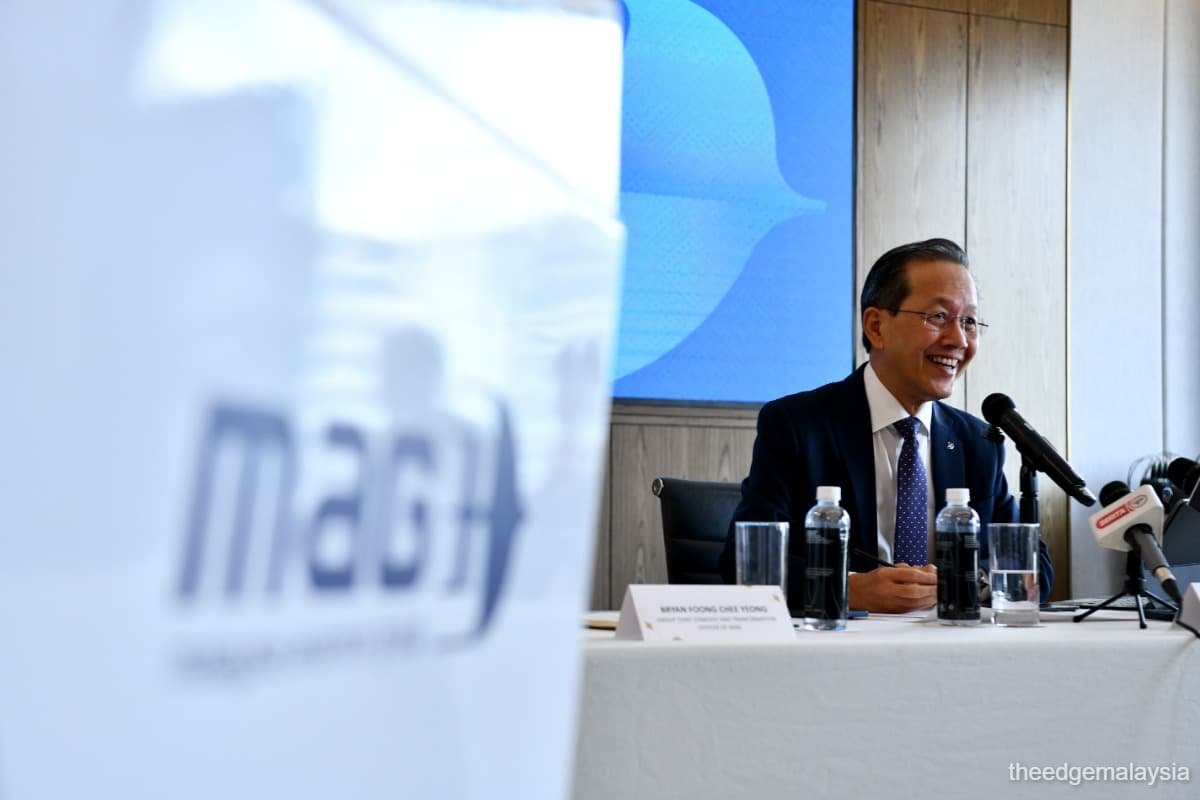
KUALA LUMPUR (April 17): Malaysia Aviation Group Bhd (MAG), the parent company of national carrier Malaysia Airlines Bhd, posted a net profit of RM54 million for the financial year ended Dec 31, 2024 (FY2024) despite a drastic 18% capacity cut across its network in the fourth quarter of 2024, helped mainly by a RM426 million reversal of impairments.
The capacity reduction, which erased most of the gains it made in the first three quarters of the year, had affected a total of 6,388 flights and one million customers, said MAG group managing director Datuk Captain Izham Ismail at a media briefing on the group's 2024 annual performance on Thursday.
The FY2024 net profit is the group's second consecutive annual profit, and down 93% from the RM766.19 million it made in FY2023. "This (the FY2024 performance) was achieved despite [not having] any capital injection from [MAG's largest shareholder] Khazanah Nasional Bhd," said Izham.
Without the capacity cut, MAG could have achieved RM585 million in net profit, as its cargo and other non-airline segments helped buffer the dip in passenger revenue, said Izham.
Annual revenue dropped to RM13.68 billion from RM13.85 billion in FY2023, due to the capacity cut.
The group, which also owns Firefly and Amal, saw passenger numbers across the group rose 14.5% to 16.6 million, with the average load factor improving three percentage points to 80%, although its passenger yield declined to 30.1 sen from 33.3 sen.
Malaysia Airlines posted an operating profit of RM139 million in FY2024, plunging 87% from RM1.09 billion in FY2023, primarily due to lower yields and the impact of the capacity cut.
Firefly, meanwhile, saw its losses widen year-on-year (y-o-y), following the commencement of jet operations at Subang Airport. Although the load factor improved by 10 percentage points, its yield fell 19% due to the new jet services.
Amal, which provides pilgrimage service for haj and umrah, recorded a 36% y-o-y improvement in financial performances.
As for the cargo business, MASkargo recorded a stronger performance driven by higher load factor, while AeroDarat Services’ operating profit tripled, amid increased flight handling volume for both MAG and third-party airlines.
Looking ahead, Izham said that the group is focused on fleet modernisation, with plans to operate a fleet of 55 Boeing 737-8 and 737-10 aircraft by 2030, while progressively integrating the Airbus A330neos into its long-haul operations.
Forward bookings are up by approximately 9% y-o-y, with the network expansion expected to include key regional and long-haul destinations such as Asean, Australia, New Zealand, South Asia, and the return of flights to Paris in March this year.
“That being said, we remain cautious. Rising tariffs, inflationary pressures, and global supply chain volatility will continue to shape our cost landscape,” Izham said.
“As we move ahead, it is crucial that we stay prudent, balancing the need to manage costs with the necessity of investing in key areas to maintain our momentum and long-term growth,” he added.