

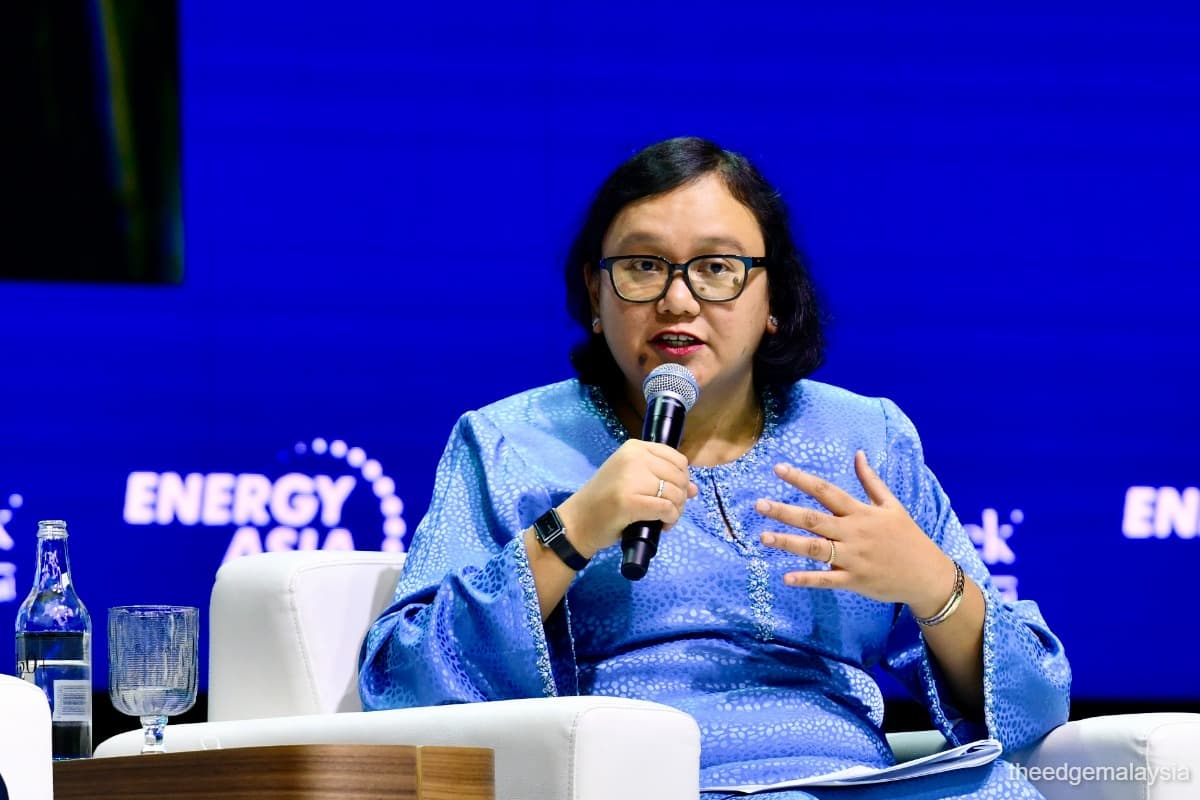
KUALA LUMPUR (June 17): Petroliam Nasional Bhd (Petronas) will allocate 20% of its total capital expenditure (capex) over the next five years to low-carbon and decarbonisation projects as it works towards achieving net zero carbon emissions by 2050, according to Petronas senior vice-president of corporate strategy Marina Md Taib.
Investment decisions will be guided by three key pillars — a clear energy transition strategy, disciplined capital allocation, and a more robust investment framework that incorporates carbon-related metrics alongside financial returns.
“Whatever we do, with regard to the trade that we are operating in, we try to take the long-term view and try to stay the course. We need to make sure that our portfolio is robust and resilient,” Marina said during a panel discussion at the Energy Asia 2025 conference.
The national oil company will also continue to pursue the dual challenge of producing more energy for growing Asian demand with less emissions, while expanding into new growth areas such as specialty chemicals, hydrogen, renewables and carbon capture and storage (CCS).
“The dual challenge of continuing to invest in core business, with low emissions and also investing in new businesses helps us in terms of our resilient cash flow and portfolio coming ahead,” she said.
Petronas has also been actively reviewing and refining its portfolio, having exited ventures like its refineries in South Africa and upstream assets in South Sudan to focus on assets with stronger strategic fit and value potential, Marina said.
“We have made our investment framework a bit more robust by taking into consideration investments in core assets, new businesses and also different locations,” she said. “So we have specific hurdle rates that we try to meet in terms of different assets, low carbon assets, and varied risk profiles that we carry out,” she said.
These hurdle rates are not static but reviewed regularly to reflect changing market dynamics and risk appetites, including non-financial performance measures, she said.
The framework now integrates non-financial performance measures as well — a significant evolution for an oil and gas major traditionally focused on financial returns.
“If you are just looking at pure returns, you might just invest in core, but we need to make sure that we prepare ourselves for new businesses for the future,” she added.