

This article first appeared in City & Country, The Edge Malaysia Weekly on July 29, 2024 - August 4, 2024

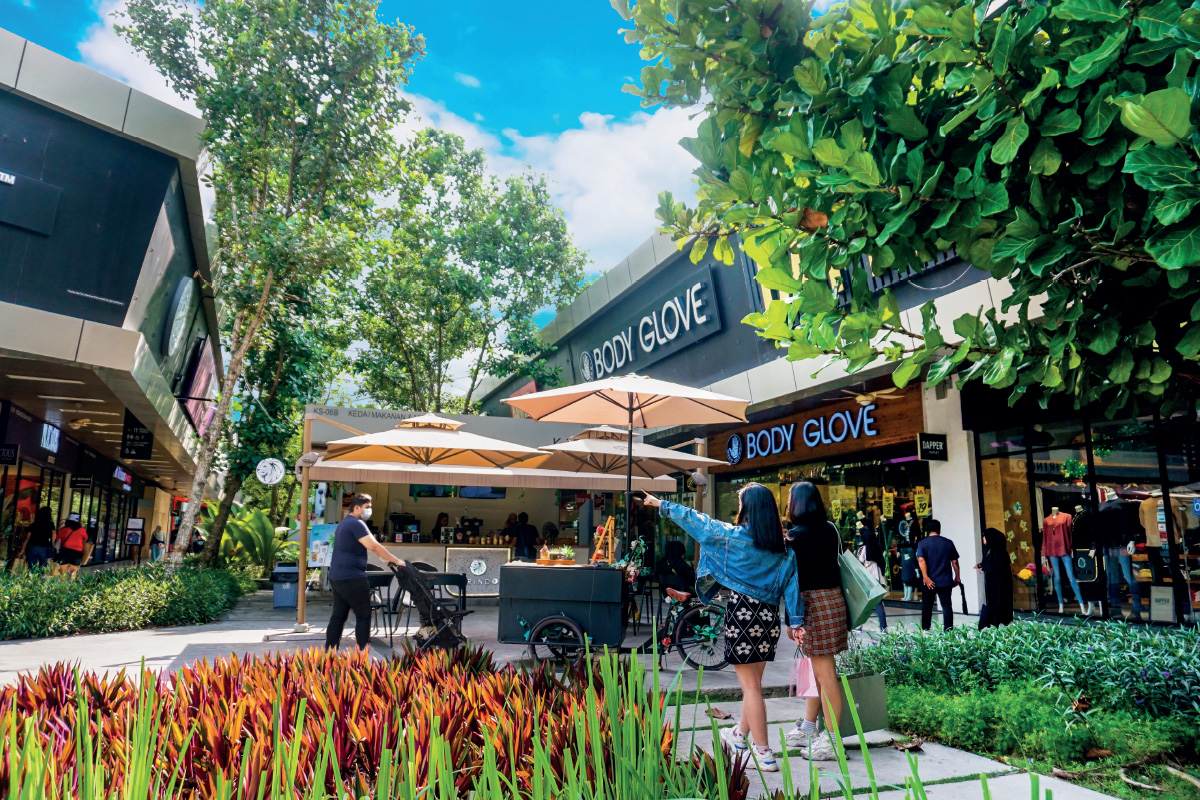
The first of its kind in the northern region, Design Village Outlet Mall (Design Village) in Penang is also the largest outlet mall in Malaysia. Similar to Genting Highlands Premium Outlets and Johor Premium Outlets, it has an open-air concept, plenty of natural light and ventilation, and is set amid lush greenery.
The mall is located in Bandar Cassia in Batu Kawan and spans 25 acres. It opened its doors on Nov 23, 2016, and has grown steadily since.
Developed and managed by PE Land (Penang) Sdn Bhd, Design Village comprises 183 shop lots that offer a diverse array of merchandise by local and international brands, including fashion, beauty, sports, home living and F&B. As at March this year, the mall had an occupancy rate of 83% and is targeting to reach 93% by March 2025.
“At PE Land, we believe in creating a retail environment that not only delights our shoppers but also contributes positively to the community and environment. Our commitment to sustainability is at the core of everything we do.
“We were very conscious at the time of ensuring it was more lifestyle-driven and sustainable instead of just a typical shopping mall model that is more value-driven,” says PE Holdings Sdn Bhd CEO and PE Land (Penang) executive director Joanna Ling.

Concurring with Ling, PE Land (Penang) chief operating officer Andy Song says the design and planning stages of the mall were crucial for its long-term upkeep. “I think it was our decision from the very beginning to create a more experiential retail offering. Not many shopping malls in Malaysia have built something like ours, especially on a 25-acre land. Our founders and owners had a very long view of our assets.
“The open-air concept of Design Village allows us to provide a unique shopping experience that embraces the natural landscape of Batu Kawan. It’s a win-win for our tenants and shoppers, offering a refreshing ambience while reducing our carbon footprint.”
Song adds that shoppers will also benefit from the quality products offered at low prices. “This helps reduce redundant stock that might otherwise end up as waste in landfills, aligning with our sustainability goals. By providing affordable options for consumers, we contribute to a more sustainable retail ecosystem that minimises waste and promotes responsible consumption.”


The RM160 million mall is part of Penang Development Corp’s master plan for the Northern Corridor Economic Region. The master plan aims to develop a retail catalyst to transform the quiet agricultural backwater in Penang into a new, rapidly growing township.
For ensuring the development will be self-sustainable in the long run, Design Village Outlet Mall is the Bronze winner in the Below 10 Years — Non-strata Retail category in The Edge Malaysia Best Managed & Sustainable Property Awards 2024.
Healthy rebound from pandemic
“So we decided to pick up an MBE franchise and run it on our property. We created additional income for us, as well as supporting our ecosystem in terms of e-commerce. [In 2021], we made about RM1 million in sales from e-commerce alone,” he explains.
The Covid-19 pandemic caused many businesses to struggle, and Design Village was no exception. “The pandemic hit us by surprise but we immediately sprang into action. Bandar Cassia in Batu Kawan is an island accessible via two bridges. So when the [movement control order was implemented], we had no access to the outside world. The barrier was at the bridge, so you can’t come in and out without prior approval.

“We had limited F&B outlets here, so we were categorised as non-essential operators. Then it came down to shutting down the mall completely or opting for a more innovative solution. We decided to choose a defensive model in order to protect our interests in Batu Kawan, by not charging rent on any of our tenants during that particular period.”
To adapt to the situation, Song says the team created APRIL, an e-commerce platform aimed at marketing the products sold at the mall. “We devised, planned and launched it in less than six months. Our marketing team assisted the tenants in promoting their products. These efforts not only maintained tenant engagement but also significantly increased our branding and visibility in the market.”
As a result, once movement restrictions were eased, Song says there was a surge in shopper traffic that helped them recover faster. The team also managed to retain 99% of their tenants, minimising the loss of retail staff.
To further improve its income stream, the team ventured into logistics services by setting up its very own Mail Boxes Etc (MBE) outlet called MBE Design Village. “We realised that shipment had become a problem, [as we had issues shipping the products out] due to MCOs. We’d always have to drive to the nearest courier company but with movement restrictions, that was difficult.
“So we decided to pick up an MBE franchise and run it on our property. We created additional income for us, as well as supporting our ecosystem in terms of e-commerce. [In 2021], we made about RM1 million in sales from e-commerce alone,” he explains
Challenges of open-air mall
According to Song, the main challenge in maintaining an open-air concept mall is the weather. Unlike indoor malls, Song says Design Village had to prioritise weatherproofing and regular maintenance of the ETFE (ethylene tetrafluoroethylene) canopies that protect shoppers from the sun and rain.
“We anticipated weather issues when we were designing the mall, so naturally we were prepared. We made calculations of the sun’s position and studied the area’s wind path. Even if there’s a storm, we won’t be worried because we have built enough drainage to ensure there is no stagnant water anywhere within and around the mall,” Song says.
“Additionally, as a greenfield project in a greenfield area, we face the challenge of land settlement due to the peat soil in the region. With many developments causing the new land to sink, we need to continually monitor and plan to rectify these settlements to ensure the stability and safety of our infrastructure.”
Another significant problem is the occasional intrusion by reptiles such as monitor lizards and snakes into the mall’s green spaces. “This site used to be an oil palm plantation, so naturally we did get quite a few reptile infestation cases in the last three to four years. To address this, we invested in training our security personnel with Jabatan Pertahanan Awam to handle these reptiles safely and effectively.”
Song adds that the training includes learning about the reptiles’ breeding and feeding habits to minimise their intrusion and effectively catch them when detected during their inspection of the landscape, which is done daily before the mall opens.
Besides reptiles, Song says Batu Kawan also has a large crow population. “This poses a challenge to us because crows are scavengers and they might become health hazards. To manage this, we ensure our trees are not used by crows for nesting. Our gardeners regularly inspect the trees for them. We also work closely with the local council to keep their population in check, ensuring that our waste management practices do not attract these birds, and maintain the safety and cleanliness of our mall environment.”

Regular inspection key to longevity
Ling says Design Village’s commitment to sustainability extends to regular maintenance, including weekly cleaning of sewage and drainage systems to prevent blockages and maintaining optimal performance to avoid contamination of the environment.
“These initiatives form part of our broader strategy to ensure long-term financial sustainability and resilience, enabling us to invest in future growth and improvements while maintaining our commitment to environmental stewardship,” she adds.
To ensure the mall is consistently well-maintained and upgraded, the team implemented comprehensive standard operating procedures (SOPs) for all departments of the mall’s management. The SOPs are divided into four categories, namely tenant relations, facility maintenance, security protocols and emergency response.
Ling adds, “Our commitment to SOPs extends beyond mere documentation. We conduct regular training sessions and workshops to familiarise staff with SOPs, reinforce best practices, and promote a culture of accountability and continuous improvement. Feedback mechanisms are in place to solicit input from staff and tenants, enabling us to refine our SOPs based on real-world experiences and evolving needs.”
Taking it a step further, Song says the mall also has many green features to reduce energy consumption. They include a large-scale solar power system, LED lighting, variable refrigerant volume (VRV) air conditioning units as well as 790 trees.
“To ensure the longevity and effectiveness of these features, we have established comprehensive maintenance schedules, and continuously monitor and optimise our systems. For instance, our solar panels have a lifecycle of 25 years and are subject to annual performance reviews and cleaning. The LED lighting system, with a lifespan of approximately 50,000 hours, undergoes periodic inspections and replacements as needed. Similarly, our VRV air-conditioning units, which have a lifespan of around 15 years, are maintained regularly to ensure optimal performance and energy efficiency.”
As part of its long-term plan to maintain these green features, Ling says, “Sustainability is not just a buzzword for us; it’s a commitment. Our long-term plan includes staying abreast of the latest sustainability technologies and practices to keep improving our environmental impact.”
Besides its commitment to sustainability, Ling says it was crucial for them to incorporate energy-saving features as an outlet business model typically has a slimmer profit margin than traditional retail malls.
“We developed it this way so that we’d be able to keep our costs down. This consideration influenced our decision to adopt an outdoor mall concept that ensures the rent remains competitive [while] helping our tenants keep their operating costs low at the same time.”
According to Song, Design Village’s solar power project with 3,584 units of solar photovoltaic panels, installed in May 2023, has already yielded significant savings by generating 2,868MWh of green energy annually. This initiative, he adds, has helped avoid 39,037 tons of CO2 emissions over 10 years, equivalent to the petrol used to drive 151 million kilometres. The estimated total solar power generated will save RM5 million over 15 years and RM17.8 million over 25 years, he explains.
Additionally, the mall’s use of LED lighting and automated systems further reduces utility expenses.

Striving to execute more upgrades
Song says the management team plans to maximise the capacity allowed for solar power installation to further reduce its energy costs and enhance its sustainability efforts. Additionally, it also plans to implement advanced water wastage and leakage detection systems with annual rectification processes to ensure efficient water usage.
“We also plan to enhance our digital infrastructure to improve the shopping experience and streamline operations. This includes implementing smart building technologies and expanding our e-commerce capabilities. We also aim to enhance our waste management and recycling programmes to further our sustainability goals. Moreover, we will continue to host community-centric events and initiatives to strengthen our engagement with the local community.”
Song also says his team is pursuing a Green Building Index Bronze certification starting this year. “Over the next 10 to 12 years, we plan to continuously improve our practices and infrastructure to eventually achieve Platinum certification. This phased approach ensures that we systematically enhance our sustainability standards and remain at the forefront of sustainable retail development.”
Ling says her team has set an eight-year target to be 10 times ahead of where it was on day one, describing it as an ambitious yet not impossible goal.
“By doing so, we’d be able to redeploy our gains into redeveloping our mall because 25 acres is a lot of land and there are a lot of things we can do there.”
Save by subscribing to us for your print and/or digital copy.
P/S: The Edge is also available on Apple's App Store and Android's Google Play.