

This article first appeared in City & Country, The Edge Malaysia Weekly on July 29, 2024 - August 4, 2024

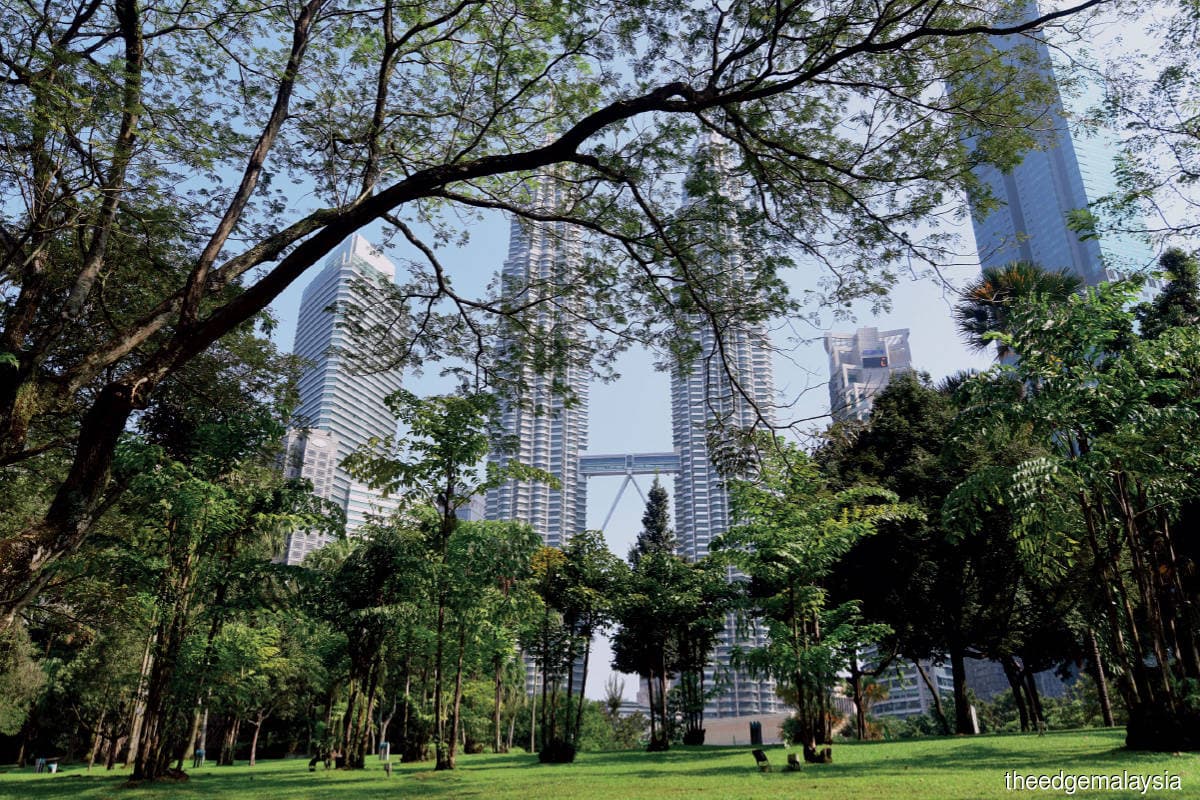
Occupying half of the 100-acre Kuala Lumpur City Centre (KLCC) development, KLCC Park is not only an integral green lung that integrates seamlessly with the office towers — including the world-renowned Petronas Twin Towers, retail complexes, hotels, residential as well as entertainment and recreation components within the precinct — but also serves as a respite from the hustle and bustle of the city for city folks, office-goers and visitors.
Its 1.3km rubberised jogging track is frequented by joggers and fitness enthusiasts, and its two-acre children’s playground and pool is a popular spot with families on weekends. In addition to the various water features scattered around the park, one of its main draws is the 10,000 sq m man-made Lake Symphony and water fountain, which lights up the night sky with its light and musical displays daily. The urban park also regularly serves as a venue for festivals, concerts and cultural performances.
“This is a place for people. It’s a people’s park,” says KLCC (Holdings) Sdn Bhd group CEO Datuk Md Shah Mahmood. “Hence, it’s important for us to preserve the park as a green lung and ensure that it provides all the immediate benefits to the people and the environment.”
KLCC Park is managed by KLCC Urusharta Sdn Bhd, a wholly owned subsidiary of KLCC Property Holdings Bhd (KLCCP), whose immediate holding company is KLCC (Holdings) — the master developer of the KLCC development. KLCCP, along with KLCC Real Estate Investment Trust (KLCC REIT), forms Petroliam Nasional Bhd (Petronas)-controlled KLCCP Stapled Group (KL:KLCC), the largest REIT and only stapled security in the country.
While the maintenance of a public space is always a challenge, KLCC Park continues to be a beloved city park thanks to the commitment and team effort of the management team as well as the diverse leadership made up of the 23 common estate lot owners whose lots share a boundary with the park, says Md Shah.
“It’s a collaborative effort to ensure that we deliver what we’re supposed to deliver, and this is monitored every quarter. I also believe in everybody having the same goal and focusing on the customer experience, so whenever we get a complaint, we take immediate action. It’s always a continuous improvement process,” he adds.

This year, KLCC Park is the recipient of three awards under The Edge Malaysia Best Managed & Sustainable Property Awards 2024 — a Gold award under the 10 Years and Above — Specialised category, the Editor’s Choice award for Exemplary Community Magnet, as well as The Edge Malaysia-ILAM Sustainable Landscape Awards 2024.
The park had previously won Gold and the Editor’s Choice award in 2018.
Merging nature’s creations with man-made designs
Opened in 1998, KLCC Park was designed by world-famous Brazilian landscape architect, the late Roberto Burle Marx, with the aim to “leave the world a little more sensitive and a little more educated to the importance of nature”.


Just as it integrates with the modern skyscrapers and buildings surrounding it, the park’s landscape also merges nature’s creations with man-made designs through a combination of trees, shrubs, stones, wood and sculptures.
In addition, the green lung helps mitigate the urban heat island effect in the city centre, serving as a pleasant pathway for pedestrians commuting across the KLCC precinct as well as mitigating stormwater runoff.
The park’s botanical collection includes some 1,700 trees and 60,000 shrubs, selected to attract local and migratory birds. It’s interesting to note that some of the park’s mature trees were transplanted from the old Selangor Turf Club.
Apart from the historical trees, 40% of the park is covered with indigenous trees and shrubs, which often require less water, fertiliser, pesticide and maintenance, and serve as food for native butterflies, insects, birds and other animals.
The park also incorporates sustainable designs like the use of clay pavers for pathways and recycled Cengal wood for the hardscapes such as benches, wakafs or gazebos, a police beat base, changing rooms, rain shelters and drinking fountains.

For the maintenance of the trees and shrubs in the park, the team uses organic fertilisers as well as organic mulching to improve soil structure and fertility.
In 2019, the management team appointed a certified arborist to carry out assessments on around 1,700 trees in the park to ensure they were healthy.
“This included carrying out a tree inventory, a detailed risk assessment and an evaluation of the overall health and condition of the trees in the park. So from there, we have identified which tree needs to be replaced and whether major pruning, soil rejuvenation, vertical mulching and fertiliser programmes need to be done. These works have been done in three phases since 2019 with a significant investment of over RM1 million,” says Md Shah.

“And this year we are appointing a second certified arborist to do a follow up on the plant health assessment and we’ll do another one in one to two years,” he adds. “We also have two in-house arborists that have been here since the design/installation stage of the park, so they know the trees very well.”
To ensure the park is well maintained in the future, Md Shah says knowledge transfer is important. “We need to make sure that everything is being cascaded down, so we’re documenting all our policies, guidelines and SOPs (standard operating procedures) and systematising them. I think it’s important to document these things not just for now but for the future. It’s part of our system of improvement.”
As it takes over RM2 million a year to maintain the park, the team leverages cost-effective maintenance methods such as robotic pool cleaning and having an Internet of Things (IoT)-enabled pump room.
“Robotic pool cleaners are energy efficient. And with an IoT pump room, for example, people don’t need to check or start the underground pumps manually, as everything is now automated,” he says.
Some other cost-effective measures include a water irrigation system, artificial turf, soil sensors, a digital timer for the lighting system and energy-saving park lighting.

Safe sanctuary for all
Ensuring the park is safe is a key priority for the management team, says Md Shah. “It’s always a challenge dealing with a public space. For example, we’ll have to assess and control the types of activities that people want to organise so we don’t open the floodgates to things that can affect the safety and security within the park. We have to make sure that whatever activity that is going to be done at the park fits the criteria we have set.”
In addition, the park’s safety and security features have been upgraded. “In fact, our security cameras have an audio alarm so our security can give commands from the ISOC. (Integrated Security Operation Centre) So, for example, if people are at the park after closing hours, the security will warn them via the audio cameras,” he explains.
The park, which receives 5,000 to 15,000 visitors daily and up to 30,000 to 50,000 during events, is equipped with an integrated security surveillance system with 239 CCTVs, 26 emergency help points and 86 concrete planter boxes that serve as a CPTED (crime prevention through environmental design) and auxiliary police.
“The auxiliary police at the park help to ensure that the park is secure 24/7. It is important for us that people are safe and there are no incidents or accidents,” says Md Shah.
The team also works hard to ensure that the park is clean and safe to use every day. “We make sure the children’s pool is cleaned every day and the exercise equipment is up to date and safe; for example, we regularly replace the EPDM (ethylene propylene diene monomer) jogging track, even though it costs millions. Even the toilets, we ensure they are well maintained and cleaned so we don’t get complaints,” he says. “And when there are events, such as big celebrations or concerts that run until midnight, we make sure the park is all clean by morning. I’m proud of how efficiently we’ve been doing this over the years.”

In addition to big events and celebrations, KLCC Park also serves as a venue for cultural and community events including food fairs, fitness classes, traditional music and dance performances, batik painting workshops, art installations and arty inflatable displays, to name a few.
“We always make sure there are activities happening at the park, which we organise together with our precinct partners. For example, we have the Picnic in the Park with Suria KLCC on weekends. We also have Sustainable September where we run ESG activities throughout the month of September, which is getting more popular, and we’ve done things like blood donation drives and bake for charity,” he says.
Meanwhile, an ongoing initiative to increase public participation at the park is QR tree tagging. “We are tagging every single tree [in the park] and also looking at incorporating braille for people to learn more about the trees,” Md Shah says.
“I want to bring in more educational tourism initiatives because I believe we have one of the best parks. We’re looking at inviting schoolchildren to participate because the park is a safe place for them to learn about the trees, how to take care of plants and these sorts of things. And it’s also a safe place for them to run,” he adds. “We’re also thinking of offering guided tours in the future, maybe as part of the hotel packages offered by the hotels around the park.”
Some of the park’s community-oriented and inclusive design includes multipurpose spaces, movable furniture and modular structures that allow flexibility and adaptability to accommodate a variety of activities throughout the year, as well as barrier-free pathways, wheelchair-accessible facilities and inclusive children’s play areas for people of all ages, abilities and backgrounds.
As much as it is an important habitat for flora and fauna, KLCC Park is a vibrant, inclusive and sustainable sanctuary for the community in the heart of the city centre.
Save by subscribing to us for your print and/or digital copy.
P/S: The Edge is also available on Apple's App Store and Android's Google Play.