

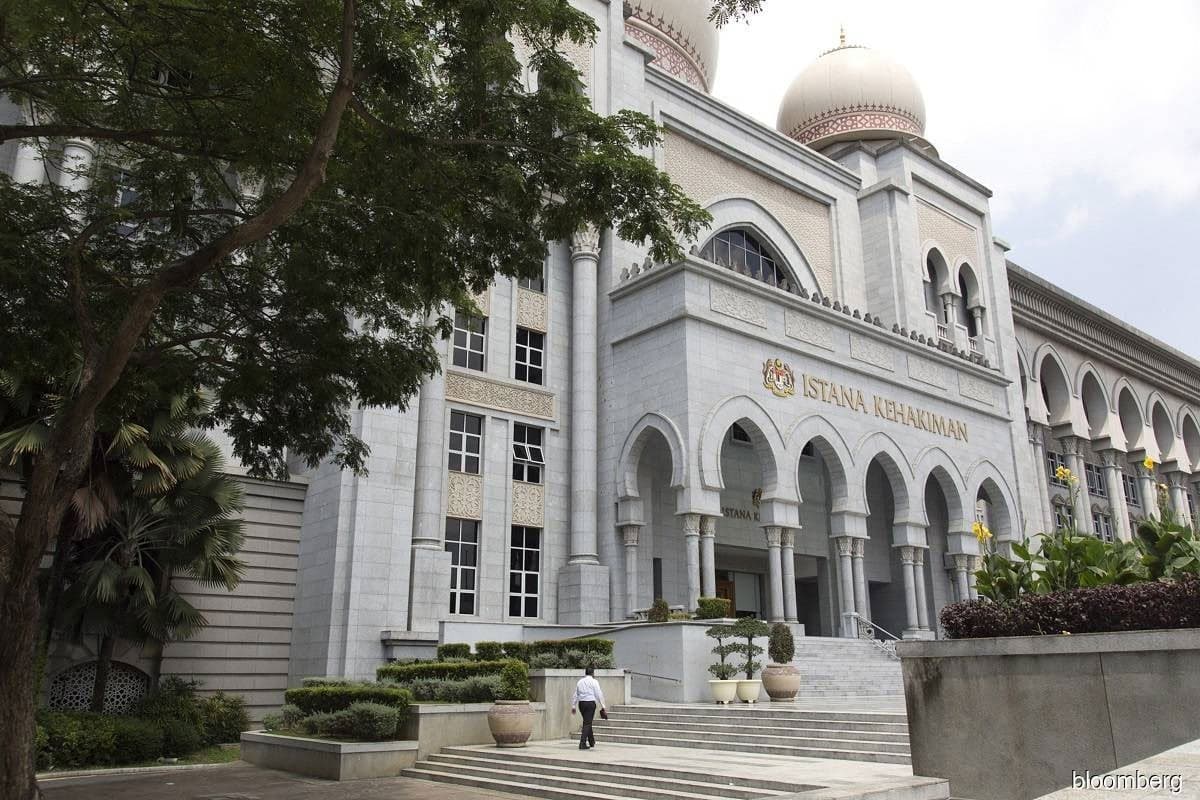
KUALA LUMPUR (May 3): In a majority decision, the Federal Court has dismissed a woman's final challenge to change her religious status as a Muslim.
President of Court of Appeal Tan Sri Abang Iskandar Abang Hashim, who led the three-member panel, formed the majority decision along with apex court judge Datuk Abu Bakar Jais.
Federal Court judge Datuk Mary Lim Thiam Suan dissented.
The woman, who turns 38 this year, is contesting the appellate court's majority decision which reinstated her religious status as a Muslim in January last year.
In gist, the woman, whose identity has been withheld at the request of her counsels, maintains that her unilateral conversion as a minor and the validity of the conversion certification was illegal as it contradicted the enforced state enactment at that time. Thus, she argues that she was never a Muslim in the first place and the civil courts have jurisdiction to decide on her case.
The woman, born to a non-Muslim couple in 1986, was converted to Islam at around the age of four-and-a-half by her mother when the mother embraced Islam in May 1991. A conversion card was issued to the child two years later in 1993.
During her conversion, the administration of Muslim Law Enactment 1952 was still in force, in which Section 147 explicitly states that “no person who has not attained the age of puberty shall be converted to the Muslim religion”.
The respondents — the Selangor state government and the Selangor Islamic Religious Council (Mais) — contended that the validity of a conversion should not be the sole determining factor of the woman's religious status, but rather, the factual matrix of her case has to be considered as a whole.
This would include, among others, the woman's previous proceedings in the shariah courts and her upbringing by her Muslim-convert mother.
Majority: Validity of conversion not sole determinant
Reading out the majority decision, Abang Iskandar said that invalidity of a conversion certification did not mean that the woman was never a Muslim in the first place.
"We are convinced by the approach taken by the respondents that an invalid conversion [of the woman] at the age of five does not necessarily mean that she factually never was a Muslim," he said.
The apex court judge said that the woman had been placed under the care and custody of her Muslim-convert mother (when the parents separated and then divorced) and the woman's upbringing also needed to be evaluated.
He added that the prior proceedings in the shariah court in this case was also an important factor to be looked into. He highlighted that there were contradictions in the woman and her mother's averments in shariah and civil proceedings.
"We find that, despite the impugned conversion, [the woman] was factually a Muslim since her childhood when she was legally in the care of her mother. She was raised and brought up on the basis that she was a Muslim [in line with the state enactment's definition of a Muslim]," he added.
"For as long as someone professes the religion of Islam, one is legally identified as a Muslim irrespective of one's degree of faith and practice of the Islamic teachings," he said.
Abang Iskandar noted that this case did not concern constitutional interpretation, but rather was an interpretation of the apex court's landmark decision in Rosliza Ibrahim. In the 2021 landmark decision, the court drew a distinction between renunciation and ab initio (never a Muslim to begin with).
In that decision, a nine-member panel chaired by Chief Justice Tengku Maimun Tuan Mat unanimously held that Rosliza was not a Muslim and that the shariah court was the avenue for renunciation cases whereas the civil courts were the avenue for ab initio cases.
It has to be noted that Rosliza had taken her case straight to the civil court and there were no shariah court proceedings in her case.
Abang Iskandar said that having considered the facts of the case before him, the woman's case cannot be considered as one who was never a Muslim in the first place.
From the onset, Abang Iskandar said that in deciding this case, he was mindful that it was a "very delicate" issue affecting one's religious faith and identity.
"It's not an easy task and something that must not be taken lightly," he said.
Dissenting: Woman has ‘unequivocally and resoundingly’ got the right to have her case determined by civil courts
The woman had filed a summons in the Shariah High Court against the Federal Territory Islamic Religious Council in 2013, seeking a declaration that she was no longer Muslim, but this was dismissed in July 2017.
Subsequently, she appealed the decision in the Shariah Court of Appeal in August 2017, but this was dismissed in January 2021.
Then, following the Rozliza decision, she took the matter to the civil courts, filing an originating summons in May 2021. In December that year, the High Court granted her declaration, ruling that she was not a person professing the religion of Islam on the grounds that she was never a Muslim to begin with.
In reading her dissenting judgement, Lim said that the woman was "unequivocally and resoundingly" entitled to bring her case to the civil courts.
"Access to justice and equal protection of the law are fundamental liberties guaranteed under the Federal Constitution to persons such as the appellant," Lim said.
In arriving at a decision in this matter, she said that the civil courts have a duty to examine the facts and relevant laws which include enactments passed by the state legislature or the administration of Islamic law.
Lim added that in her view, this case falls within the ambit of someone who was never a Muslim to begin with.
"She was never a Muslim because of the invalid and illegal conversion," said the apex court judge.
She elaborated that the woman had explained that she took the matter to the shariah courts because that was the only option available by law to her at that point in time. She said that this course of action should not be held against the woman, given the prevalent case laws at that point in time.
"To hold the reasons against her would amount to deprivation of her only recourse and access for justice.
"Up until the decisions in Indira Gandhi, Rosliza and several other cases, the law in the jurisdiction of the court in respect of apostasy and the issue of constitutional identity was unclear," she said.
The panel made no order as to cost. There are three separately written judgments.
Abang Iskandar said that although he and Abu Bakar shared a similar broad view of the case, they had their individual reasoning. The judgements will be released at a later time.
Read also:
Validity of conversion cert should not be sole determining factor in woman's religious status, court told
Court of Appeal allows MAIS' appeal to reinstate woman as Muslim in majority decision
Apex court grants leave to woman challenging religious status
Woman's challenge against COA decision to reinstate her as Muslim to be heard at the Fed Court on May 22