

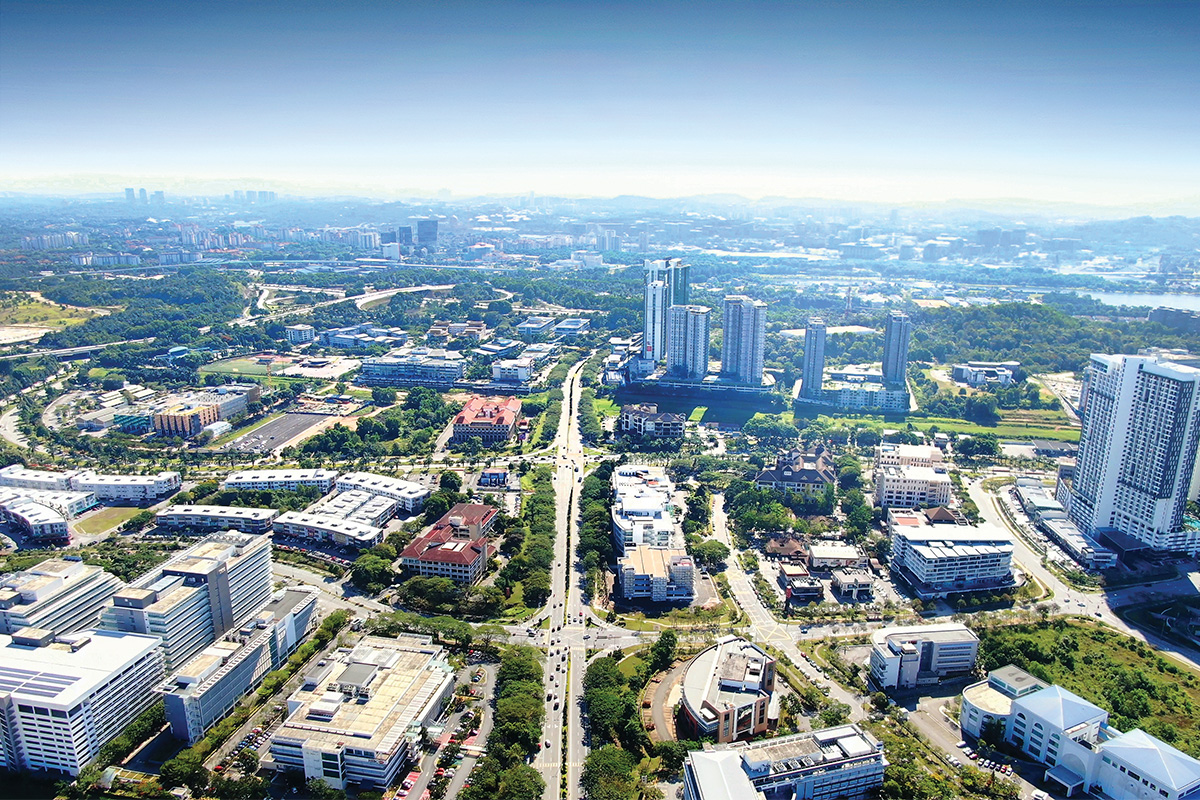
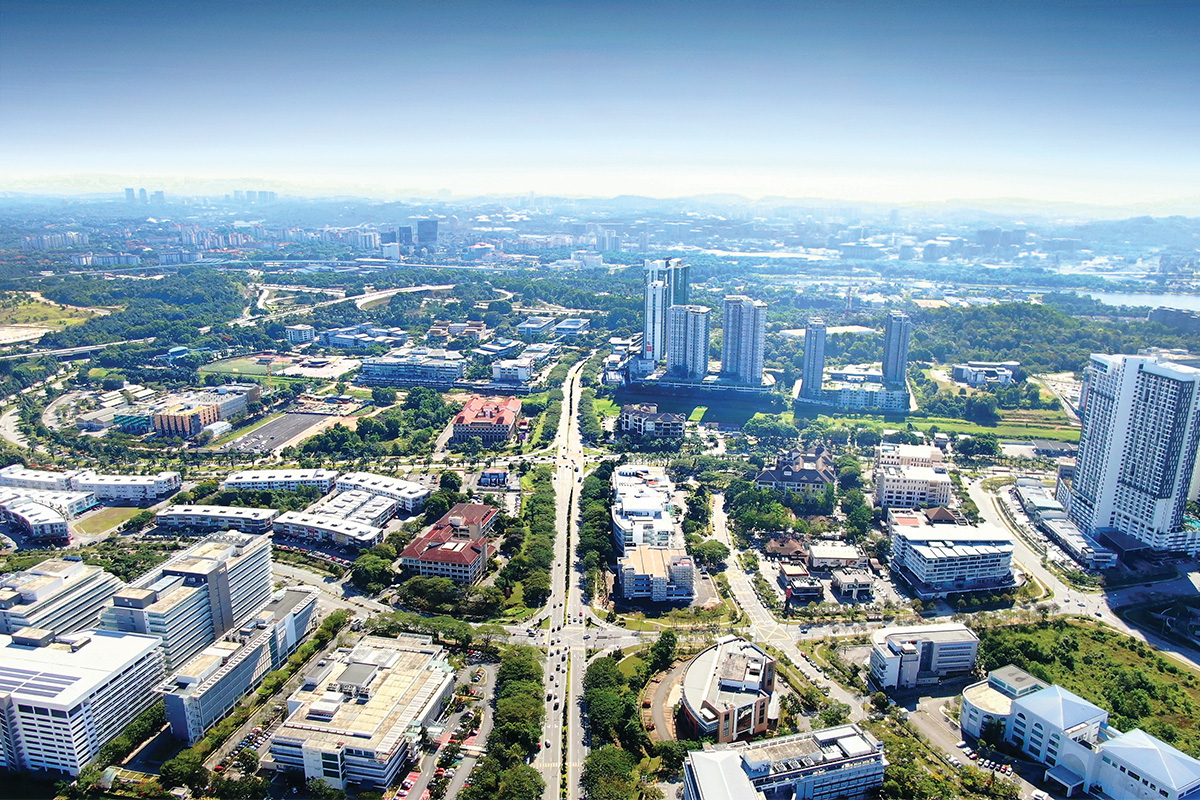
On 17 May 1997, on a hill in Sepang surrounded by oil palm, the then Prime Minister of Malaysia used a smart card to send a command to a machine, which then drilled into the ground.1 Cyberjaya was launched as the nucleus of the Multimedia Super Corridor (MSC), at a time when fewer than three in every 100 Malaysians were online. Seven weeks later, the Asian financial crisis hit, and within two years, Businessweek had called the MSC a folly. Cyberjaya was built anyway.
The MSC brought innovation to Malaysia, and Cyberjaya provided the ground for it. Fibre and redundant power were in place before the first tech companies arrived. They came and kept coming. Today, Cyberjaya is one of Malaysia’s largest tech hubs, hosting the companies, agencies and institutions that drive the nation’s digital economy. The challenges of the early years helped shape Cyberjaya’s resilience and long-term character.
Selangor understands this well. When Sultan Sharafuddin Idris Shah Alhaj ascended the throne in 2001, Cyberjaya was four years old and still had more roundabouts than rooftops. Over the past 25 years, the state and the city have grown together. As Selangor advances its digital ambitions, Cyberjaya is where much of that vision is already at work.
The numbers support that ambition. The state’s economy grew 6.3% in 2025 to RM460.1 billion, ahead of the national rate of 5.2%, and now makes up 26.5% of Malaysia’s gross domestic product, more than 1.7 times the size of Kuala Lumpur’s.2 Selangor accounts for a third of the nation’s manufacturing and more than a quarter of its services.3 It aims to be the first state to reach a RM500 billion economy, and under the Second Selangor Plan (RS-2), it targets RM600 billion by 2030.4
As the economy grows, technology has become integral to that growth. The digital economy is one of five focus sectors under RS-2, supported by the state’s Digital Future Action Plan.5 In the first half of 2026, Selangor attracted RM70 billion in approved investments, led by artificial intelligence (AI), cloud computing, cybersecurity and data analytics.6 Malaysia Digital Economy Corporation (MDEC) figures show that Selangor and Kuala Lumpur together accounted for 88% of approved Malaysia Digital (MD) investments in the third quarter of 2025.
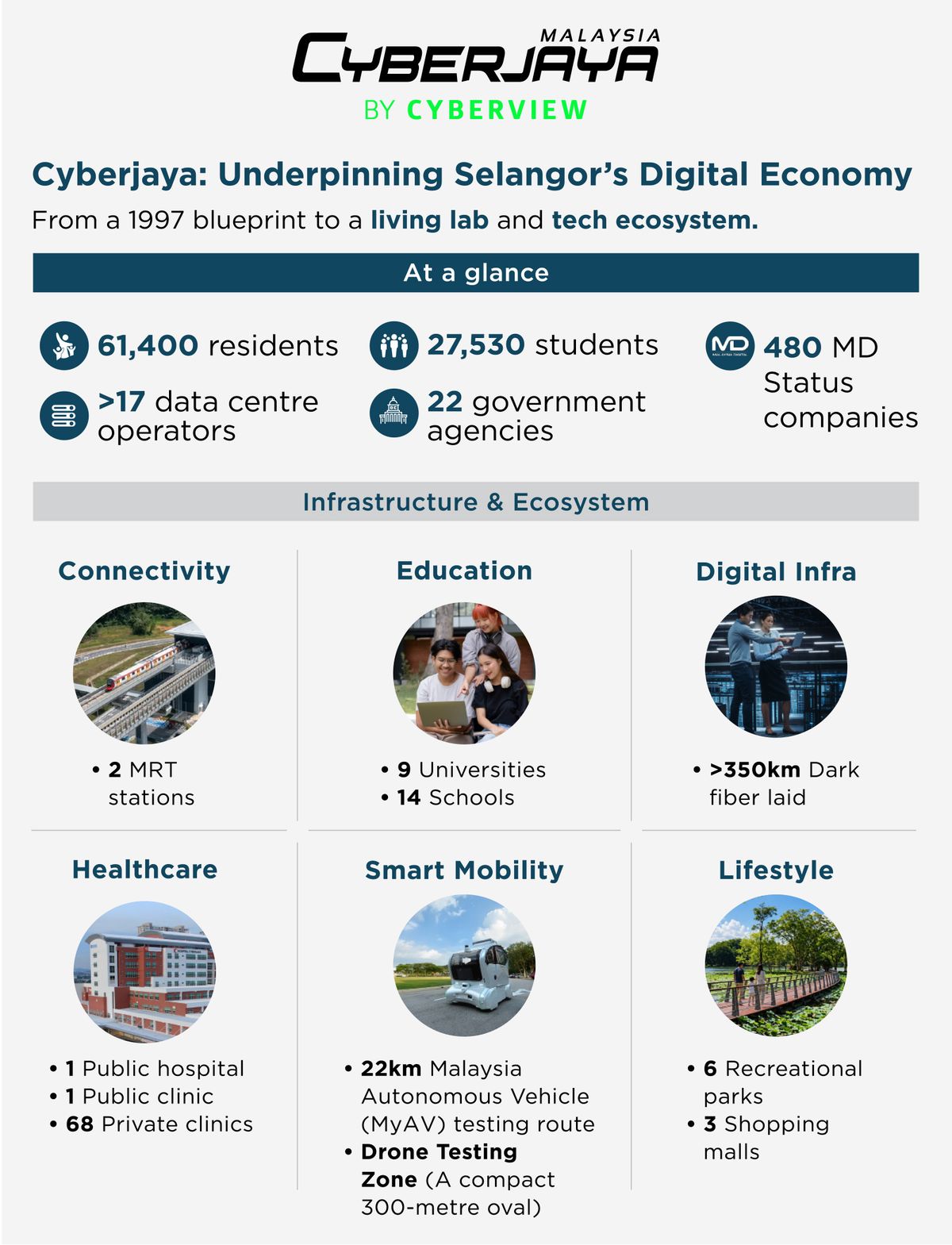
This is where Cyberjaya comes in. If Selangor is the nation’s economic engine, Cyberjaya is where the technology that powers it is put to the test. The city is positioned as a Living Lab, where new technologies are piloted in real conditions before being scaled across the state and country. Cyberview’s subsidiary, Futurise, leads the National Regulatory Sandbox, helping regulators and innovators develop solutions together. The country’s first public-road testing route for autonomous vehicles opened here in 2020 and now spans 22km. In July, Malaysia’s first remote operations centre for autonomous logistics vehicles was launched here with the Selangor Information Technology and Digital Economy Corporation (Sidec), paving the way for Level 4 trials. Behind it all is the digital infrastructure that continues to attract data centres and technology investments.
The foundation laid on that hill in 1997 now carries the weight of Selangor’s ambition. The next 25 years will test it further, and that is what it was built for.
A Steward for Cyberjaya
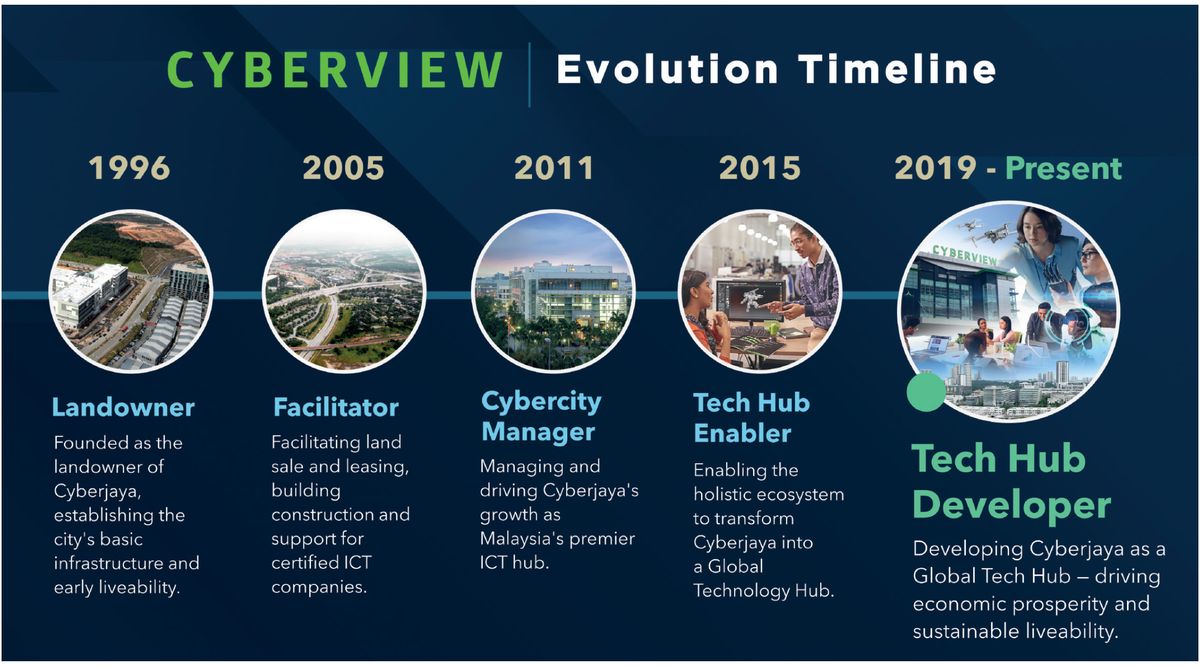
None of this looks after itself. Behind it is Cyberview, the company majority-owned by the Minister of Finance Incorporated and mandated to develop Cyberjaya. Cyberview’s role has evolved from land manager to technology hub developer, mandated to drive Cyberjaya’s development as a global tech hub.

The mandate is broad. Cyberview brings in foreign and domestic investment, creates spaces, ensures the city’s digital infrastructure is in place, and curates the mix of multinationals, home-grown tech firms and start-ups that anchor the ecosystem. It also helps shape Cyberjaya as a place where people build careers and communities.
Proof in Progress
Cyberjaya today has a population of more than 100,000, including residents and students. It is home to 17 schools, colleges and universities, 480 MD Status companies and 22 government agencies, supported by healthcare, lifestyle amenities and extensive electric vehicle charging facilities. Its digital infrastructure continues to attract new investment.
The Living Lab is where the ecosystem proves itself. Since 2013, the Cyberview Living Lab® Accelerator (CLLA) has nurtured 177 start-ups, which have raised more than RM285 million, generated more than RM891 million in cumulative revenue and created more than 1,800 jobs. The programme has become a launch pad for start-ups moving from early validation to commercialisation and scale. Cyberjaya does more than host technology companies; it helps grow them.
The next frontier is semiconductors. Malaysia Semiconductor IC Design Park 2 and the Advanced Semiconductor Academy of Malaysia are now in Cyberjaya. Their roots lie in a national ambition to strengthen Malaysia’s role in integrated circuit design. Selangor operationalises that ambition, and it has become a significant part of the state’s wider digital agenda. With global supply chains being redrawn and the race for deep-tech talent intensifying, this is where much of the value of the next 25 years will be created.
Balancing Innovation with Liveability
A more difficult measure of success is balancing innovation with quality of life. In today’s environment of economic uncertainty and growing competition among regional tech hubs, Cyberview’s focus extends beyond investment attraction to creating a city where people choose to live, work and stay.
Talent retention depends on housing, mobility and community. This has led Cyberview to prioritise urban rejuvenation, public space activation and improved connectivity. The recent rejuvenation of Century Square reflects this approach, combining modernisation with technology that enhances user experience, safety and comfort. The wider objective is to ensure Cyberjaya continues to develop as a complete city, not just a technology destination.
What's Next for Cyberjaya and Cyberview
Cyberjaya’s next phase is about deepening its role in Selangor’s growth. As the state’s digital plans turn to AI, data sovereignty and next-generation services, Cyberjaya offers what few other locations can build quickly; infrastructure that is already in place, nearly three decades of experience, and a community of talent that took years to form.
Cyberview’s priorities include strengthening the semiconductor and deep-tech ecosystem, attracting businesses that leverage Cyberjaya’s data centre and AI infrastructure, scaling start-ups beyond incubation, and continuing urban rejuvenation initiatives.
The semiconductor agenda is especially important to the “Made by Malaysia” aspiration, which seeks to move the country further up the technology value chain through design, testing and intellectual property creation. Investment builds capability, capability develops talent, and talent generates high-value jobs that support long-term economic growth.
Beyond infrastructure and investment, Cyberjaya’s long-term strength will lie in its ability to connect technology, talent and community. As AI, advanced manufacturing and digital services reshape economies, cities that can provide both innovation capacity and quality of life will be best positioned to compete. Cyberjaya enters this next chapter with the advantage of experience, an established ecosystem and a clear development mandate. The focus now is on deepening partnerships across industry, academia and government, ensuring that innovation translates into opportunities for businesses, researchers, entrepreneurs and future generations of Malaysians.
For investors, the value lies in what has been built over time. Infrastructure can be replicated, but talent ecosystems require years to develop. Cyberjaya has spent nearly three decades building one in partnership with academia and industry.
A Fitting Chapter for the Jubilee
There is a wider meaning to Cyberjaya’s progress in this jubilee year. Over the past 25 years, under the reign of Sultan Sharafuddin Idris Shah Alhaj, Selangor has grown its industrial base while embracing new sectors. Cyberjaya has followed the same path, from a flagship concept to an established technology city. Each step has required patience and belief in long-term outcomes, the hallmarks of stable leadership.
1Bill Tarrant (Reuters), “Malaysia launches futuristic multimedia city”, Business Today, June 1997.
2Department of Statistics Malaysia, Selangor Gross Domestic Product (GDP), 2025, 1 July 2026; “Selangor's GDP grows to RM460.1 bil in 2025”, The Edge Malaysia, 2 July 2026.
3“Amirudin: Selangor economy surges to RM460.1b in 2025, contributing 26.5pc of Malaysia’s GDP”, Malay Mail, 2 July 2026.
4RM500 billion goal: Malay Mail, 2 July 2026. RM600 billion target: “Selangor aims for RM600bil revenue by 2030”, The Star, 7 August 2026; “Selangor to review, enhance RS-2 within two years, says Amirudin”, Bernama, 21 August 2026.
5Bernama, 21 August 2026; “RS-2 perkasa ekonomi digital, kreatif”, Berita RTM, 7 August 2026.
6Malaysian Investment Development Authority (MIDA), approved investments for 1H 2026, as reported in “Malaysia secures RM218.5bil in approved investments in 1H26”, The Star, 28 August 2026.