


(Nov 27): Bank Indonesia will stay focused on stability next year as it pursues monetary policy that keeps inflation within its target range, while confronting sustained pressure on the rupiah.
“Bank Indonesia will remain committed to maintaining stability amid high external pressures in order to help sustain economic growth,” governor Destry Damayanti said in a speech at the central bank’s annual meeting in Jakarta on Friday, her first since taking over as governor.
Noting that the bank expects global risks to remain elevated next year, Destry said BI will continue its efforts to stabilise the currency through “smart intervention”, hedging incentives and local currency transactions.
Foreign exchange reserve adequacy will also be maintained to support rupiah stability.
The rupiah is Asia’s worst-performing currency this year, while the benchmark stock index, down 38%, is the world’s worst-performing major market.
The central bank said Indonesia’s economic growth may reach 6% in 2027.
Bank Indonesia faces the challenging job of both supporting the currency and the broader economy, which has been battered by the impact of higher energy prices due to the US war on Iran.
While gross domestic product expanded 5.5% in the third quarter, many in the nation of 280 million people are struggling with the high cost of living, and concerns about policy direction and the deficit have led foreign investors to pull funds.
At the same event, President Prabowo Subianto said Bank Indonesia must safeguard national interests despite its independence, calling for a central bank that serves the nation’s broader priorities.
He also urged banks to direct financing towards domestic economic needs and a wider pool of borrowers, rather than repeatedly benefiting the “same people.” Economic growth, he said, must be felt in factories, rice fields, markets and households, not just reflected in headline figures.
Destry faces multiple challenges as she enters her first full year as governor. Persistent rupiah weakness has forced BI to tighten monetary policy even as it keeps macroprudential settings loose to support growth.
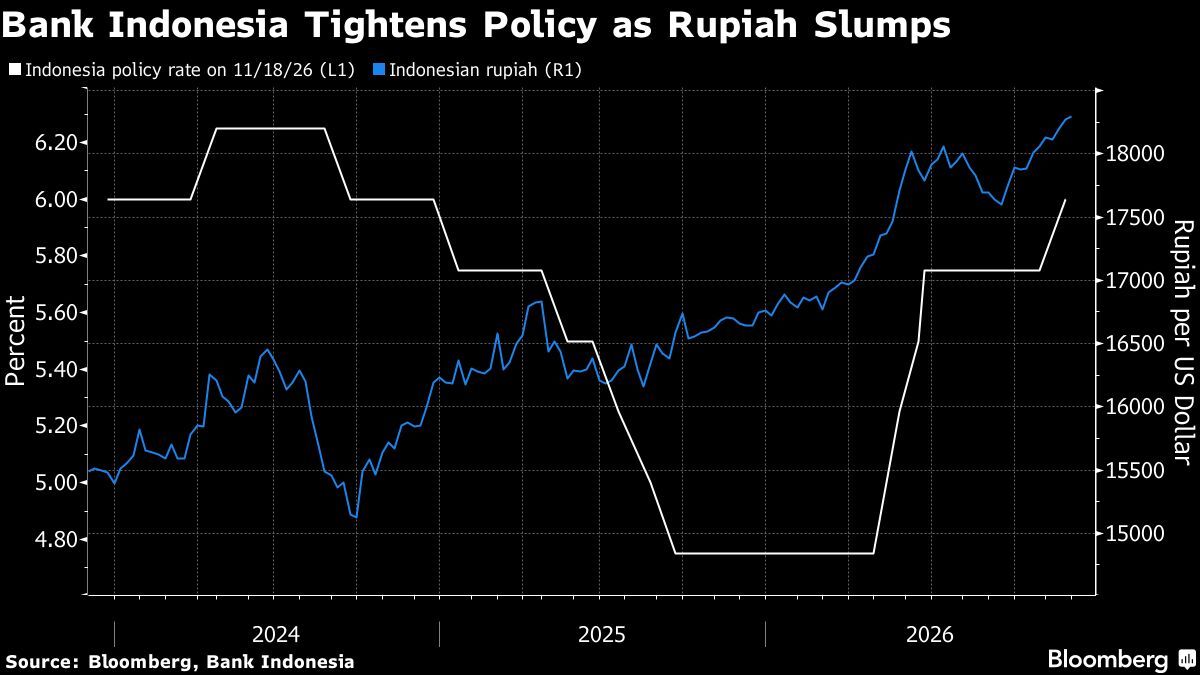
BI resumed raising its benchmark interest rate by 25 basis points to 6% this month, bringing cumulative tightening since May to 125 basis points. Policymakers said the latest move was needed to strengthen the rupiah against heightened global uncertainty, including the prospect of US rates staying higher for longer, and was a preemptive step to keep inflation within target through 2027.
The tightening cycle began with a 50-basis-point hike in May, followed by an out-of-cycle 25-basis-point increase in early June after the rupiah weakened past 18,000 per dollar. It raised rates by another quarter point at its regular June meeting as currency pressures persisted.
However the rupiah has recently continued to weaken, hitting successive record lows in November and trading closer to 18,400 per dollar. The currency has lost almost a 10th of its value this year, pressured by a stronger dollar, global risk aversion and domestic concerns.
Pressure intensified after MSCI Inc warned in October that Indonesia could be downgraded directly to standalone-market status from emerging market. The index provider cited concerns over opaque shareholding structures, suspected coordinated trading and weak enforcement, raising the risk of further foreign outflows.
However, MSCI has held out the possibility of avoiding a downgrade for the country, according to people with knowledge of a discussion between the firm’s chief executive and the president.
BI has increasingly supplemented interest rates with other tools to defend the currency. It has intervened in offshore non-deliverable forwards and the domestic spot and DNDF markets, while offering discounts on hedging premiums to encourage foreign funding and portfolio inflows.
The economy has so far weathered the cumulative effect of multiple rate hikes. Yet growth of consumer-facing sector slowed as the strength of underlying private demand is weighed down by a softer rupiah and job cuts in labour-intensive sectors.
Uploaded by Evelyn Chan