

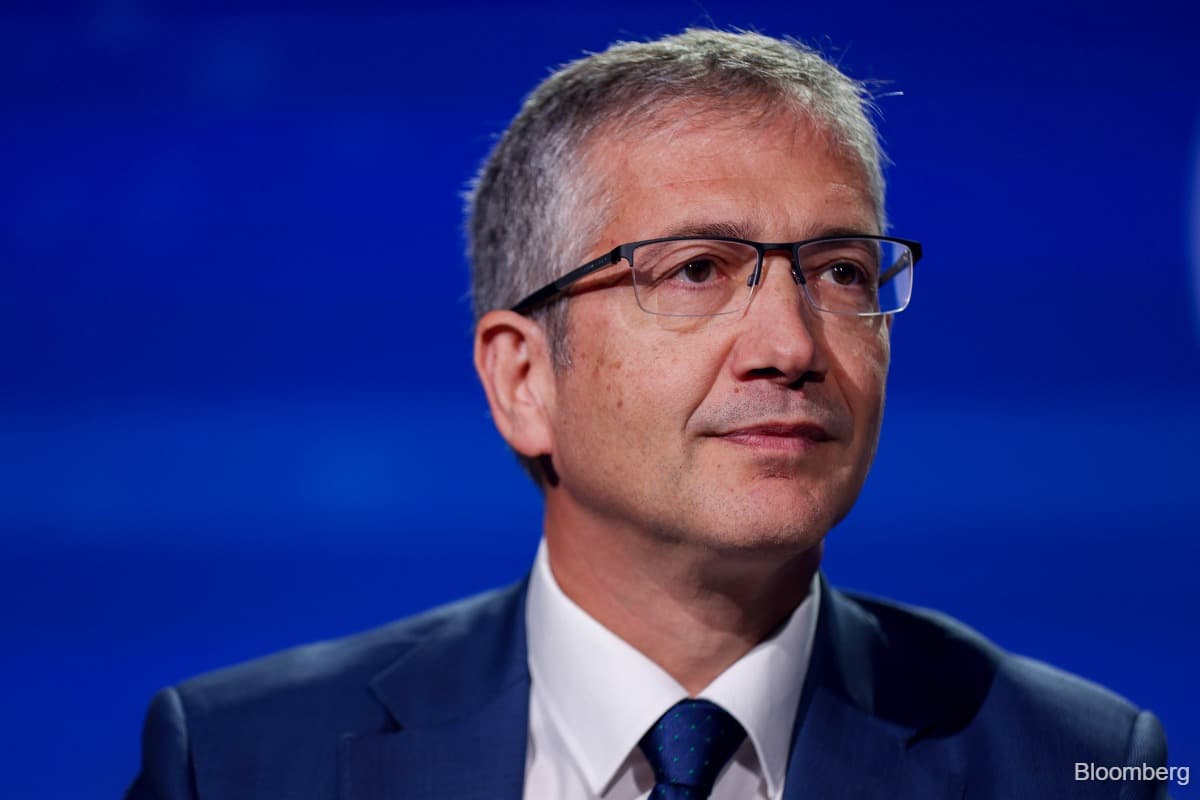
(Nov 26): Pablo Hernandez de Cos is set to become European Central Bank president, directing the region’s fight against inflation and possible bond turmoil.
With the Dutch government aligning with the consensus of European peers after previously pushing for its own candidate, leaders meeting in Brussels are poised to nominate the 55-year-old Spaniard later on Thursday. He will succeed Christine Lagarde, who will end her term early to leave the institution on Feb 7.
While De Cos will still need to testify to the European Parliament, its opinion isn’t binding, and the political agreement now in train means his appointment as president is essentially assured.
That would hand Spain the ECB’s top role for the first time, coinciding with the transformation of the euro area’s fourth-largest member from a onetime victim of the region’s past debt crisis to become its best-performing major economy.
De Cos, a former governor of the Bank of Spain who is now chief of the Bank for International Settlements, will oversee monetary policy in a region of 21 member states and 350 million people. Among his tasks will be quelling inflation running at double the 2% target, while confronting the danger of a new sovereign debt crisis.
Market tensions over high borrowings in countries like France are a major concern. So far, ECB officials have put the onus on Paris to solve fiscal issues, but if rising yields begin to impede the effectiveness of their monetary policy, a decision on whether to step in may be needed.
De Cos was already firmly on track to win the role after securing the backing of France and Germany in recent weeks over the rival candidacy of former Dutch central bank governor Klaas Knot.
The appointment will be the most important element to one of the biggest reshuffles of the ECB’s six-strong executive board since the institution’s inception more than 25 years ago, installing a new management team before French elections in spring.
The result means the euro will enter its fourth decade without Germany ever having had the presidency. It had little chance of winning it this time, with two of its nationals still set to hold key roles in coming years: Ursula von der Leyen at the helm of the European Commission and Claudia Buch running the ECB’s bank watchdog.
Berlin opted instead to go for the chief economist position and nominated Princeton University professor Markus Brunnermeier to succeed incumbent Philip Lane when his term ends in May next year.
France, which has had the presidency twice, picked former minister and OECD chief economist Laurence Boone to join the ECB board. She will get the markets portfolio that becomes available after Germany’s Isabel Schnabel exits in January — a position that may prove key in the event of a bond crisis.
As a consequence of Brunnermeier’s start in June, Germany will have no seat on the board for the five months from Schnabel’s departure in January, a potentially crucial period if market turbulence erupts around France’s budget and elections.
“I’m not hoping for a crisis anytime soon but the interesting aspect for markets is what kind of direction the ECB toolkit will be taken in,” said Michala Marcussen, chief economist at Societe Generale. “The president of course does not make decisions in isolation, but the president has an important role in guiding and pushing on the toolkit.”
De Cos holds a doctorate in economics and a degree in law. The former chair of the Basel Committee on Banking Supervision was widely deemed more dovish than Knot on monetary policy, but has a track record of preaching fiscal rectitude in Spain.
In a recent interview De Cos said central banks must “remain vigilant about inflation risks” stemming from high energy prices, while also signalling concern over high levels of borrowing by some nations.
He started his career at Spain’s central bank in the late 1990s before working as an adviser to the ECB’s executive board from 2004 to 2007. De Cos then led the Bank of Spain as governor for a non-renewable six-year term that started in 2018.
The exit of the BIS chief opens up another high-level position in the global central-banking community less than two years after the last change at that institution. It’s unclear if Europe will be able to retain that top job against competition from global peers. De Cos’s predecessor there was Mexico’s Agustin Carstens.
Uploaded by Evelyn Chan