

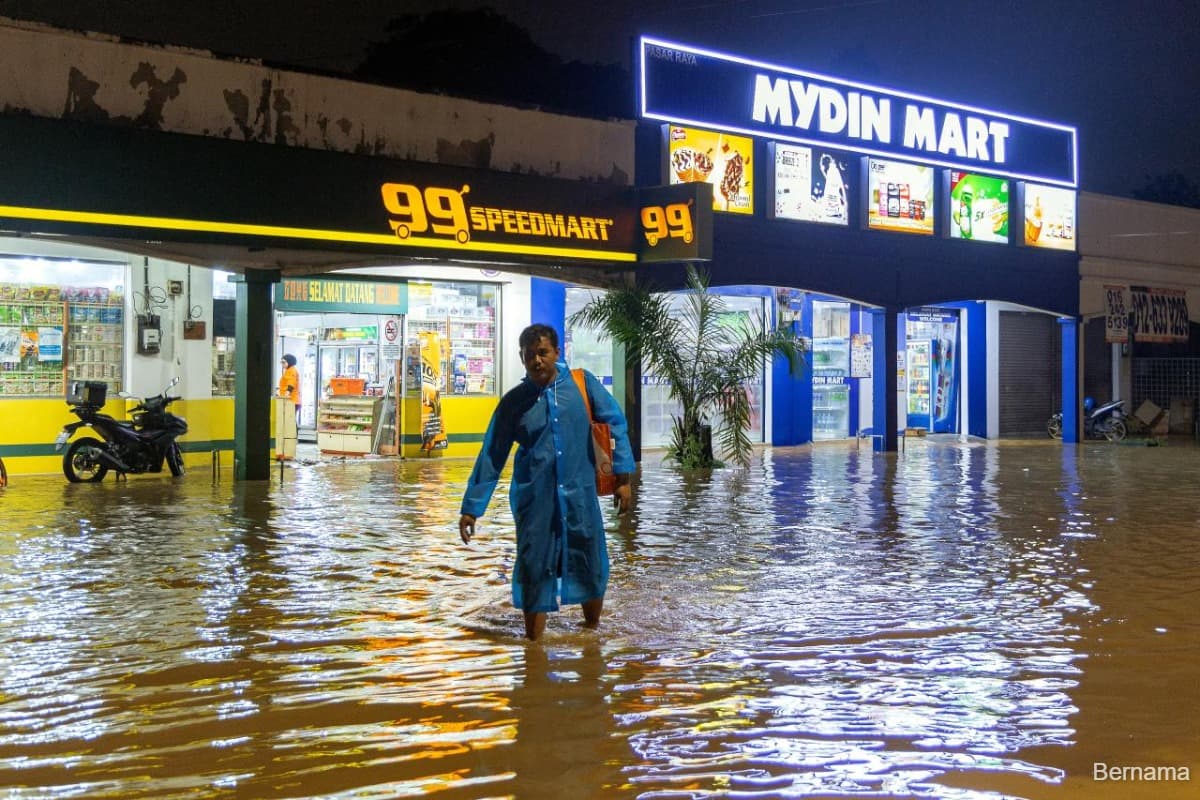
(Nov 26): In November 2024, floodwaters cut road access to nine evacuation centres in Kelantan. Seven were in Pengkalan Kubur. Police deployed helicopters to deliver food and other essentials. For families waiting at those centres, the immediate concern was whether the next delivery would arrive in time for dinner.
Two years on, as Malaysia prepares for another northeast monsoon, Agriculture and Food Security Minister Datuk Seri Mohamad Sabu has assured the public that the national rice stock is sufficient for six months, with frozen fish adequate for eight. He was right to discourage panic buying. A rush to the shops can clear shelves in a matter of hours. We would add a local test to that national reassurance. If floodwaters cut off the only road into a district tonight, residents need to know how tomorrow’s food will reach them.
On Aug 4, the Deputy Minister of Agriculture and Food Security Datuk Chan Foong Hin told the Dewan Negara that Malaysia held about 1.24 million tonnes of rice as at 30 June 2026, enough for approximately six months of national consumption. Of that, 200,000 tonnes made up the national buffer stock managed by Padiberas Nasional Bhd (Bernas). The remaining 1.04 million tonnes, or about 84%, was held commercially.
The national buffer stock provides a safeguard against supply disruptions, while commercial inventories sustain the everyday flow of rice through warehouses, distributors, and retailers. Getting that rice to households still depends on passable routes, functioning warehouses, and transport. Food security does not end at the warehouse door.
For businesses, maintaining additional stocks in flood-prone areas means higher inventory costs and the risk of unsold inventory. Without a way to share those costs, a retailer may have little reason to hold extra supplies for an emergency.
District authorities should map where commercial stocks are held and which roads tend to flood. A small shop on the same side of the river as the villages it serves may be more useful than a much larger warehouse across a bridge that often closes.
Before the monsoon, the district could agree with the shopkeeper on how much food and drinking water to set aside and who can release it during emergencies. The shopkeeper could rotate those supplies through ordinary sales and replenish them as needed. To make such arrangements commercially viable, authorities could offer modest holding fees or establish emergency purchase agreements with predetermined prices and payment terms. Agreed prices and payment terms would let shopkeepers release supplies promptly and know when they will be paid.
Suppose a wholesaler has enough rice to supply a district for a week. The warehouse is dry, but the road its lorries normally use is impassable. A boat can get through if the crews can coordinate the transfer. The lorry driver needs to know where to meet it, the boat crew needs to know where to unload, and the district team needs to tell them which villages are still waiting for supplies. A patchy mobile signal can delay all three.
The Malaysian Communications and Multimedia Commission’s (MCMC) PRIME system can provide emergency radio and internet connectivity when ordinary networks are disrupted. The MCMC has already deployed it during disaster response in Sabah. Responders could use PRIME to coordinate the lorry-to-boat transfer and relay changes to the delivery route. While emergency connectivity is being set up, a printed contact list and an agreed meeting point can keep the delivery moving.
Residents need timely information too. The MCMC and the National Disaster Management Agency (Nadma) are developing an early warning system that uses cell broadcast technology to send alerts to compatible mobile phones in targeted areas. For residents who need to evacuate, an early warning can give them time to leave while the roads are still passable.
Nadma says it has prepared 170,000 ready-to-eat meals for evacuees arriving at relief centres and 60,000 food kits for those returning home. The armed forces have placed 5,234 personnel on standby, along with land, water, and air assets. But district plans also need to reach households unable to access relief centres. Consider an older couple whose home is still dry even though the road to the shops is already impassable. A village head or community volunteer may know they are there and can alert the district team. The delivery plan should give that person a way to report what the couple needs and tell them when help is coming.
To strengthen operational readiness, we propose Nadma to run a 72-hour food distribution exercise with a flood-prone district. Give the district disaster committee, wholesalers, retailers, and transport operators the same scenario. The main road is cut, mobile service is intermittent, and some households cannot reach a relief centre. Then move an actual load. Time how long it takes to release the stock, transfer it to suitable transport, and hand it over to the people who need it.
Publish how long the first delivery took and which communities the district could reach within 72 hours. If the plan relies on the same lorry to serve three villages, time the delivery to the last one. The first delivery tells us how quickly we can respond. The last tells us who may be left behind. If a village is still waiting on the third day, the district has a concrete reason to arrange another route or put supplies closer to it before the next flood.
The exercise should record what each delivery cost as well as how long it took. An airlift may be the only option once roads are cut. The exercise should compare its cost with the cost of keeping supplies closer to villages that are regularly isolated. Published timings tell a district where it is exposed. Published costs tell the Treasury whether reducing that exposure is worth paying for.
Record what arrived, too. A boatload of rice is useful where families still have clean water and a way to cook. Where they have lost both, the first delivery should include drinking water and food people can eat straight away. Unloading at a jetty is only one step. The exercise should account for residents with limited mobility who cannot walk there or carry supplies home.
A payment outage can interrupt access to food even when a supermarket has power, staff, and shelves full of stock. Retailers should have a way to accept cash and record sales during a payment outage. A retailer can test that procedure on an ordinary Tuesday, when staff have time to practise it.
Households can prepare too. The Federation of Malaysian Consumer Associations has suggested keeping 72 hours of essentials. A family that can afford it can gradually set aside drinking water and ready-to-eat food during routine shopping trips. Some households will struggle to do even that. Districts should account for those households when planning emergency delivery routes.
The next time the government reports how much food Malaysia can supply, we should be able to say, with the same confidence, how soon the next delivery will reach Pengkalan Kubur if the road floods tonight.
Because the true measure of food security is not about how much we have in reserve, but whether it reaches those who need it most.
Dr Sean Thum is a policy officer at the Ministry of Communications. Ilham Aqeel Azhari is a Madani fellow at the Ministry of Defence. Jocelin Chee Ming Ming is a Madani fellow at the Ministry of Agriculture and Food Security.