

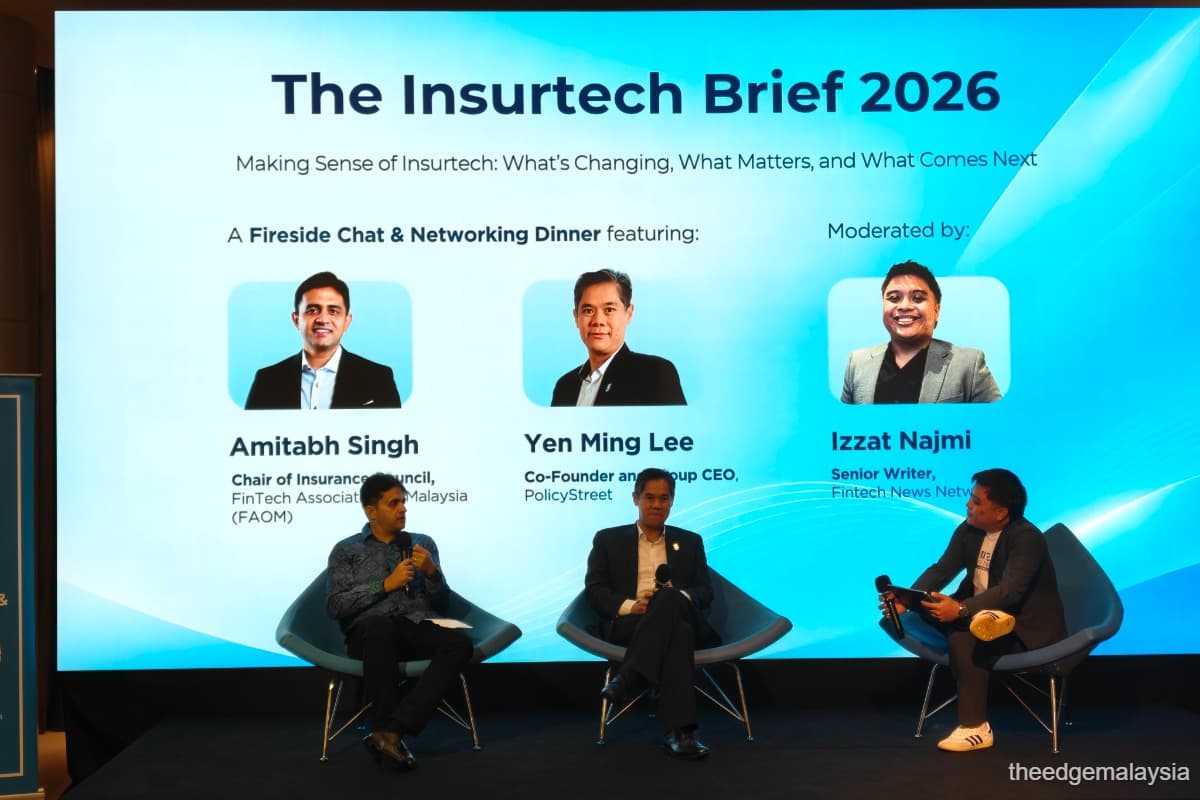
KUALA LUMPUR (Nov 26): Agentic artificial intelligence (AI) could help insurers cut underwriting costs and expand coverage rather than displace human agents, according to Fintech Association of Malaysia Insurance Council chair Amitabh Singh.
Unlike conventional AI tools that respond to prompts or retrieve information, agentic AI can be assigned specific tasks and work through different stages of a process, allowing underwriters to spend less time reviewing documents and customer records.
Amitabh was speaking alongside PolicyStreet co-founder and group chief executive officer Lee Yen Ming at a fireside chat titled “The Insurtech Brief: What's Next for Insurance in Malaysia?” held here on Wednesday (Nov 25).
He said insurers could assign different tasks to specialised AI agents to carry out parts of the underwriting process that would otherwise require hours of manual review.
"You do the same thing or a similar thing that you did before, but with much more efficiency. Where one underwriter last time could do 10 (applications), (the AI agent) can do 100," he said.
Citing medical insurance applications as an example, Amitabh said AI agents could review different sources of information, including an applicant's medical history and other relevant records.
"For example, when it's insurance for medical, one agent can actually be instructed to go and look at the social media profile. So you don't have to go and look through somebody's Facebook or TikTok. There's an agent that does that, pulls out information, summarises and gives it to you," Amitabh said.
The technology could also help insurers identify information in historical medical records, such as blood test results indicating potential hypertension or diabetes, which underwriters could factor into policy pricing.
At PolicyStreet, AI is already being used to speed up the processing of quotations and claims for consumers and businesses, Lee said.
"When you look at information that consumers give, for example, if you're buying car insurance and you give us a road tax or a (vehicle) grant, AI is now used to simplify the documents so that we are able to process your quotations in a faster manner."
"We believe AI can now assist consumers out there, even businesses out there, to simplify the claims by processing all the information that you've given so that we can relay it in a timely manner to the insurers," he added.
While a Bank Negara Malaysia survey found that 77% of insurance operators in Malaysia had used at least one AI tool in 2024, a 58% increase from the previous year, Amitabh cautioned against taking headline adoption figures at face value.
"When any survey like this comes out and says this many per cent are (using AI), I don't believe it, because your CEO using ChatGPT to write an email doesn't count as usage. I think the real adoption is mostly at the back end, how do you reduce those little frictions?"
He expects the industry to move beyond the current hype cycle towards deeper operational adoption over the next six to 12 months.
Addressing concerns over the livelihoods of insurance agents, Amitabh said human agents "are not going anywhere, not in the foreseeable future. Digital-led or agentic insurance will definitely serve to expand the pie and have a lot more coverage, especially for bite-sized insurance".
He explained that small-ticket policies are often uneconomical for human agents to sell because of high distribution costs.
For full-time agents, the technology will primarily eliminate manual "grunt work", such as maintaining physical diaries of client notes, although some part-time agents may feel the impact.
Lee said the extent of digital adoption would also depend on the type of insurance product.
"A lot of times, I think agentic AI, when it comes in, is not really replacing the agents, but changing how the agents now work, how they now sell policies," he said.
"When it's P&C (property and casualty) or general, it tends to be more digital-led because it's easier, it's a simple policy, it's a one-off, annual policy. When it's life, and you have to pay for your entire life, that's where you tend to be more comfortable if you can talk to someone," he added.
Even as automation accelerates, both speakers stressed the importance of human oversight in critical insurance decisions.
"There's a limit in terms of what AI can approve so that when complex cases come in, that's where you need human intervention," Lee said. "The entire ability for a human to still decipher, to make judgement, is still required."
Amitabh added that insurers should retain human involvement in core processes to ensure they do not lose the expertise needed to make decisions when technology fails.
"When things go wrong, you as an organisation need to be able to switch offline. If you have nobody who knows how to do this, you shut down," he said.
Prior to the fireside chat, PolicyStreet entered a partnership with foodpanda, with support from BlueOrchard, to launch what it described as Malaysia's first embedded Climate Income Protection pilot, providing free flood coverage to more than 30,000 active delivery riders from Nov 26.
Under the initiative, eligible riders displaced to temporary relief centres for seven days or more due to flooding will automatically receive a one-off RM350 payout without having to file a claim or submit documentation.