

(Nov 26): Major US trading partners responded with disappointment and protests while holding out the prospect of negotiations after the Trump administration rolled out a fresh round of tariffs on goods from China, the European Union and a dozen other economies.
For now, officials from Singapore to Japan are signalling a preference for negotiation over retaliation, even as China and the European Union have made clear they could hit back if Washington pushes beyond the terms of existing trade deals. The Trump administration plans to impose levies on imports from economies it accuses of contributing to excess manufacturing capacity and hurting US companies.
The new tariffs mark the latest effort by the Trump administration to reinstate an expansive trade agenda that included country-by-country levies implemented using emergency powers. Those were struck down by the Supreme Court in February, forcing the president to invoke other legal authorities to restore the duties.
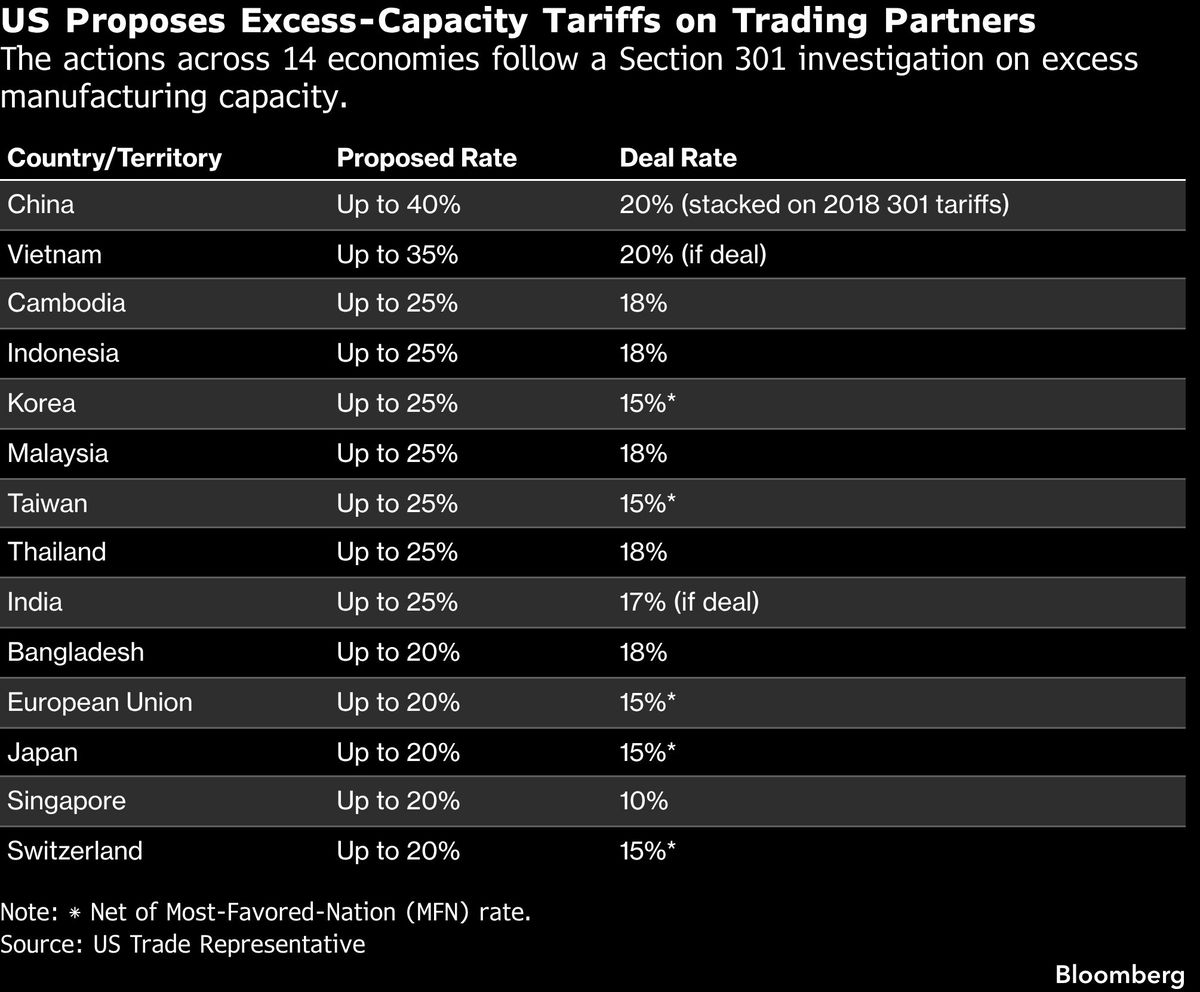
Singapore said it disagreed with the US findings that its policies contribute to a glut in manufacturing capacity and will urge Washington to reconsider proposed tariffs of up to 20% on the city-state’s exports.
The rate could be lowered to 10% if Singapore reaches a reciprocal trade agreement with the US or concludes other negotiations that address Washington’s concerns.
“Singapore’s economic policies do not protect our domestic market or subsidise manufacturing for export,” the Ministry of Energy, Trade and Industry said on Thursday. “Our free trade agreements seek to lower barriers to trade and investments.”
Japan protested US plans to impose a 15% levy on its products, with the chief government spokesman calling the move “regrettable.”
“Japan does not have any non-market policies or practices, or structural excess production capacity,” Chief Cabinet Secretary Minoru Kihara said at a regular news conference.
He Yadong, a spokesperson for China’s Commerce Ministry, said at a news briefing on Thursday that Beijing reserves the right to take necessary measures in response to the proposed tariffs and will closely monitor developments.
Chinese Foreign Ministry spokesman Guo Jiakun told reporters at a briefing on Wednesday that the prospect of new US tariffs on its exports was “political manoeuvring” and said the two nations should work together to maintain their trade truce.
The actions across 14 economies follow a Section 301 investigation on excess manufacturing capacity.
For many economies, the proposed rates are broadly in line with levels previously negotiated with Washington before the court’s decision. They aren’t expected to take effect until after a written-comment period and public hearings, with implementation possible in late January.
The tariff for imports from China would rise to 20%, in line with the country’s prior agreement with the Trump administration — though that rate could double to 40% if talks between the two countries fall apart, according to a senior US official. The official briefed reporters on condition of anonymity ahead of Wednesday’s announcement.
Products from the EU will be taxed at 15% in compliance with the US’s deal with the bloc, though that could also rise to as much as 20%, according to the Office of the US Trade Representative (USTR).
The US plans to impose a 17% tariff on Indian goods, putting pressure on the country to reach a trade deal or face a higher levy. The rate is lower than those proposed for other Asian economies including Vietnam, Malaysia and Bangladesh, but would rise to 25% if India fails to secure a deal with the US, its biggest export market, according to USTR.
US and Indian negotiators have been working towards a deal since agreeing to a framework in February. US trade probes and a recently passed law on Russian oil sanctions have complicated the talks.
Imports from South Korea and Switzerland — prominent US trading partners — would be hit with a 15% rate. The rate could go up to 25% for South Korea and 20% for the European nation, USTR said.
The USTR is also raising tariffs on imports from Brazil by modifying measures stemming from an earlier investigation into the country’s digital policies and trade practices.
Brazil’s government issued a sharply worded response to the levies and vowed it would “not yield to this kind of threat.” Its Foreign Ministry said the US’s unilateral decision constituted an “unacceptable action” in the context of ongoing bilateral negotiations.
Uploaded by Evelyn Chan