

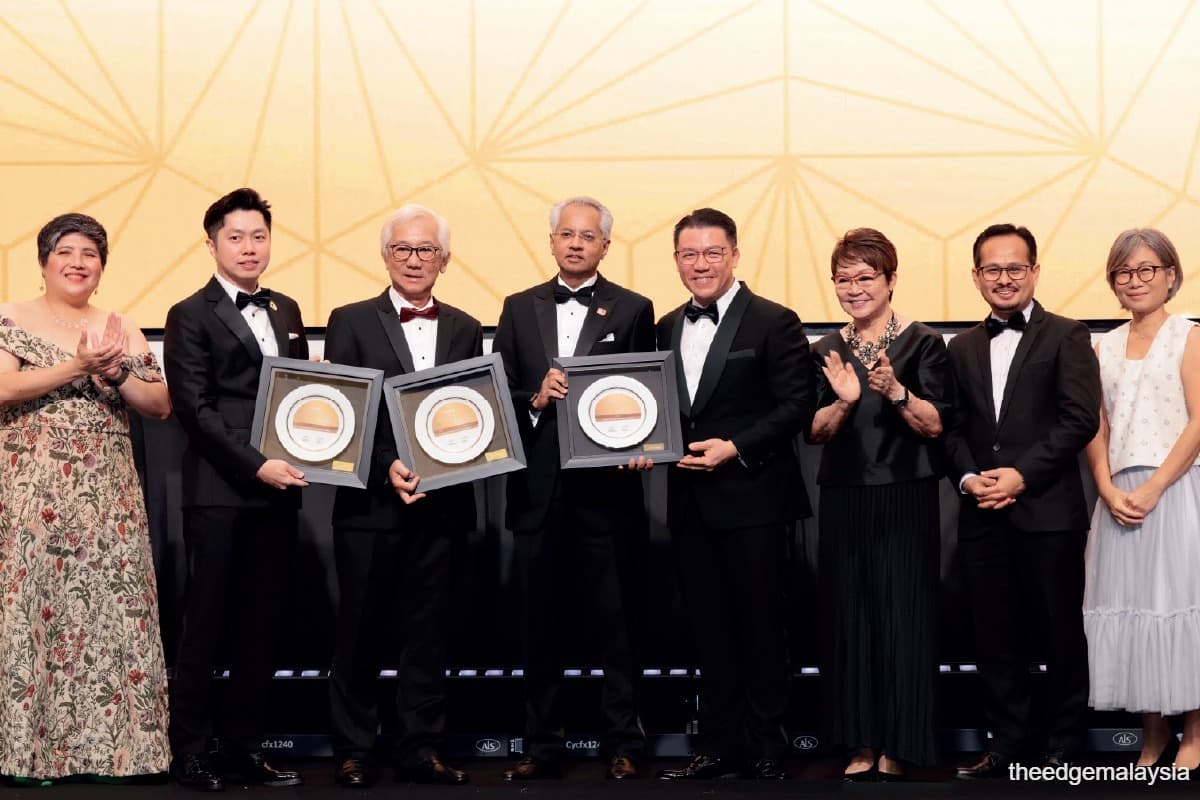
This article first appeared in City & Country, The Edge Malaysia Weekly on November 30, 2026 - December 6, 2026
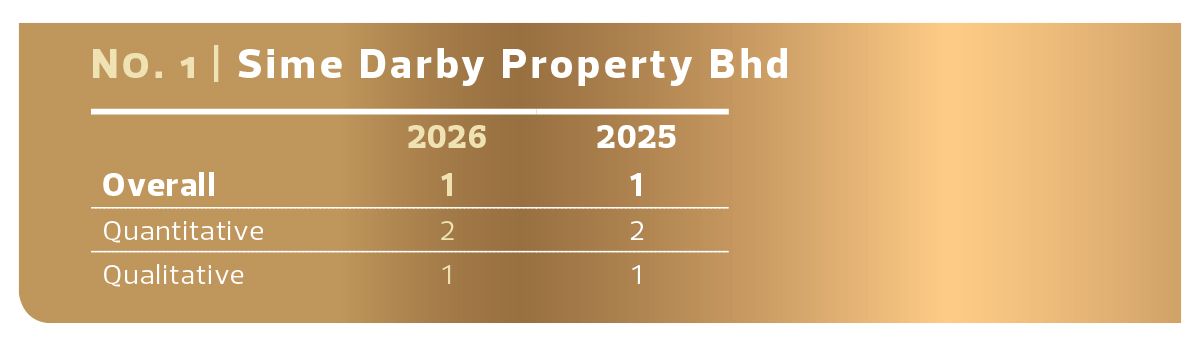
In a property market shaped by rising costs and volatility, growth is no longer simply about building more. For Sime Darby Property Bhd (KL:SIMEPROP), this means looking beyond its reputation as a township developer and venturing into a more diversified business model, with industrial development, recurring income and fund management.
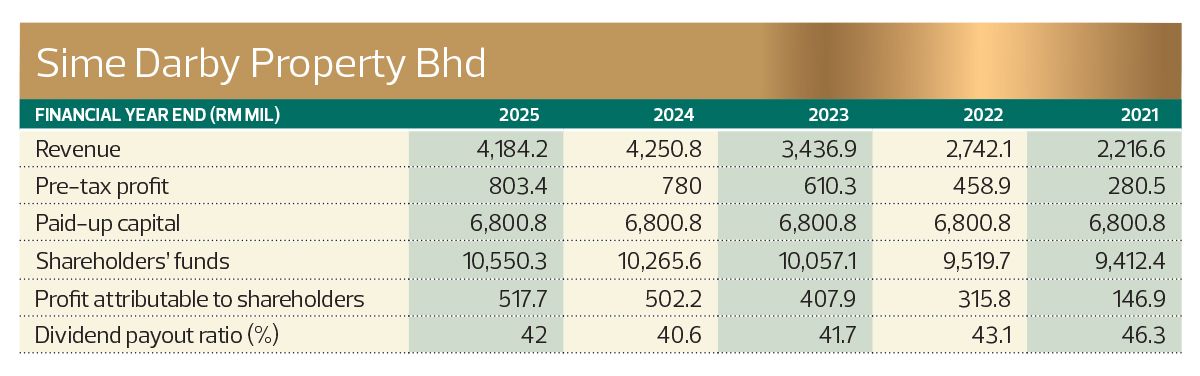
The group’s FY2025 performance reflects the progress made in this direction. For the financial year ended Dec 31, 2025, Sime Darby Property achieved a record profit before tax of RM803.4 million, compared with RM780 million in FY2024. Net profit also rose in FY2025 to RM517.74 million, from RM502.2 million in FY2024.
Full-year revenue stood at RM4.18 billion, slightly below the RM4.25 billion recorded in the previous year. Its full-year launches were valued at RM3.6 billion, comprising industrial products (37%), landed residential properties (36%), high-rise residential developments (15%) and commercial products (12%).
While property development remained the group’s main earnings contributor, its investment and asset management (IAM) segment also reached a milestone, recording its highest revenue of RM183.9 million, supported by stronger mall performance and industrial asset acquisitions.
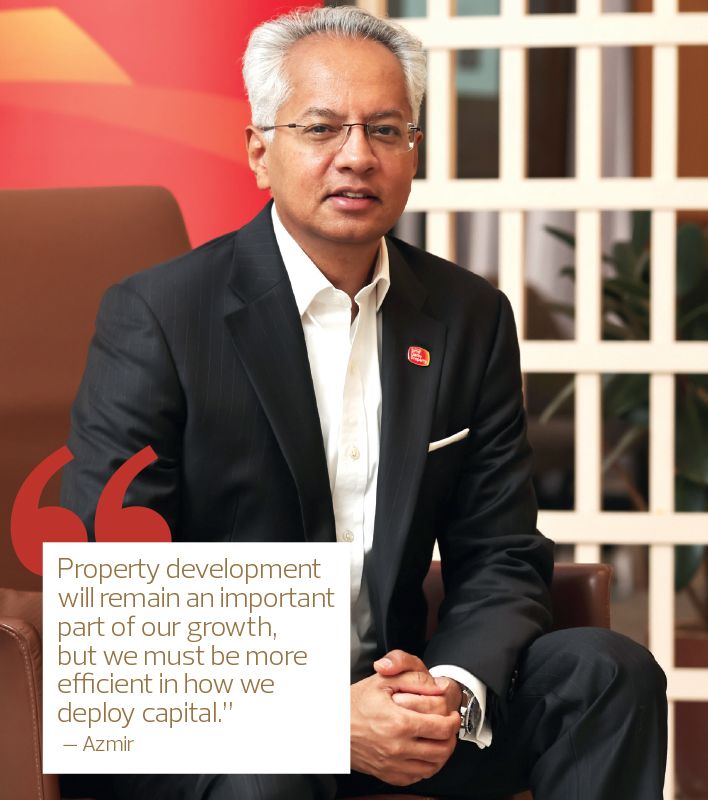
In an interview with City & Country, Sime Darby Property group managing director and CEO Datuk Seri Azmir Merican discusses the group’s FY2025 performance, opportunities in its industrial business and how the new SHIFT32 strategy will shape its next phase of growth.
City & Country: FY2025 was another record year for Sime Darby Property. What do you attribute the group’s financial performance to, and how do you plan to sustain it over the next few years?
Datuk Seri Azmir Merican: In 2025, we built on the momentum from 2024. We achieved record sales of RM4.2 billion, led by our industrial segment, as well as landed residential and high-rise residential properties. All these segments delivered strong sales, which translated into our ability to protect margins. As a result, we achieved a record profit before tax of RM803 million for FY2025.
For our IAM segment, we tripled our assets under management (AUM), growing from RM1.5 billion in 2021 to RM5 billion last year. That is a significant achievement. The segment also recorded its highest revenue and profit before tax, at RM183.9 million and RM48.1 million respectively.
IAM has benefited from the performance of our malls, including Elmina Lakeside Mall and KLGCC Mall. Both are relatively new, so their contributions in 2025 were not yet significant. However, Elmina Lakeside Mall is doing very well, while KL East Mall is performing superbly.
We have also acquired two warehouse assets, which have further supported revenue growth.
Our focus for 2026 is to sustain this performance, albeit under a very different set of circumstances. We have seen the impact of volatility in raw material prices. Margins are therefore a big issue, and when they come under pressure, we also need to look at rationalising our pricing. Ultimately, this affects how much of the additional cost will be borne by purchasers. It is a fine balance that we need to strike.
The industrial segment contributed the most to sales in FY2025. What are its demand drivers, and where do you see the biggest opportunities moving forward?
It depends on the location. We look at areas such as City of Elmina, Bandar Bukit Raja and Serenia City, where different locations cater to different industrial requirements.
We develop large assets of about one million sq ft through our fund platform. These are substantial, one-off developments. We also have smaller industrial parks that we develop ourselves. One example is Bandar Bukit Raja 4, which we have started monetising with the sale of industrial land plots and ready-built factories.
The demand for both products has been very good. Our advantage is that we have been present in Bandar Bukit Raja for a long time, so we understand the market and our customers.
We know what businesses are looking for, whether they are expanding, relocating or moving to a new area. Some need additional space, while others require more modern facilities because their existing premises no longer meet their operational needs.
Our Kuala Selangor industrial hub project, a joint venture with SD Guthrie Bhd (KL:SDG), will introduce another dimension to our industrial strategy. We intend to execute it through a land banking fund.
Malaysia has not had a fund of this nature before. Essentially, a land banking fund acquires land and determines how best to unlock its potential. Unlike a real estate investment trust (REIT), which can continue to receive asset injections, a fund has a finite lifespan. Investors need to recycle their capital and eventually exit.
This model supports our strategy of churning capital while generating recurring income. As the fund manager, we can earn income from managing the fund while working alongside investors to unlock the land’s value.
The fund will undertake master developer-type work to assess the land and determine its best use. We may develop certain parcels ourselves, while others could be monetised.
One of our key strengths is our ability to master plan large townships. A successful industrial park requires the right infrastructure from day one. That is our differentiator, particularly as businesses increasingly look for Grade A industrial facilities with well-planned infrastructure.
SHIFT25 concluded in FY2025. Did the strategy achieve what it was intended to do?
We are very happy with what we achieved in 2025. We translated the objectives and targets we had set into actual results, building on the good performance recorded over the past two to three years.
Traditionally, Sime Darby Property was known for delivering landed homes. Today, we undertake both landed and high-rise developments, with launches across the two segments now almost equal. We have also grown our industrial business, which has become our largest segment.
We have demonstrated our ability to deliver high-rise projects, although this comes with greater complexity. Once you move into vertical developments, the risks increase significantly, and mistakes can have serious consequences.
Another important achievement has been growing our second engine of growth — recurring income. We launched our first private equity real estate development fund, allowing us to undertake projects using third-party capital rather than relying entirely on our own balance sheet.
We have launched the New Economic Venture (NEV), our first fully shariah-compliant property-managed fund. The fund is backed by the Employees Provident Fund, Lembaga Angkatan Tentera and Great Eastern Life Assurance (Malaysia) Bhd.
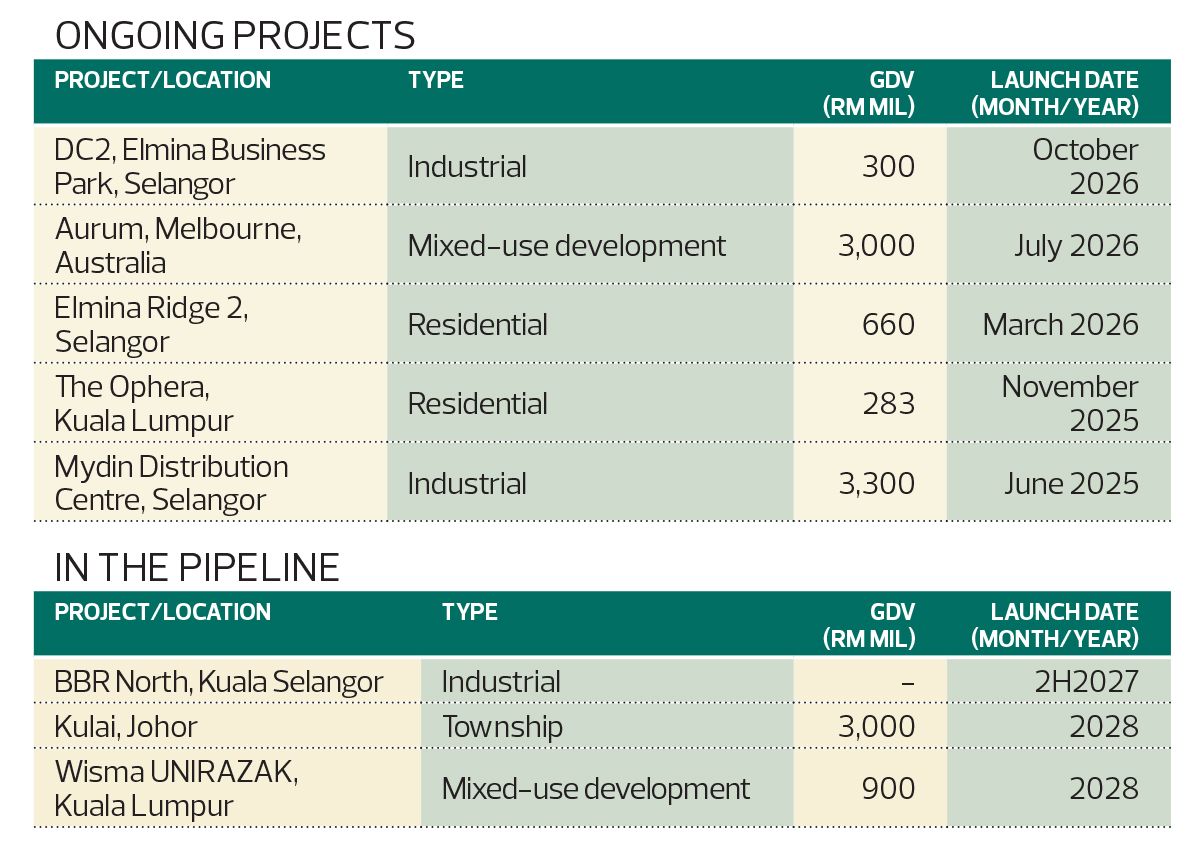
As for our Industrial Development Fund, we are working alongside ESR Group as co-managers. We have also demonstrated our ability to deliver large industrial assets in Bandar Bukit Raja and secure tenants. Metrohub 1 and Metrohub 2, part of the E-Metro Logistics Park, achieved 100% occupancy. Metrohub 4 has just been completed, so occupancy is still below 40%, but we expect it to improve over the coming year. Metrohub 3 commenced construction in July this year and is expected to be completed in 3Q2027.
These development funds are generally higher-risk, higher-return vehicles because they involve development risks. We are now looking at introducing a land fund, which is relatively lower risk because it is backed by land. The challenge is to leverage our master-planning capabilities and attract investors who are interested in the returns these funds can generate.
Overall, we have grown our AUM from RM1.5 billion to RM5 billion, with the pipeline expected to take it to at least RM8 billion in the near future. We have also shown that, as an established developer, we are prepared to explore initiatives beyond our traditional business. These include affordable housing and opportunities in the energy sector. We were among the partners involved in rolling out a rooftop solar project under the Corporate Renewable Energy Supply Scheme, linked to the National Energy Transition Roadmap. We are also exploring the potential of installing solar panels on landed homes in Malaysia.
SHIFT32 has several key pillars, including recurring income, industrial expansion, the NEV fund, entry into Kuala Lumpur city centre, opportunities arising from the Johor-Singapore Special Economic Zone (JS-SEZ) and a net zero commitment. What are your strategies for these areas?
We have said that we want to be the best in our business, and we have demonstrated that we can improve and deliver results. As the business evolves, however, there are three critical areas we need to address.
First, we need greater discipline in managing capital. For property developers, return on equity (ROE) should receive more attention. We believe there is room to improve this through better asset turnover, which would ultimately translate into stronger returns.
The challenge is partly related to the amount of land we hold. Land recorded as inventory on the balance sheet does not necessarily generate returns while it remains undeveloped. We need to rethink this approach so that land can contribute value even before development begins. That is why we believe land should be treated as capital, rather than as inventory.
We will need a framework for land banking and a more disciplined approach to determining how much land we should hold. For instance, a developer focusing on high-rise projects may not need to hold as much land as one developing large townships. These are areas where we can rationalise our holdings.
Second, we need to reconsider how Sime Darby Property grows. Organic growth remains important, but we also want to establish more platforms that allow us to manage third-party capital.
Our objective is to churn the same capital two, three or even four times, generating more value from each ringgit invested.
Traditionally, developers hold capital in the business and spend several years developing land before selling the completed product. In the case of income-generating assets such as malls, developers may retain ownership or unlock their value through a REIT.
We want to develop a more integrated fund platform to manage this entire process. We can identify and master plan the land, bring in a development fund to undertake the project, and subsequently move the stabilised asset into another fund structure. In this way, we are developing an entire value chain for our fund management business.
With SHIFT32 in place, what does your target earnings mix look like across the group’s business segments?
We want to grow sustainably. The objective is not simply to achieve growth for a few years, but to establish a formula that we can repeat over the next seven years. That is the fundamental idea behind SHIFT32.
Each of our growth engines has its own targets. For property development, we are targeting annual sales of RM4 billion. There are also opportunities in Australia and affordable housing, which we believe have considerable potential.
For recurring income, we have established targets and a pipeline. Our focus is on delivering existing projects while creating new funds to support further growth.
The next priority is to grow smarter. If asset turnover and ROE become important performance indicators, everyone in the organisation needs to understand how they are measured and how their decisions affect these metrics.
These are not necessarily questions that property developers traditionally ask. I did not always focus on return on assets (ROA) and ROE either, but we need to understand where we stand and how we can improve.
Ultimately, this will make us better business people. As a country, we also need to make our capital base more productive. Property development will remain an important part of our growth, but we must be more efficient in how we deploy capital.
Following the acquisition of land on which Aurum will be built, does Sime Darby Property have plans for more recurring-income-type projects in Australia? What about the UK?
In Australia, particularly Melbourne, our main objective is to establish a strong brand and reputation by delivering quality products. We certainly have an appetite for more opportunities, but we want to be selective. Establishing ourselves also gives us a better understanding of the market and its requirements.
As for Battersea Power Station, the master plan was recently revised. The original plan had been drawn up quite some time ago, and we only received approval this year to launch the next phase, Phase 3C.
A lot has changed since the original plan was conceived, so we felt it was the right time to refresh it and ensure that we offer a product that is relevant and exciting to the market. We have invested a significant amount in the development, so the project needs to be positioned appropriately to command the right price and allow us to recoup our investment.
We take guidance from Prime Minister Datuk Seri Anwar Ibrahim’s comments regarding the initial investment in redevelopment and the challenges of recovering those costs. We are open to understanding the situation and finding ways to move forward.
A company of our size and standing should be able to perform well. As the prime minister highlighted, we are also looking at ways to mitigate the situation and recoup our investment.
Where does Sime Darby Property see its next growth opportunities, geographically and by segment?
First and foremost, growth depends on the country’s economic performance. Our business supports underlying economic growth, and one important factor is consumer confidence. When people feel positive about the economy, they are more likely to make the decision to purchase a home.
Our advantage is that we operate in established townships that we have developed ourselves. We understand these markets, know what our customers want and can identify emerging patterns and growth trends. This allows us to plan our products and developments accordingly.
At the same time, we want to introduce new products and explore the segments and platforms we have discussed. These will provide additional drivers of growth beyond our traditional property development business. I remain optimistic about the opportunities ahead, but we must also be mindful of global developments.
The operating environment remains challenging, and uncertainty has almost become the norm. We are facing considerable volatility and rising prices, so we need to be prepared to respond to changing circumstances. The challenge is to strike the right balance between maintaining margins, managing costs and keeping our products accessible to purchasers.
Save by subscribing to us for your print and/or digital copy.
P/S: The Edge is also available on Apple's App Store and Android's Google Play.