

(Nov 25): Germany’s economy expanded at a slower pace than first thought in the third quarter as investment slumped.
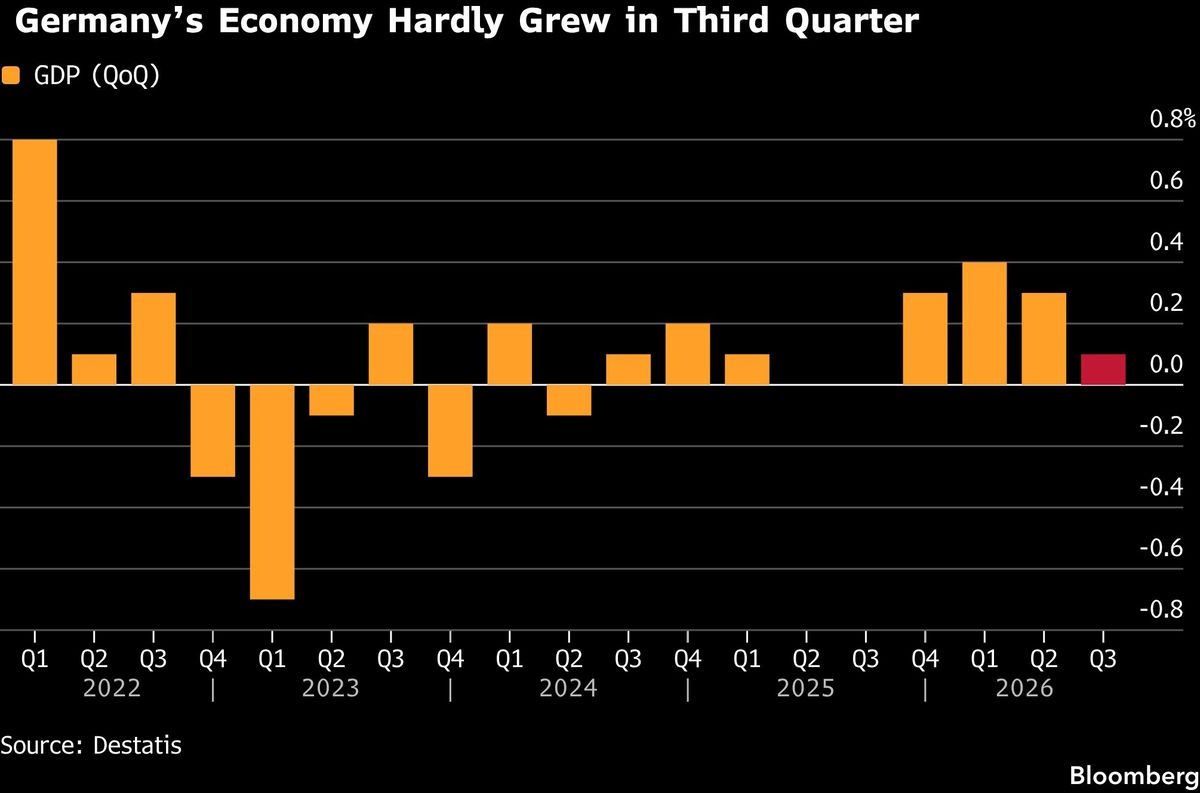
Gross domestic product rose 0.1% between July and September, less than the 0.2% preliminary reading, the statistics office said Wednesday (Nov 25). While government spending jumped 0.3% from the previous three months and private consumption increased 0.1%, capital investment sank 1.2%.
The economy is still on track for its best year since 2022 after German Chancellor Friedrich Merz’s government launched a vast public-spending drive to shore up infrastructure and defence capabilities.
Exports, the country’s traditional growth driver, also played a key role in the first half of the year as companies benefited from the global investment boom in artificial intelligence. The pharmaceutical industry probably saw extra demand before new US tariffs and chemical firms got a temporary boost from the Iran war hurting Asian competitors.
That changed in the third quarter as goods exports fell 0.8%, driven by decreases in cars, chemicals and metals, Destatis said. Imports dropped even more strongly, however.
Michael Herzum, an economist at Union Investment, said private investment remains the weak point of Germany’s recovery.
“The high level of geopolitical uncertainty during the summer months dampened companies’ willingness to invest,” he said in a statement, adding it’s crucial that firms resume doing so to expand production.
Commerzbank chief economist Joerg Kraemer said the development shows companies’ disappointment about the government’s inability to enact economic reforms.
The Bundesbank has said activity will pick up again in the final quarter as exports regain momentum. Overall, the government’s economic advisers expect 1.3% expansion in GDP this year followed by 1% in 2027.
Uploaded by Arion Yeow