

SINGAPORE (Nov 25): By rights, China should be having a terrible year. Oversupply and debt are weighing down its property sector, a key pillar of its economy. Companies aren’t investing, consumers are reluctant to spend, and the government has already pulled its favoured financial levers. All the while, war in the Middle East is challenging the biggest oil importer.
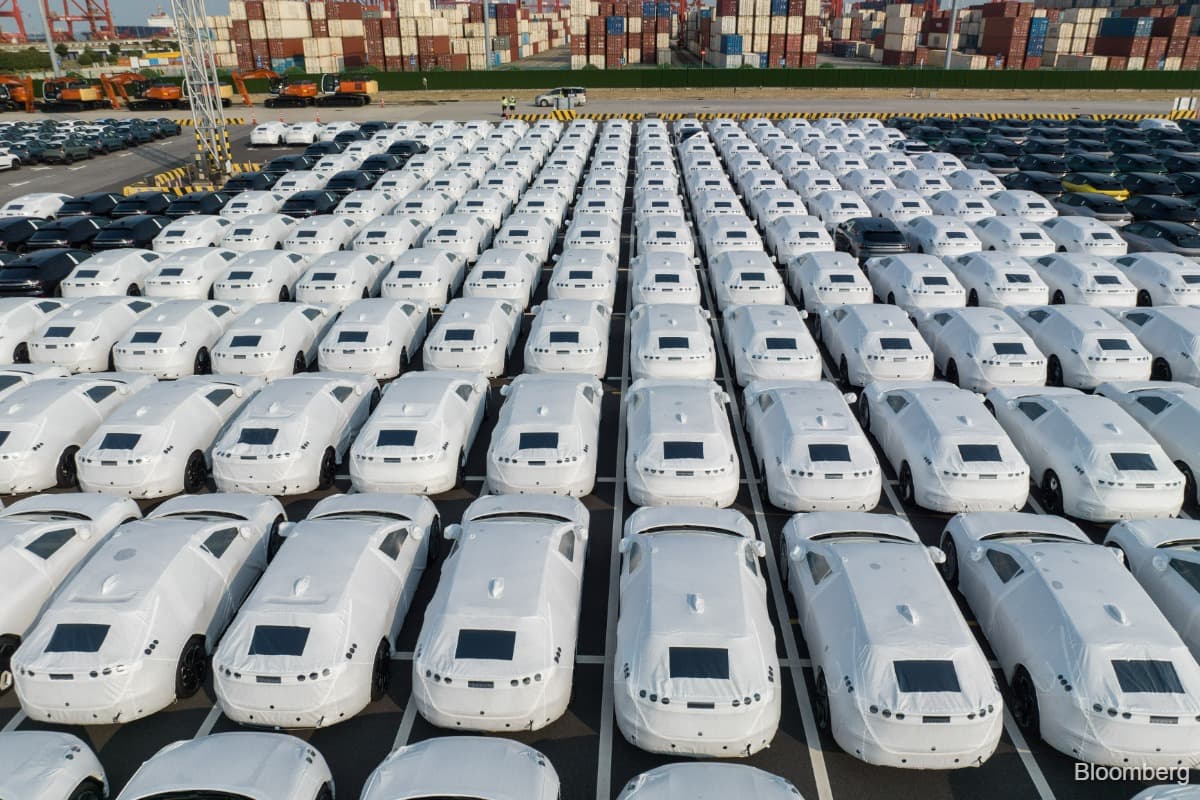
And yet, once again, the world’s second-largest economy should meet Beijing’s targets. Analysts debate the reliability of official growth figures, but exports have been strong for months in spite of multiplying trade barriers. Factories are busy, and trendy restaurants in Shanghai are bustling. The country’s cars, machinery, electronics and cheap consumer goods keep finding their way into large, profitable markets.
China has long navigated around the divisions in its economy, but they are widening. As economist Xia Chun wrote in a commentary published in Caixin Global, the much-cited K-shaped economy, in which higher-income workers thrive while everyone else founders, is morphing. Instead, it’s becoming an “i” shape, with a small number of flourishing sectors floating disconnected above the rest.
Plowing capital into artificial intelligence, robotics and export-oriented industries has offered bright spots. Still, that approach leaves China dependent on other countries’ trade policies. This should give everyone pause, including the miners and oil producers relying on China’s seemingly limitless appetite for raw materials.
For much of the past two decades, those companies’ output and China’s capital flowed primarily into property and infrastructure, along with credit and household savings. Vast copper imports, along with the world’s largest cement and steel industries, moved in essentially one direction. The country’s rising home prices created wealth, which fed back into cars, appliances and more property.
That chain broke when the bottom fell out of the real estate market, and the economy was left to digest tens of millions of empty homes. Investment capital, electricity, copper and engineering began to shift into electric vehicles (EVs), clean-energy generation, batteries and factories.
Arguably, the US is seeing something similar with AI. There, too, economists such as Tiffany Wilding at Pacific Investment Management Co have pointed out that rather than expanding the economy, technology is altering it, as gargantuan investments in some areas hide gaps in others.
The Iran war has tested the resilience of Beijing’s model. As a major importer, China has always worried about strategic choke points such as the Strait of Hormuz. Most of its oil comes from overseas, often by ship from the Middle East through the waterway. Any major disruption to those supplies, along with soaring crude and freight costs, should in theory have crippled the economy. Months of war have certainly caused pain. Refineries, especially those private companies dependent on Iranian oil, found themselves under pressure and reduced production. Petrochemical makers suffered. Demand for naphtha, liquefied petroleum gas and other feedstocks dropped.
But China benefited from the billions it’s invested over the decades in renewable energy, nuclear power and EVs to cushion the energy shock, as well as vast crude stockpiles. Factories didn’t stop, and there was no national crisis.
Exports also helped support China’s appetite for raw materials. Commodity trading giant Trafigura estimates 60% of global copper demand growth last year came from the metal embedded in Chinese goods exported to emerging markets. As a result, copper prices, once tightly correlated with Chinese growth, held up for months even with the real estate sector in the doldrums — until concerns about artificial intelligence rattled markets.
The question is how far demand overseas can continue to compensate for weakness at home. During China’s first export boom in the early 2000s, after Beijing’s accession to the World Trade Organization, foreign investment poured into factories, creating jobs and raising wages. Now more of that investment is happening in countries where labour is cheaper, taking the trickle-down effect elsewhere. With exports driving much of the activity that remains, China is also left worryingly reliant on the economic health and choices of others. Moreover, the world simply doesn’t need an infinite number of EVs and washing machines, meaning the current growth rates will have to slow. “It is called defying gravity. Nobody can defy gravity,” says Alicia Garcia Herrero, chief economist for the Asia Pacific at Natixis in Hong Kong. “When you have exports growing at 36% overall, semiconductors growing around 100%, EVs growing at 60% and the world is growing at 2.5%, you know this is not going to last.”
China is counting down to its twice-a-decade Communist Party congress next year. It’s typically a moment for personnel changes, promotions and toeing the line, not bold new directions. The government remains far better at mobilising funds than at redirecting them. “It’s not so much that people do not know what they need to do. It is much more that they do not even dare to say there is something to be done,” Garcia Herrero says. “Everything will be very, very constrained.”