

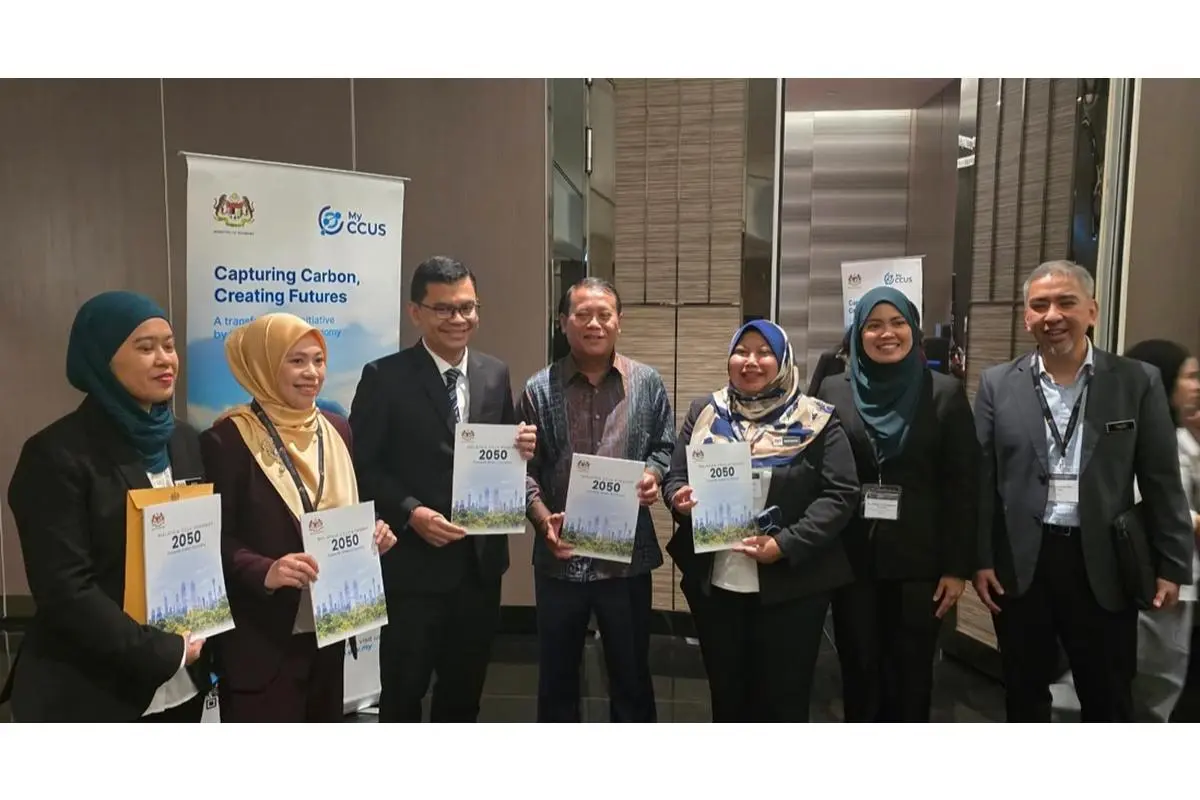
KUALA LUMPUR (Nov 24): The Ministry of Economy has launched a roadmap to develop Malaysia’s carbon capture, utilisation and storage (CCUS) industry. The goal is to help local industries cut emissions and make the country a trusted destination for storing carbon dioxide captured elsewhere in Asia.
Under the Malaysia CCUS Roadmap 2050: Towards Green Economy, the ministry targets three to six CCUS hubs and RM160 billion to RM170 billion in investment by 2050. It also projects US$200 billion (RM823 billion) to US$250 billion in cumulative gross value added and 150,000 to 250,000 direct and indirect jobs at peak operations.
The roadmap builds on the CCUS Act 2025, which sets rules for licensing, cross-border carbon dioxide shipments and the long-term monitoring and management of storage sites.
“Malaysia aspires to be the Northern Lights of the East. Norway’s Northern Lights project demonstrates how carbon dioxide can be captured in one country, transported across borders and stored in monitored geological formations beneath the seabed. Malaysia has the location, geology and offshore experience to pursue a similar role for Asean and the wider Asia-Pacific,” said Economy Minister Akmal Nasrullah Mohd Nasir at the APAC CCUS & Hydrogen Decarbonisation Summit at Pullman Kuala Lumpur City Centre.
“Earning that trust will require government-to-government cooperation, common standards, transparent monitoring and dependable long-term stewardship. Our ambition is to make Malaysia a trusted destination for cross-border carbon storage, supported by clear responsibilities, robust safeguards and commercially sound arrangements,” he said.
The government wants to begin injecting captured carbon dioxide underground as early as 2030. Akmal said the next steps are to assess projects, secure approvals and funding, and plan the facilities and safety measures needed to store the gas.
CCUS has drawn criticism from environmental groups over its cost, environmental risks and who would be responsible for storage sites in the long term.
Asked about those concerns after the launch, Akmal said the government needed to engage with civil society groups and added that the government will need to expand renewable energy and find ways to cut emissions that industries continue to produce.
“But definitely in terms of the bigger picture, I think, as Malaysia has already embarked [on] the journey to achieve net zero, we really have to build up that momentum and really look for the success story overall. But managing it definitely, we have to ensure the process, the mechanisms, will also take care of the impact at the local situations,” he said.
Under the roadmap, the government plans to build the first hubs on the east coast of Peninsular Malaysia, where factories could share pipelines and storage sites to lower costs. The government also plans to negotiate agreements with other countries on shared rules for shipping captured carbon dioxide to Malaysia and storing it safely.
Four projects will establish what it costs to capture carbon dioxide, how the gas can be turned into products and whether it can be stored offshore at scale.
The first is the National Carbon Capture Project, which will test ways to capture emissions from steelmaking at Eastern Steel Sdn Bhd’s plant in Kemaman, Terengganu. The Ministry of Investment, Trade and Industry is leading the project, with Sirim Bhd carrying out the pilot.
For the Southern CCS Hub, Petroliam Nasional Bhd (PETRONAS), Mitsui & Co Ltd and TotalEnergies SE plan to receive captured carbon dioxide at a terminal in Kuantan and pipe its 245km offshore pipeline to the depleted Duyong field. The hub is designed to store up to five million tonnes a year beneath the seabed. Akmal told reporters the PETRONAS-led project was expected to deliver the first injection under the roadmap.
Under Project Dragon, Tenaga Nasional Bhd (KL:TENAGA) is testing how to capture carbon dioxide from exhaust gases at its Jimah East power plant and use it to make products such as synthetic fuels. Its other project, Chlorobloom, uses carbon dioxide from power plant exhaust to grow algae that could be used in aquaculture, animal feed and fertiliser.
The roadmap sets out 27 initiatives. Fourteen advance the industry’s development, while the other 13 cover regulation, financing and incentives, worker training and public education.
Akmal said CCUS could help steelmakers, cement producers, refineries and chemical plants cut emissions that are difficult to eliminate.
“Carbon storage as a service, low-carbon products, blue hydrogen and ammonia could create new commercial pathways. Our oil and gas services and equipment companies, engineers and technicians can apply established expertise to these emerging value chains,” he said in his keynote address.