

(Nov 23): Private-sector activity in the euro area extended its spell of healthy growth as a roaring performance by Germany offset weakness in France.
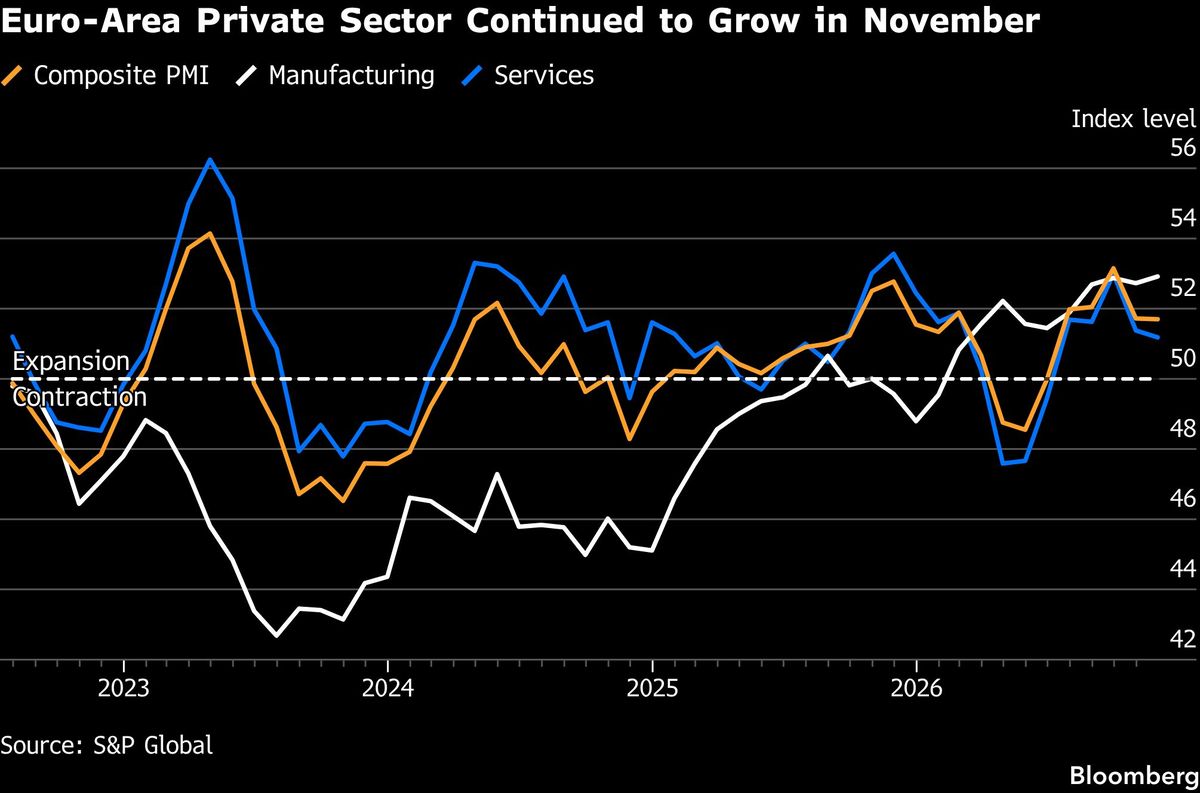
The Composite Purchasing Managers’ Index compiled by S&P Global held at 51.7 in November, remaining above the 50 threshold separating expansion from contraction. Economists had expected it to rise slightly.
The region’s two largest economies diverged dramatically. France, where economic growth has come to a standstill amid fears over the budget and upcoming elections, saw its slump in business activity worsen more than expected. Germany‘s reading, by contrast, surpassed all estimates as vast government spending underpins a long-awaited recovery.
The data “signal sustained steady growth for the eurozone in November,” Chris Williamson, chief business economist at S&P Global Market Intelligence, said Monday (Nov 23) in a statement. “But this overall picture of continuing economic resilience masks worrying divergences in performance.”
Europe as a whole continues to defy headwinds that have included the Iran war, US tariffs and extreme weather. Despite the inflation unleashed by the fighting in the Middle East, the European Commission said last week that growth in the 21-nation euro zone will reach 1.2% this year, a pace it will match in 2027.
Economy Commissioner Valdis Dombrovskis warned, however, that the region can’t take its resilience for granted, highlighting challenges such as stretched public finances in some member states and dwindling competitiveness.
On top of the regional divergence, S&P Global said manufacturing has been faring much better than services due to large-scale investments in defence and artificial intelligence. Many consumer-facing businesses, meanwhile, are suffering from an uncertain political environment, social unrest and high living costs, Williamson said.
That’s also weighing on the outlook for the year ahead, which dipped for the fourth month to the lowest since May. While manufacturers became more optimistic, services sentiment waned.
Tighter monetary policy is presenting an increasing drag, the data showed. The European Central Bank is set to deliver this year’s third-quarter-point increase in borrowing costs in December and officials have recently signalled the hiking campaign may continue beyond that.
Turning to inflation, which is currently at 4%, Williamson said lower oil prices and slumping demand tamed overall pressures in November.
“Alongside the soft-looking labour market indicators from the survey, the slower price growth could ease some concerns about the persistence of elevated inflation if it persists,” he said. “But for now, the surveys send a clear hawkish signal of inflation still running well ahead of the ECB’s 2% target in the coming months.”
PMIs are closely watched by markets as they arrive early in the month and are good at revealing trends and turning points in an economy. A measure of breadth of changes in output rather than depth, business surveys can sometimes be difficult to map directly to quarterly GDP.
Uploaded by Arion Yeow