

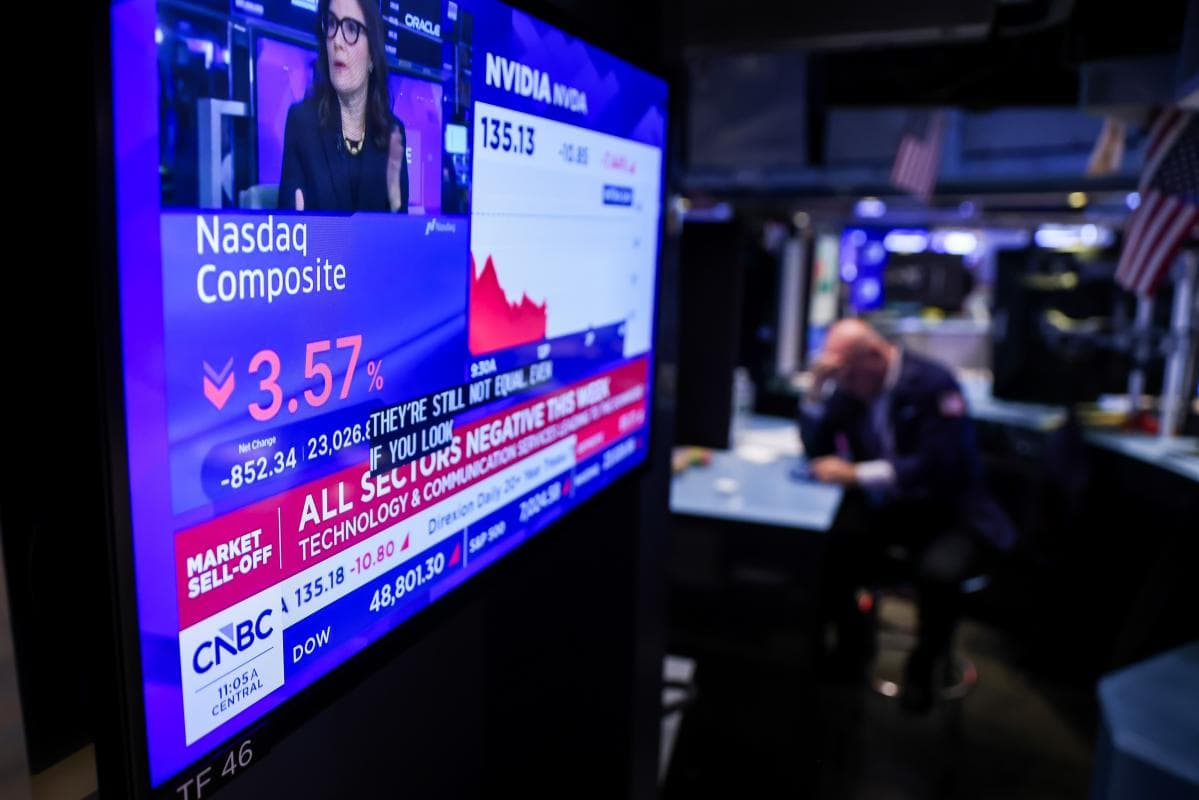
(Nov 23) : Since the fundamental outlook did not change dramatically during last week’s massive selloff in stocks and many valuation measures are now screaming bargain, contrarian impulses to buy the dip are running strong.
Yet for a lot of professional money managers, there are too many lingering questions heading into a holiday-shortened week of trading in the US to lend confidence to the idea that the bottom has been set after the Nasdaq 100 Index extended its drop from an Oct. 6 record to 19.8% and the S&P 500’s drawdown reached 12%.
Among those questions: Will the headlines continue to move beyond Jensen Huang’s personal life and into the financial decision made at Nvidia Inc. under his leadership? Will either sophisticated hedge funds or retail traders be willing to buy the dip Monday morning? Will the Federal Reserve follow through on raising interest rates as foreshadowed in speeches by several of its policymakers last week?
“The market is working through a stack of problems at once — inflationary pressures, a December rate hike, and renewed doubt about what AI returns actually look like in 2028 and 2029,” said Dave Mazza, chief executive officer at Roundhill Investments. “None of that resolves next week, and with no positive catalyst on the calendar, buyers have little reason to show up with conviction.”
At Goldman Sachs Group Inc., the equity trading desk is telling clients that panic like last week’s is usually a good opportunity to buy — but there are important differences with this setup. The first is that the Fed is in a hiking cycle. And secondly, investor positioning is complicated: While hedge funds are “overwhelmingly downbeat” and have cut leverage to a five-year low, other groups remain relatively well-invested and believe hedge funds will be forced to buy back in. So the Goldman traders suggest profiting from what may have been the worst of the volatility by selling put options rather than bottom-fishing in equities.
The selloff has also spread across systematic investors, with commodity trading advisers, or CTAs, selling an estimated US$57 billion in equities over the past month, according to Goldman’s estimates. Their net positioning in US stocks has turned short by US$19 billion. While systematic flows remain a source of selling pressure globally, most of the remaining risk is now concentrated outside the US. In the US, much of the selling has already taken place, and CTAs could become buyers if stocks rebound, Goldman’s models show.
“We can make a pretty compelling argument that vol has overshot without necessarily having to call the bottom in equities,” the traders wrote in a note to clients.
That type of sentiment was echoed by many on the buy side.
“It feels like we are getting to the point that the selling may be exhausted and a bounce should be in the offing — but there are no real identifiable catalysts,” said Joe Gilbert, portfolio manager at Integrity Asset Management. “A flat week next week may be a victory for the bulls.”
For many deciding whether to buy the dip, however, the first step is wrapping their heads around what created all that turbulence that crashed stocks and sent the Cboe Volatility Index to a 19-month high of almost 36 by the end of the week.
After all, there were high hopes that two events – Nvidia’s earnings report on Tuesday and Anthropic PBC’s stock market debut on Thursday – would revive confidence in the wobbling AI trade that had fueled the bull market for four years. Instead, the S&P 500 extended its losing streak to seven straight days, posting a weekly loss of 8.6% — its worst in 19 months.
Liquidity Strained
For some, Anthropic’s record US$119.5 billion equity offering was too much for the market to handle, especially given the turmoil in the AI trade amid growing scrutiny of Huang and Nvidia.
“Anthropic sucked a massive amount of liquidity in an already weak AI narrative,” Daniel Kim, chief investment officer at Penserra Global Investors, said on Friday. “I read this week as a washout, and I think Anthropic was likely the final shoe to drop. Good news was sold all week, and by Friday hedges like gold were being sold alongside semis, which is the mark of forced selling. And that tends to exhaust itself quickly.”
Yet a short trading week upcoming in the US – markets are closed on Thursday and half of Friday for Thanksgiving – could also strain liquidity.
“I would not be surprised if the unwind continues through the shortened week, since thin holiday liquidity is a poor setting for the market to form a new view,” Kim added. “Once that selling has cleared, we could get a strong rally heading into Christmas.”
Of course, much of the market’s sentiment will hinge on what more shoes may drop in the saga involving Jensen Huang and Nvidia. The chipmaker’s strong earnings report — total sales rose 103% in the latest quarter and revenue is expected to grow 75% in the next fiscal year – only led to a brief rebound in the shares before scrutiny of the company and its former leader continued to build throughout the week.
Nvidia Probes
California Attorney General Rob Bonta said on Thursday that the chipmaker is being investigated in his state to determine whether any of its actions resulted in advanced chips or confidential information being improperly obtained by China. His office is also looking into whether the company misled investors about the situation.
That same day, two Democrats on the House Foreign Affairs Committee asked the Commerce Department to turn over information regarding allegations that Nvidia tried to influence an inquiry into Megaspeed International, the cloud computing company linked to the woman who had a relationship with Huang.
And on Friday, Reuters reported that the US Securities and Exchange Commission was probing the company over potential accounting issues.
Nvidia ended the week down 23%, its worst since 2008, and has lost 48% since Oct. 6.
Given the company’s crucial role as not only the seller of the most important chips used in AI, but also its significance as the “Bank of Nvidia” providing financing to a wide array of players in the industry, each negative headline hurt the broader market as well.
Traders watched as crucial technical levels like the 200-day moving average and even the round number of 7,000 offered no support to the S&P 500, which closed the week at a seven-month low of 6,910.39.
“I thought 7,000 had at least a real chance of being a level where the market would find support,” said Steve Sosnick, chief strategist at Interactive Brokers. “Then the latest Nvidia stuff came out and it was ‘boom,’ like a knife through butter.”
To Keith Lerner, chief investment officer of Truist Advisory Services, it’s not that investors lost confidence in the long-term potential of AI last week, it’s that they lost confidence in the earnings forecasts that have been supporting stocks tied to the industry. And that loss of confidence is being amplified by a Fed that is signaling additional rate hikes.
Indeed, even as Nvidia and Anthropic captured most of the market’s attention during the week, many investors made note of a series of speeches by Fed policymakers with hawkish tones. On Wednesday, Fed Governor Christopher Waller even urged his colleagues to consider a larger, half-percentage-point rate hike at its December meeting.
“Perhaps the market is waking up to the idea that we’re actually in a rate hiking cycle,” said Roundhill’s Mazza.
Still, as investors prepare for a new week of trading, the question on many of their minds is when — not if — to buy the dip.
“We may see a bit more technical declines come on Monday or retail waking up and de-risking,” said Nadine Terman, chief executive officer of Solstein Capital, who expects declines to follow through in Asia and Europe at the start of the new week.
Yet she added: “I am just on the phone now with a client talking about timing for bottom feeding.”
uploaded by Isabelle Francis