

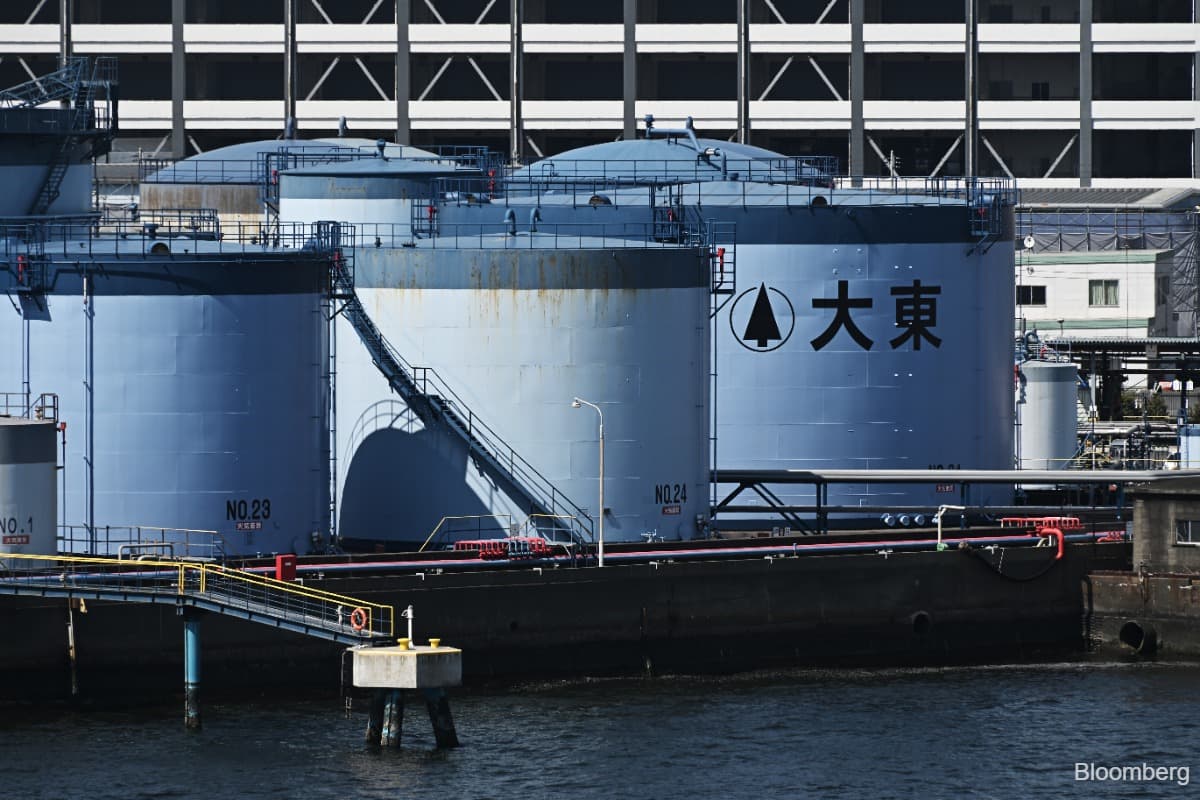
(Nov 20): Saudi Arabia reached an agreement to help replenish Japan’s depleted crude stockpiles and expand the kingdom’s own storage capacity in the Asian country.
The accord is further evidence of how major producers and consumers are taking steps to boost energy security after the US-Iran war caused the greatest oil supply disruption in history.
Tokyo will buy as much as eight million barrels of Saudi crude for its national petroleum reserve, subject to favourable market conditions, according to a joint statement on Friday carried by the Saudi Press Agency.
Riyadh will also be given temporary use of 16 million barrels of oil storage capacity in Japan, expanding its existing eight million-barrel holding. The kingdom has already begun to replenish these facilities, according to the statement.
Stockpiles of crude and fuel in consuming nations played a vital role in the initial months of the Middle East war, when tanker traffic through the Strait of Hormuz was almost entirely choked off by Iranian attacks. They helped to ensure sufficient supplies of products like jet fuel through the summer travel season and mitigated price spikes.
Japan released oil from its national reserves last month as part of an effort coordinated by the International Energy Agency (IEA). Overall, IEA members agreed to discharge a record 400 million barrels from emergency stockpiles.
The agreement followed a Nov 9 virtual meeting between Saudi Energy Minister Prince Abdulaziz bin Salman and Japan’s Minister of Economy, Trade and Industry Ryosei Akazawa. They reaffirmed the two countries’ strategic partnership and support for long-term energy security, according to the statement.
The recovery in oil flows from Persian Gulf producers to near prewar levels has shifted the conversation in the global market. Brent crude has slumped more than 20% this month to about US$90 (RM369.97) a barrel and the world faces a “sizable surplus” next year that’ll drag prices lower, according to Goldman Sachs Group Inc.
One of the key questions is how and when major oil importers, which ran down their emergency stockpiles at the height of the Hormuz crisis, will make purchases to rebuild their supply buffers. The Saudi-Japan pact is one of the clearest signs yet that consumers are now considering this.
Major Persian Gulf oil exporters are also looking for ways to increase their resilience in the face of continued threats to shipping through Hormuz. Saudi Arabia has held talks with foreign governments to give state-owned Aramco access to their strategic oil storage. Last month, Singapore agreed to store the kingdom’s oil in caverns from the second half of next year.
The world needs “expanded strategic storage, larger stockpiles of products and flexible refining capacity closer to consumer markets,” Sultan Al Jaber, the chief executive officer of Abu Dhabi National Oil Co, said earlier this month. The company already signed agreements to cooperate on strategic stockpiles with South Korea and India.
Uploaded by Felyx Teoh