

This article first appeared in The Edge Malaysia Weekly on November 23, 2026 - November 29, 2026
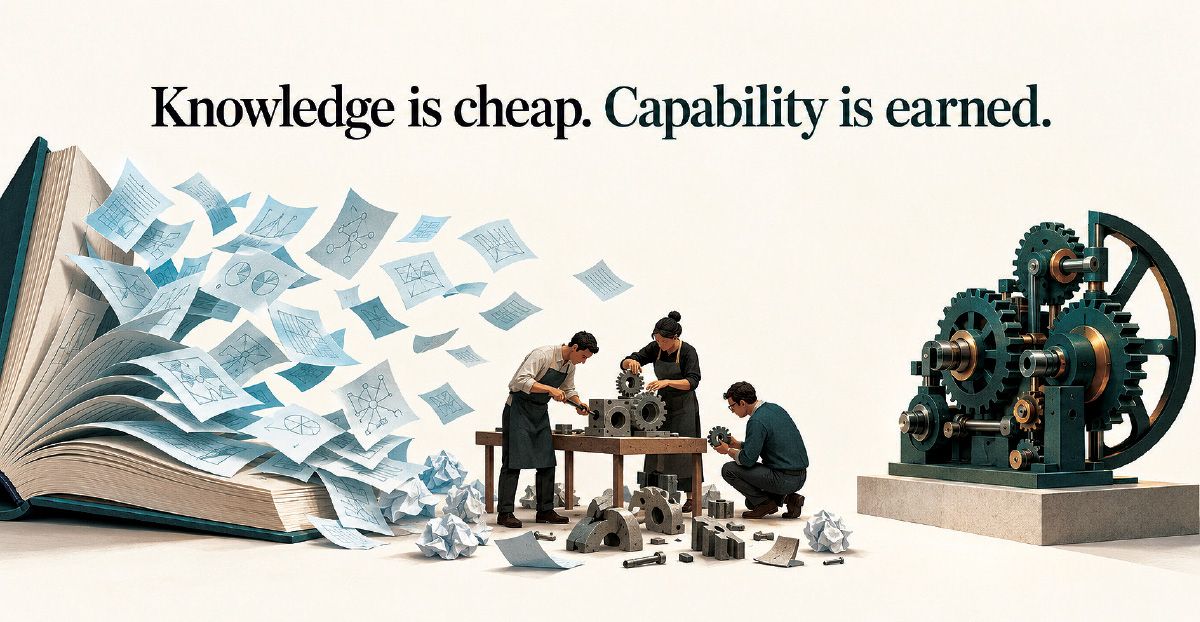

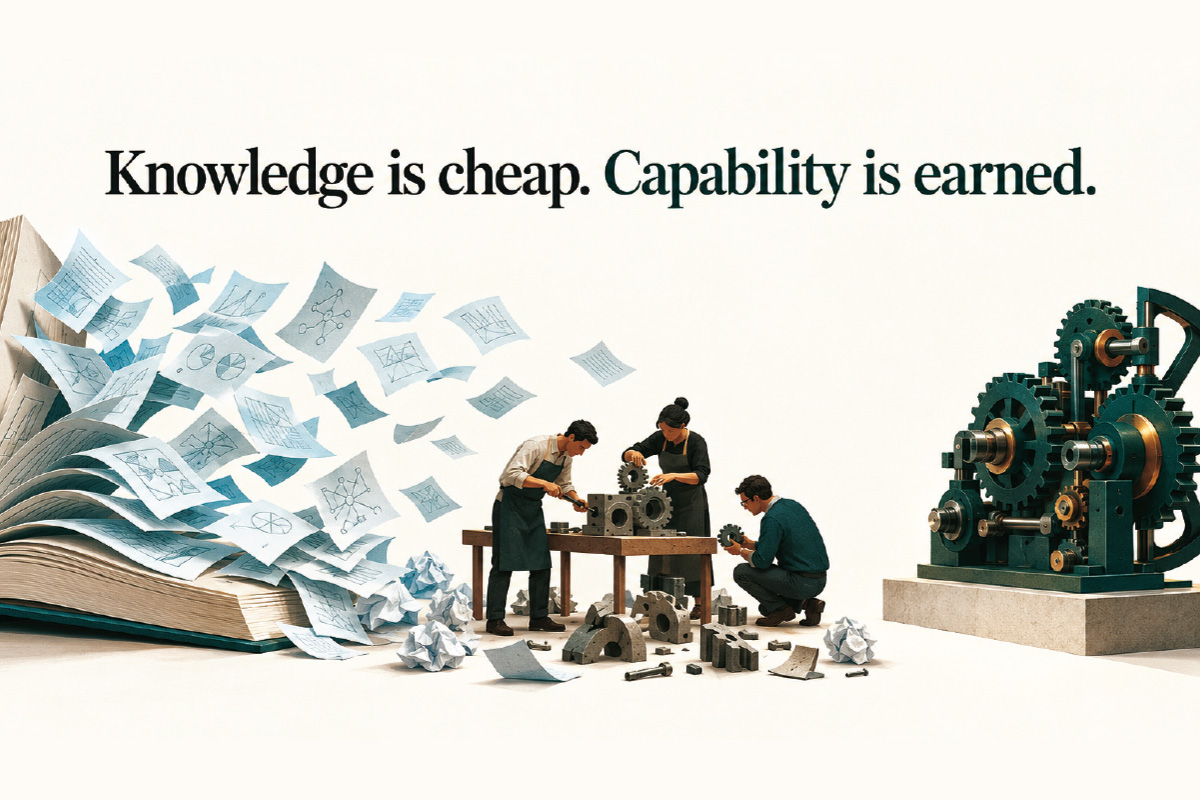
The means of acquiring knowledge have never been more accessible. A company can buy the same machine as a successful rival. Governments can study the policies of prosperous countries. Artificial intelligence (AI) can now explain technical problems in seconds.
Clearly, knowledge is central to what people and firms can do. Yet, if knowledge is so widely available, why is prosperity so difficult to reproduce?
Part of the answer can be found in one of the most famous anecdotes in economics. In The Wealth of Nations, Adam Smith famously illustrates the division of labour with the example of a pin factory. By dividing production into specialised tasks, workers make far more pins than if each person made a complete pin alone. Repetition improves workers’ dexterity; it also exposes inefficiencies and encourages improvements in the production process.
Kenneth Arrow later formalised this process as “learning by doing”: Production itself generates knowledge. Workers become better at a task by performing it repeatedly, solving problems and discovering improvements along the way. This helps explain why prosperity cannot simply be copied. Much of the knowledge that underpins it is developed through the process of production itself.
But there is another problem, too. The knowledge generated through production is often dispersed. A worker might understand the behaviour of a specific machine; a supplier might know why a component is delayed; and so on. As Friedrich Hayek observed, no single planner can conceivably possess all of this information. Markets help people respond to what others know.
Firms may also possess knowledge without having much reason to act on it. This is where competition matters. As Michael Porter argued, companies do not become internationally competitive simply because they start with cheap labour or abundant resources. Competitive rivalry forces firms to have a reason to put knowledge to work. They must experiment, improve and learn from mistakes because customers have somewhere else to go.
These insights are often studied separately. Together, they point to a broader distinction between access to knowledge and the ability to act on it.
A factory may know how a product should be made yet fail to make it consistently. It may purchase excellent equipment but lack the maintenance skills to keep it running. It may hire an experienced engineer while lacking suppliers able to meet the required standards. What is missing cannot always be found in a manual. It resides in workers’ judgement, organisational routines and relationships built through repeated problem-solving.
Consider a production fault. One factory stops the line and waits for outside help. Another identifies the cause, adjusts the process, works with its supplier and prevents the fault from recurring. Both may have access to the same technical information, but only one has developed the capability to put that knowledge to work.
The same distinction applies at the level of an industry or country. Productive capability has to be developed through sustained activity. An industry does not move up the value chain simply because sophisticated machinery arrives at its ports, nor does a country become more capable simply by producing more graduates, building research centres or accumulating patents. These measures tell us something valuable, but they do not reveal whether firms can solve difficult problems, improve their products and keep lowering costs.
This gap between access to knowledge and the ability to turn it into productive capability becomes all the more important as knowledge becomes more abundant. AI makes it cheaper and easier to access and use knowledge. It can suggest a process improvement, help write software and analyse a technical failure. But even powerful tools cannot remove the need to put knowledge into practice. Someone must still test the suggestion, adapt it to a particular workplace and make it work repeatedly. A useful answer is the beginning of learning, not proof that capability has been acquired.
Two firms may, for instance, have access to the same AI system, yet use it very differently. One may use it to reorganise production and cut defects. The other may produce a report about cutting defects without changing how it operates. The difference lies in whether knowledge changes how the firm produces and solves problems.
Smith showed how specialisation raises productivity. Arrow showed how production generates learning. Hayek showed how dispersed knowledge can become coordinated through markets. Porter showed how competition pushes firms to upgrade. These ideas trace a path from information to action — and from repeated action to durable capability.
The question is: what gives people the reason to turn knowledge into capability? The Economic Evolution looks one step deeper, asking what makes this transformation possible.
Knowledge may be becoming ever more abundant, but capability remains scarce.
Portfolio commentary
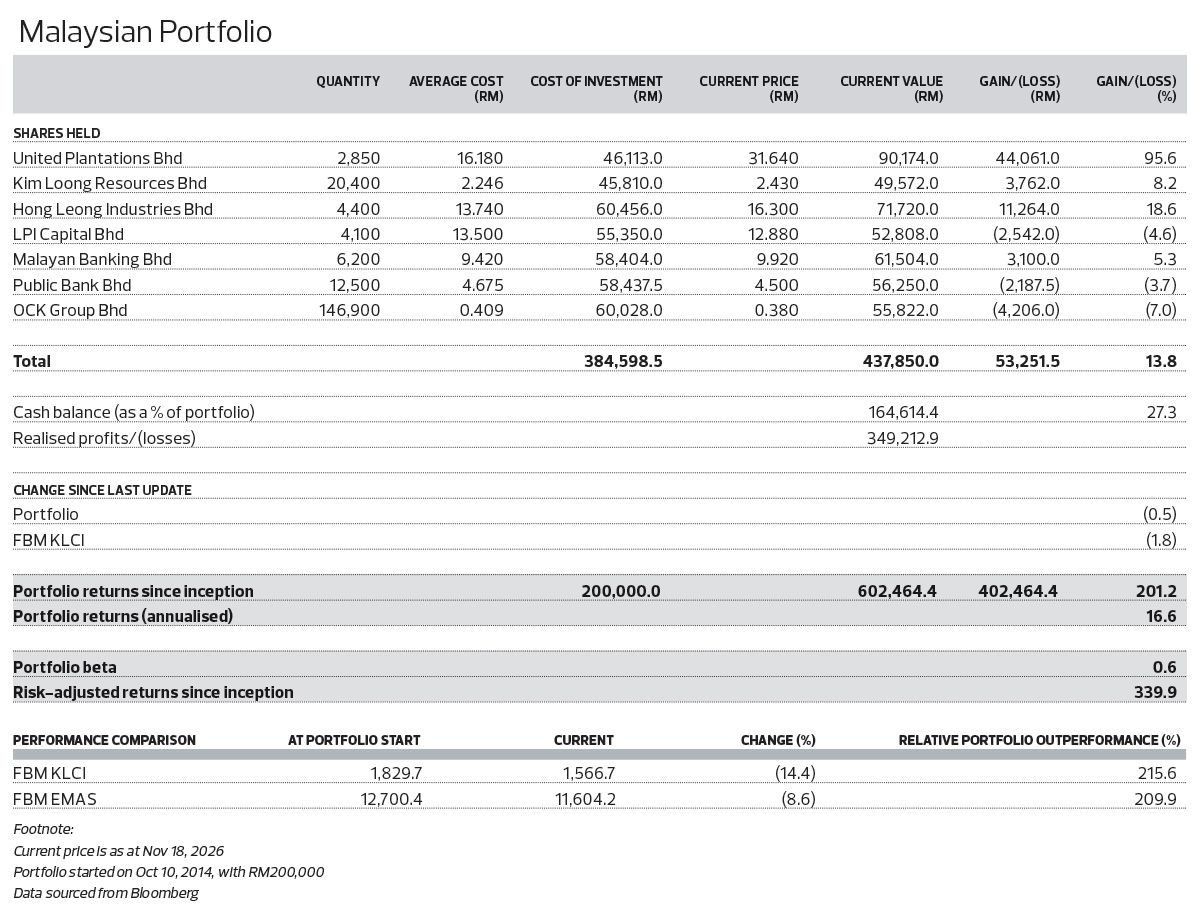
The Malaysian Portfolio was resilient in the face of the global equity market selloff. The portfolio closed marginally lower for the week ended Nov 18, down 0.5%, faring better than the benchmark FBM KLCI, which fell 1.8%. The only winners for the week were United Plantations (+4.6%) and Kim Loong Resources (+0.8%). The biggest losers were OCK Group (-7.3%), Hong Leong Industries (-3.0%) and Public Bank (-0.7%). Total portfolio returns now stand at 201.2% since inception. This portfolio is outperforming the benchmark FBM KLCI, which is down 14.4% over the same period, by a long, long way.
The Absolute Returns Portfolio fell 4.8% last week, paring total portfolio returns to 22.4% since inception. All stocks ended in the red. The biggest losers were Alibaba Group Holding (-15.2%), Nvidia Corp (-13.1%) and Singapore Tech Engineering Ltd (-11.6%).
The AI Portfolio also ended sharply lower, down 6.0%. Last week’s loss sent total portfolio returns back into negative territory, at -0.1%. There were only two gainers for the week, Naura Technology (+4.8%) and Amazon.com Inc (+0.6%) while the top losers were Unusual Machines (-24.0%), Alibaba (-15.2%) and Datadog (-9.4%).
Disclaimer: This is a personal portfolio for information purposes only and does not constitute a recommendation or solicitation or expression of views to influence readers to buy/sell stocks. Our shareholders, directors and employees may have positions in or may be materially interested in any of the stocks. We may also have or have had dealings with or may provide or have provided content services to the companies mentioned in the reports.
Save by subscribing to us for your print and/or digital copy.
P/S: The Edge is also available on Apple's App Store and Android's Google Play.