

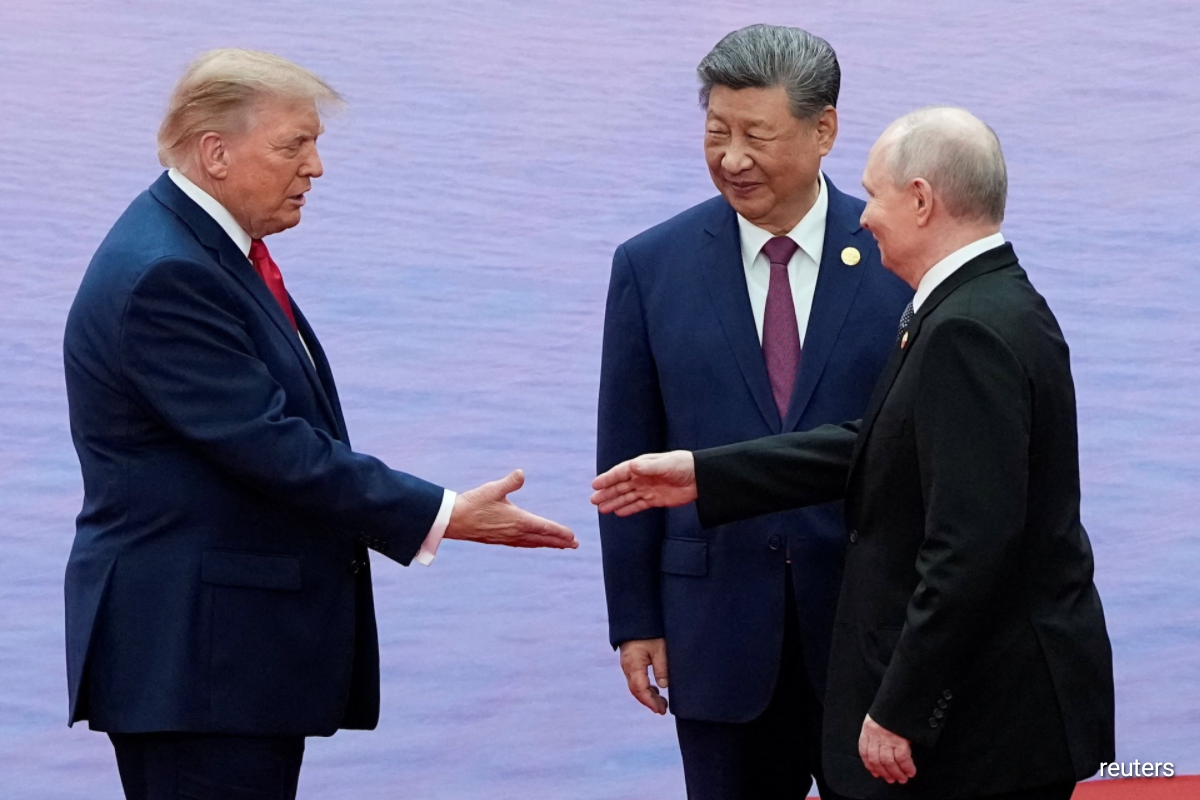
LONDON (Nov 19): Sometimes, who isn't in the room is as conspicuous as who is.
When US President Donald Trump, Chinese President Xi Jinping and Russian President Vladimir Putin meet on Thursday at the Asia-Pacific Economic Cooperation forum, Europe, the world's largest trading bloc, will be notably absent.
China has said the three-way summit will be of "groundbreaking significance" for world peace and stability. The leaders have no shortage of global crises to discuss: Russia's years-long war in Ukraine; the protracted war in Iran; nuclear arms control; and the race for supremacy in artificial intelligence.
Major diplomatic breakthroughs appear unlikely, but the symbolism still matters. The three-way gathering echoes an older era of great-power politics, when a handful of capitals sought to settle questions affecting much of the world over cigars and drinks.
The European Union is not an APEC member. Even so, Europe has as much at stake in the summit's biggest questions as anyone at the table. Its absence at such a consequential moment highlights the gulf between the bloc’s enormous economic weight and its limited geopolitical clout.
PUNCHING BELOW ITS WEIGHT
Europe is an economic powerhouse by almost any measure. In 2025, EU trade with the rest of the world totalled just over €8 trillion ($8.8 trillion), equivalent to almost 16% of global trade in goods and services, ahead of the US at 13.5% and China at 13.0%, according to EU data.
Yet the bloc’s geopolitical power does not match its economic weight. The Ukraine conflict is a prime example.
Any durable settlement would be difficult to implement without European participation. For starters, the conflict is on the European continent, and any resolution could involve Ukraine joining, or agreeing not to join, EU-related bodies. The other issue is the EU’s past and present economic relationships with Russia and the US.
Before Russia's 2022 full-scale invasion of Ukraine, Europe was Moscow's most important energy market. Russia supplied around 40% of EU natural gas imports and a quarter of its oil imports, earning around €100 billion from EU energy sales in 2021, equal to 62% of total EU imports from Russia.
Moscow thus has a powerful incentive to seek a resolution that would restore some of those commercial ties as it seeks to repair an economy battered by years of war and sanctions.
Any revival of Europe’s energy ties with Russia would have significant consequences for Washington. US energy producers filled much of the gap after Europe cut most Russian oil and gas imports in 2022. The US is currently the EU's largest oil supplier and has provided nearly two-thirds of its liquefied natural gas (LNG) imports so far this year.
Trump has nevertheless repeatedly sidelined Europe in his efforts to negotiate an end to the Ukraine conflict, while Moscow has resisted European efforts to secure a place at the negotiating table.
This partly reflects Trump’s preference for bilateral deals, but it also reflects the divisions within the EU, particularly between western and eastern European members with sharply different views of the threat and opportunity posed by Moscow.
The nearly nine-month Iran war also highlights the bloc’s waning geopolitical heft.
European powers were central to the diplomacy that produced the 2015 Iran nuclear deal during former US President Barack Obama’s administration. In theory, Europe could play an important role in hashing out a settlement to end the current conflict, whether by helping to secure shipping through the Strait of Hormuz or by agreeing to monitor a renewed agreement over Tehran's nuclear programme.
But Europe has thus far mostly kept its distance, responding primarily with strongly worded statements. Even if European leaders intervened, they would likely have far less luck than countries such as Pakistan and Qatar.
That’s because economic leverage is not the same as geopolitical influence.
A GENTLE GIANT
The EU is not a superpower like the US or China. As Canadian Prime Minister Mark Carney suggested earlier this year, Europe is among the loosely defined middle powers.
So what explains this, given the EU’s size, wealth and the continent's long history at the centre of global affairs?
First, the EU’s foreign-policy machinery is consensus-driven and often cumbersome. The bloc can only wield its formidable collective economic power through sanctions, regulation and trade policy when its 27 members agree. National governments also retain substantial control over foreign and security policy.
Military power exposes the gap most starkly. The EU's members collectively spent €418 billion on defence in 2025, up 20% from a year earlier as governments responded to the Russian threat and the Trump administration’s pressure on Europe to shoulder more of its own defence burden.
But even €418 billion in national military spending does not create an EU military. Armed forces remain under the control of member governments, while Europe's collective defence still depends heavily on the North Atlantic Treaty Organization (NATO) and, ultimately, US military power.
Recognising the problem, France, Germany and nine other EU members have recently called for reforms to make the bloc's foreign policy decisions faster and harder for individual governments to block.
But enacting changes will not be simple with so many disparate interests, particularly as European parties on the far right and far left, many of whom are suspicious of EU military action, gain popularity.
Ultimately, transforming the EU from an economic powerhouse into a geopolitical force will require more than procedural reform. It will require a rethink of the bloc’s identity.
If this doesn’t happen, Europe risks being left out of discussions that could have profound implications for its economy and national security. Shenzhen offers a preview.
Uploaded by Siow Chen Ming