

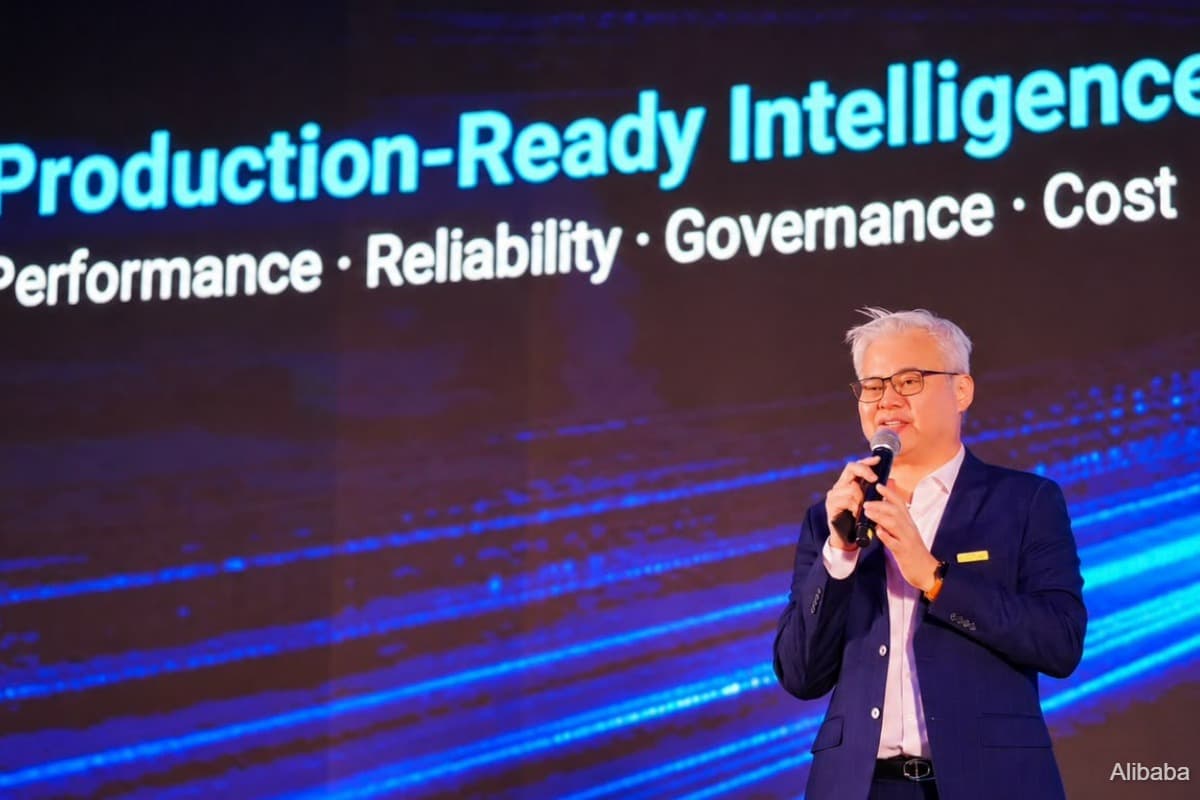
KUALA LUMPUR (Nov 19): Alibaba Cloud has launched Qwen4-Max, its latest large language model, as it looks to capture a bigger share of the enterprise artificial intelligence (AI) market by offering businesses a cheaper way to handle complex tasks and workflows.
Built for coding, research, visual reasoning and other professional tasks, the model was unveiled at the Qwen Conference Malaysia 2026 on Thursday, with Alibaba highlighting efficiency and practical applications as its main improvements over its predecessor.
Choong Hon Keat, general manager of Malaysia at Alibaba Cloud Intelligence, said enterprise customers in Malaysia had moved beyond the early stages of AI planning, with some already putting their plans into action.
He said progress varied across industries, depending on each company's appetite for risk and the regulatory and compliance requirements involved in integrating AI into its operations.
"They are at a more advanced stage in terms of planning. Some are also executing as well, depending on the appetite because there are risks to be managed, there are compliance to be managed, there are regulations that they need to follow," he said in an interview with Digital Edge on the sidelines of the launch.
Also present was Lin En Shu, head of solutions architect at Alibaba Cloud Intelligence, who said businesses were beginning to realise that getting value from AI meant learning to delegate work to the technology rather than using it merely to answer questions.
"The main learning of using AI especially is really about delegating your work to AI."
He said companies first needed to understand how to work with the technology before deciding where to deploy it, with some already relying on AI for routine tasks such as preparing reports and analysing data.
He added that agentic AI platforms, which can carry out tasks with minimal human input, could help small and medium enterprises improve their operations.
As more companies move in this direction, Alibaba is positioning Qwen4-Max as a model capable of handling more specialised tasks, with Lin saying it was designed to complete specific jobs reliably rather than simply top benchmark rankings.
"You don't need to use the most expensive models every time. You just need to get the job done and done right according to what you ask it to do."
He said each AI model had its own strengths, with customers increasingly selecting models based on the tasks they needed to perform.
Qwen4-Max has 2.4 trillion parameters, but only 71 billion are activated for each token, or unit of text, it processes.
It also comes with built-in image understanding and a one-million-token context window, allowing it to process large amounts of text, including lengthy reports, in a single session.
Alibaba said the model ranked sixth on Code Arena, a leaderboard based on real-world coding tasks, and outperformed its predecessor, Qwen3.8-Max, on the company's Work360 benchmark, which tests performance across 721 specialised industry fields.
The company added that Qwen4-Max uses 35% fewer tokens than its predecessor in high-effort reasoning mode, reducing the average cost per task by about 60%.
Lin noted, however, that the model could take longer to complete certain tasks because it performs additional checks to ensure its output follows users' instructions.
"The key difference that I noticed with Qwen, it takes longer. Yes. And the reason is because it checks its own homework."
Beyond the new model, Lin said Alibaba was also developing AI applications tailored to specific industries, including specialised tasks such as 3D modelling and circuit design.
On the local front, Choong said Malaysia remained an important market for Alibaba Cloud, which will mark its 10th year in the country in 2027.
He said the company would continue working with local businesses, partners and institutions to develop AI skills through training programmes and hands-on sessions across the country.
Alibaba Cloud also announced the opening of its third data centre in Johor, bringing its total in Malaysia to six, with the other three located in Kuala Lumpur.
The expansion is aimed at providing businesses with more local capacity to run cloud and AI operations, including companies that need to keep their data within Malaysia.