

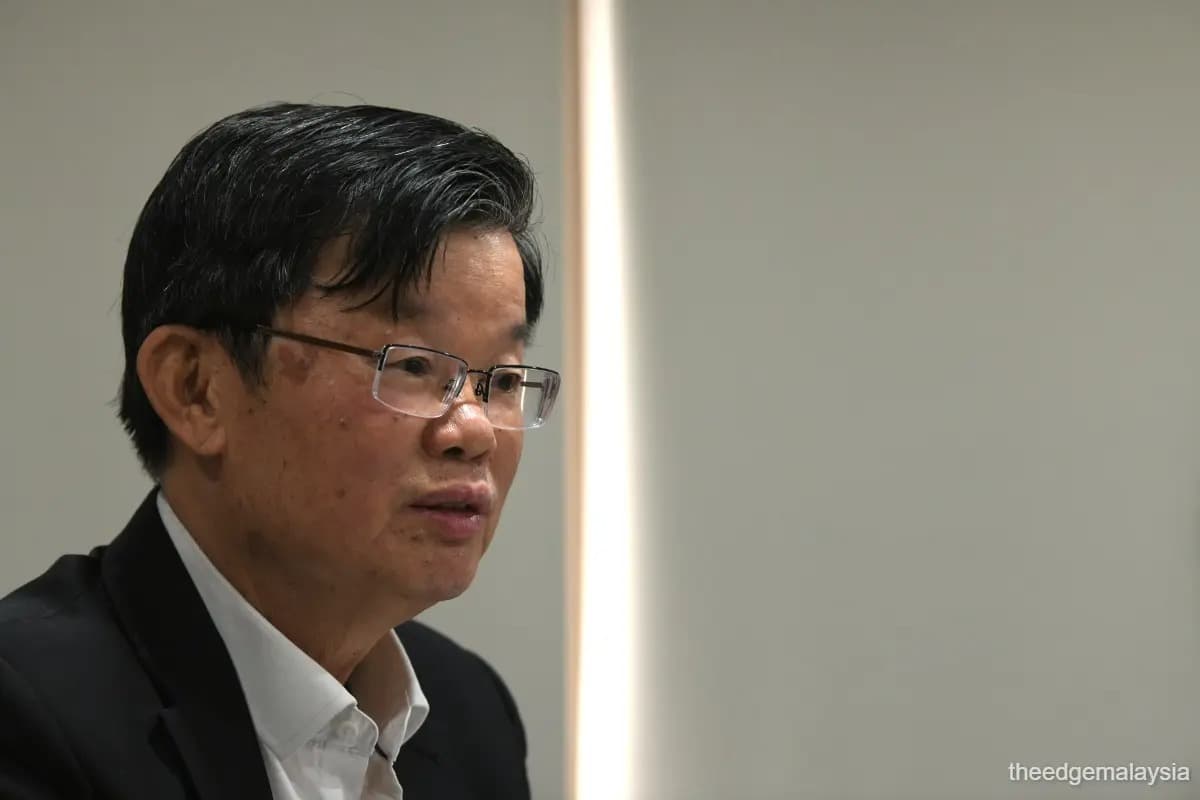
KUALA LUMPUR (Nov 19): Penang Chief Minister Chow Kon Yeow has defended the state's RM24.6 billion water supply agreement with Perak, saying it includes safeguards to protect Penang from supply disruptions and is a cheaper alternative to developing its own desalination facilities.
In a statement on Thursday, Chow criticised Bagan Member of Parliament Lim Guan Eng for repeatedly questioning the 40-year agreement despite explanations provided to state lawmakers and shareholders of PBA Holdings Bhd (KL:PBA).
The agreement, signed between PBA Holdings' subsidiary Perbadanan Bekalan Air Pulau Pinang Sdn Bhd (PBAPP) and Perak's Prasarana Air dan Irigasi Perak Sdn Bhd (PAIPP), will see Perak supply between 300 million and 500 million litres of treated water daily to Penang.
Under the agreement, PBAPP will pay a fixed capacity charge of RM210 million annually, amounting to RM8.4 billion over 40 years, alongside an estimated RM16.2 billion in charges for water supplied.
Chow explained that the fixed payment is meant to cover the construction and financing of a RM3 billion water treatment plant dedicated to Penang, rather than payment for the water itself.
Perak will bear the upfront construction and financing risks, as well as responsibility for maintaining and upgrading the infrastructure, while PBAPP will not be required to make any upfront capital contribution.
Chow stressed that Penang would only pay supply charges for water actually delivered and meeting agreed quality standards. If Perak fails to supply the required volume or quality, PAIPP would generally be required to compensate PBAPP.
However, exceptions apply in circumstances beyond Perak's control, such as severe drought or when the state's own water needs must take priority.
Chow said that if supply is suspended for more than three months through no fault of PBAPP, either party may seek to renegotiate the agreement.
Should negotiations fail after a further three months, the agreement may be terminated, with PBAPP required to settle the remaining capacity charges at a discounted value rather than continue making annual payments until 2072.
Chow said desalination, the next best alternative, would be considerably more expensive, with PBAPP's internal estimates putting the lifetime cost of a 300 million-litre-per-day desalination plant alone at more than RM25 billion.
He argued that Penang needed to secure new water sources as its existing surface water resources are expected to be fully utilised by 2030, while demand is projected to exceed 1,100 million litres daily by 2032.
His statement followed Lim's criticism on Wednesday of the RM210 million annual payment, which the former chief minister argued could leave Penang financially exposed even if Perak failed to supply treated water.
Lim also raised concerns over potential increases in water tariffs and cited objections from five PBA Holdings directors over the agreement's payment terms.
Chow maintained that the agreement had been discussed at two state assembly sittings and approved by shareholders at PBA Holdings' extraordinary general meeting on Nov 12, with about 98% of votes cast in favour.
The agreement forms part of the Northern Perak Water Supply Scheme, which involves Gamuda Bhd (KL:GAMUDA) and Perbadanan Kemajuan Negeri Perak in developing water infrastructure to serve Perak and Penang.
According to a July 15 report by The Edge, the project is expected to begin supplying treated water to Penang in the first quarter of 2032, subject to regulatory approvals and completion of the necessary infrastructure.