

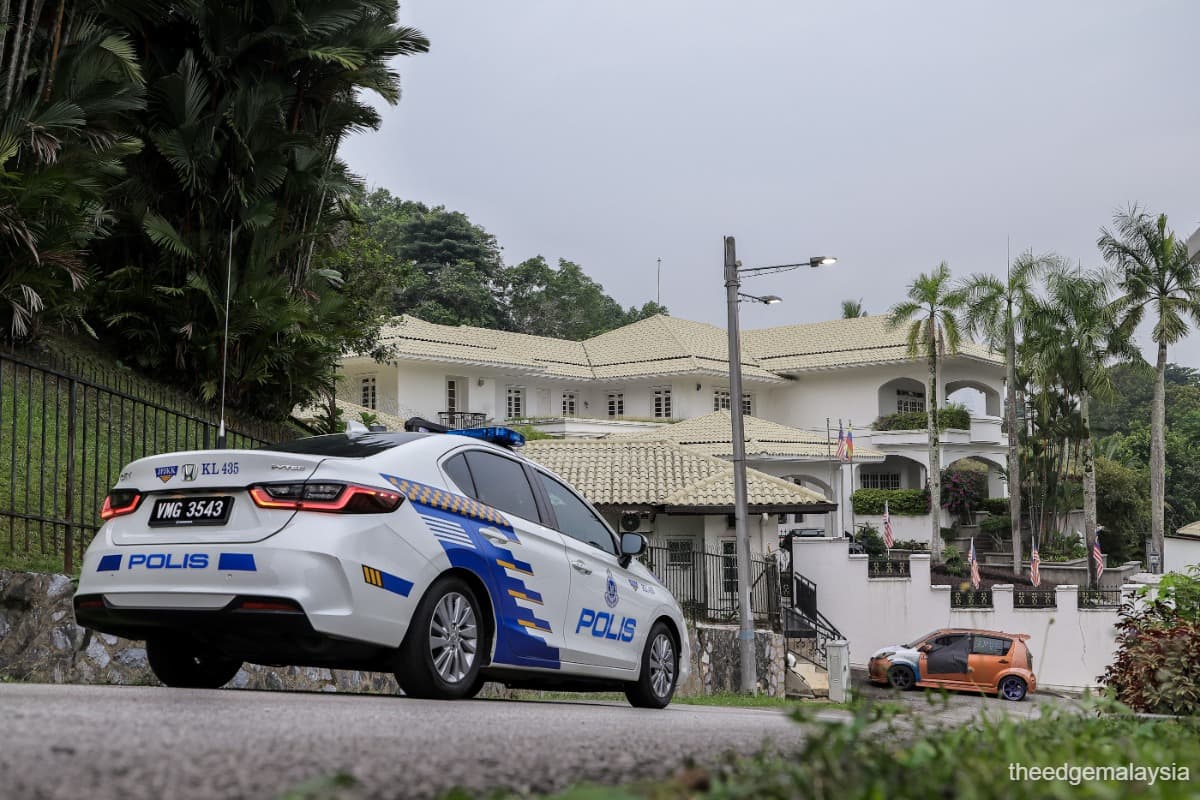
Datuk Seri Najib Razak has been tried and convicted twice. First, for the SRC International Sdn Bhd case (in respect of which all appeals have been exhausted), and second, for the 1Malaysia Development Berhad case (pending appeal). He has received two pardons on the SRC sentence.
The 1MDB conviction, sentence and stay application
In convicting him at the end of a lengthy trial in the 1MDB case, Collin Sequerah J, as His Lordship then was, stated that this case “…made Attila the Hun look like a choirboy by comparison…”. In sentencing him at the end of the 1MDB case, the High Court held that he should be sentenced to 15 years in jail to run consecutively after the expiry of the SRC sentence. See further the Malaysian Bar’s statement on Sept 25, 2026, here.
Najib’s lawyers, on Oct 14, 2026, applied to the High Court for a stay order to stay the sentence in the 1MDB case. The court held, among others, that he was not a first-time offender following his conviction and imprisonment in the SRC case, and rejected the stay application.
While Najib has appealed against his conviction and sentence in the 1MDB case, as matters stand, he is due to be imprisoned in the normal way upon completion of the SRC sentence, unless there are any other developments to the contrary.
Assets seized and returned
Following the 14th General Election, it was reported that police conducted searches and seizures at premises linked to Najib and Datin Seri Rosmah Mansor in May 2018 in connection with the 1MDB investigations. On June 27, 2018, police announced that the seized cash and valuables from their premises were estimated to be valued between RM900 million and RM1.1 billion. Of this, RM114,164,393.44 in cash, 11,991 units of jewellery, 401 watches, 16 watch accessories, 234 units of spectacles and 306 handbags were subjected to forfeiture proceedings by the public prosecutor. On Sept 14, 2020, the court allowed an application by Najib and the United Malays National Organisation (Umno) for their claim to RM114,164,393.44 to be heard separately. On May 20 2021, the High Court dismissed the public prosecutor’s application to forfeit the cash amounting to RM114,164,393.44. It was reported that this cash was subsequently returned to Najib and/or Umno. The public prosecutor also returned part of the jewellery and handbags and all of the spectacles to a representative of Rosmah, and part of the watches and all of the watch accessories to a representative of Najib.
On June 22, 2022, the public prosecutor filed an amended notice of motion (“Encl 165”) seeking forfeiture of only the remaining 2,436 units of jewellery, seven watches and 29 handbags. On Nov 14, 2022, the High Court dismissed Encl 165. The judge also refused the public prosecutor’s request to stay the decision pending an appeal. It was reported on Nov 29, 2022 that the Attorney General’s Chambers would not appeal this decision. It has been reported that much of the remainder of the seized assets has been returned to Najib and Rosmah after the High Court decision on Encl 165, as stated by the police in court in a separate court proceeding relating to Rosmah.
It is therefore unclear why the RM50 million fine, which was reduced from the original RM210 million fine imposed in the SRC case following a decision by the Pardons Board, needed to be paid by Umno following a public fundraiser.
Steps taken by the government to enable Najib’s house arrest
The government amended the discharge order dated Nov 6, 2026, for the reasons explained by the attorney general, in a media statement dated Nov 7, 2026 to enable Najib to be moved to “home detention”.
To further enable Najib’s house arrest, Home Minister, Datuk Seri Saifuddin Nasution Ismail, gazetted No 11, Jalan Langgak Duta as a prison. However, the relevant provisions of the Prison Act 1995 provide as follows:
Sections 2 and 3 of the Prison Act 1995:
2. Interpretation
(1) In this Act, unless the context otherwise requires—
“…“prison” means any house, building, enclosure or place, or any part thereof, declared to be a prison under section 3 and shall include the grounds and buildings within the prison enclosure and also the airing grounds or other grounds or buildings belonging or attached thereto and used by prisoners;…”
[Emphasis added]
“3. Power to declare prisons
The Minister may, by notification in the Gazette, declare any house, building, enclosure or place, or any part thereof, to be a prison for the purposes of this Act for the imprisonment or detention of persons lawfully in custody and may in like manner declare that any such prison shall cease to be a prison for the purposes of this Act.”
[Emphasis added]
Finally, Saifuddin issued the gazette to enable Najib’s house arrest.
Federal Government Gazette, P.U. (B) 456/202620 dated 6 November 2026:
“IN exercise of the powers conferred by section 3 of the Prison Act 1995 [Act 537], the Minister declares all buildings and areas measuring 4558.975 square metres at No. 11, Jalan Langgak Duta, Taman Duta, 50480 Kuala Lumpur situated on Lot 5746, Mukim of Kuala Lumpur, District of Kuala Lumpur, Federal Territory of Kuala Lumpur to be a prison for the purposes of the Act for the imprisonment or detention of persons lawfully in custody.”
The government’s actions appear to be incompatible with the decision of:
Alice Loke J (as Her Ladyship then was) in Dato’ Sri Mohd Najib bin Tun Hj Abd Razak v Menteri Dalam Negeri & Ors (the Addendum Order case), who held:
“[68] … I am of the view that a house arrest order is not capable of execution, there being no legal provision for such mechanism in Malaysia…”
[Emphasis added]
As can be seen from the words set out above, Malaysia does not have specific house arrest legislation, and while a building may be designated as a prison under the Prison Act 1995, such designation should not be for a single prisoner but generally as a prison for many prisoners.
The validity of the declaration of the Langgak Duta Prison remains to be tested in court. On the Pardons Board decisions, see the Malaysian Bar’s statement on Sept 25, 2026, here.
No house arrest law; the prisons are overcrowded
When questioned on the progress of house or home detention laws being passed to deal with the problem of overcrowding in prisons, Saifuddin was reported to have said on Sept 20, 2026, and via written parliamentary reply on Oct 27, 2026, that Malaysia did not have laws for home detention or house arrest to deal with the issue of overcrowding. In short, Malaysia does not have any laws that specifically and clearly provide for the infrastructure and operationalising of a house arrest system.
The issue of overcrowding in prisons is a serious one and has been addressed by the Human Rights Commission of Malaysia (Suhakam) and the Bar. Saifuddin has said that Malaysia’s 41 prisons hold about 93,000 inmates against a capacity of about 75,000. Severe overcrowding and the poor conditions that accompany it led to the events of Jan 17, 2025 at Taiping Prison. On that day, 104 remand detainees who had been transferred from the Batu Gajah Correctional Centre due to severe overcrowding refused to move into Block E of Taiping Prison, which was unsuitable and in poor condition, with a bucket sewage system, serious structural damage, flood risks and inadequate facilities. Suhakam’ss Public Inquiry Panel confirmed that Block E was unsuitable for these reasons.
See further the Malaysian Bar’s statement on 29 May 2026, here.
Therefore, it is long overdue for Malaysia to introduce a system of house arrest that is applicable to all prisoners equally, in recognition of Article 8 of the Federal Constitution (the right to equality before the law), Article 5 (the right to life and personal liberty), and the right of prisoners to be treated with dignity and humanity.
To this extent, the Malaysian Bar agrees with recent remarks by Agriculture and Food Security Minister, Datuk Seri Mohamad Sabu, who called for an egalitarian legal framework making house arrest possible universally to all prisoners. As Mat Sabu rightly emphasised, the constitutional principle of equality before the law in Article 8 of the Federal Constitution should be upheld.
Langgak Duta prison and beyond: Who should bear the costs of house arrest? Comparative practice, transparency and oversight
In certain jurisdictions, prisoners subject to house arrest are required to pay the costs of their house arrest, such as electronic monitoring and surveillance — either at a flat rate or in accordance with their means. Malaysia should adopt similar legislation or policy requiring prisoners subject to house arrest to pay the costs of their monitoring and supervision, in proportion to their means. The government of Malaysia is urged to provide clarification on whether the costs of Najib’s house arrest, including staffing, monitoring, security and upkeep of the premises, will be recovered from him and/or any third parties.
Transparency over public expenditure and oversight remains a critical issue. On Nov 12 2026, Saifuddin stated in Parliament, “…kita ada pegawai penjara tiga syif, tiga orang satu syif. Kita juga ada polis mengawasi secara omnipresence dan cara statik. Yang itu kita cuma atur tugas sajalah. Kalau dulu dia bertugas di Kajang, sekarang dia bertugas di situ. Jadi, tak ada kos tambahan ...”. Saifuddin’s answer does not say who will fill their posts at the Kajang Prison, or what the prison guards and/or police presence within and outside the new Langgak Duta Prison will cost. Also, Saifuddin appears to suggest that there is a ratio of three prison guards to every prisoner in Malaysia.
Lim Lip Eng, a member of the Parliamentary Special Select Committee on Security, questioned the claim of no additional costs in Parliament. He asked who would replace the redeployed prison officers; sought clarification on travel, allowance and police deployment costs; and asked the minister to arrange an official inspection visit of the Langgak Duta Prison for committee members.
There are undoubtedly more questions than answers at this stage.
Anand Raj is president of the Malaysian Bar.