

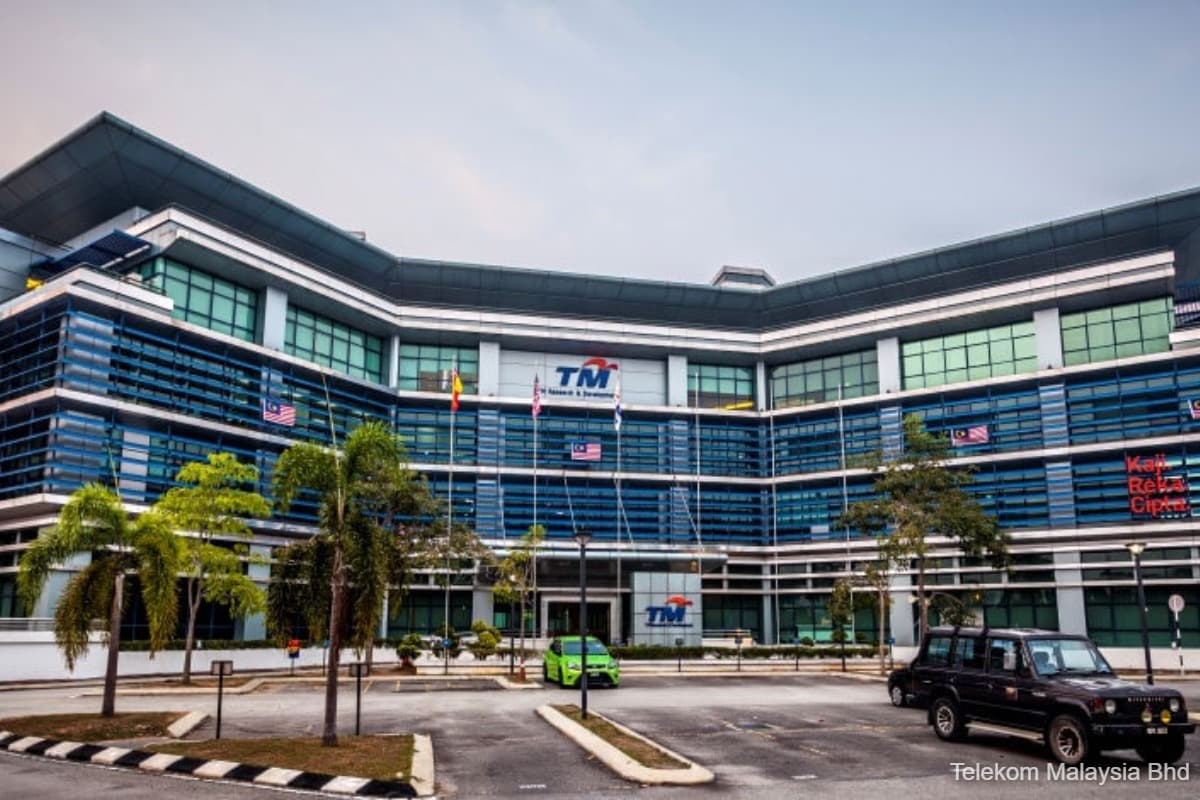
KUALA LUMPUR (Nov 18): Telekom Malaysia Bhd (KL:TM) could unlock additional earnings opportunities beyond 2030 from its RM2.7 billion undersea cable project, as growing artificial intelligence (AI) data centre investments in Sarawak drive demand for high-capacity connectivity, according to Kenanga Research.
The project, known as Sambungan Kabel Dasar Laut Madani (Salam), involves a 5,500km submarine cable connecting Peninsular Malaysia, Sarawak and Sabah. It will provide additional capacity as TM's existing undersea cable, Sistem Kabel Rakyat 1Malaysia (SKR1M), is already operating at about 85% capacity.
Kenanga in a note on Wednesday said AI data centres require substantial bandwidth, low-latency connectivity and reliable network infrastructure to support data transmission across Malaysia and international markets.
Salam's landing stations in Kuching and Bintulu (Samalaju) are strategically located near Sarawak's emerging data centre hubs, positioning TM to capture demand from upcoming developments.
Beyond providing bandwidth, TM could also act as an interconnection partner, linking data centres to internet exchange points, submarine cable systems and global connectivity networks. This would create opportunities to offer additional services such as indefeasible right of use (IRU), hot standby bandwidth allocation and managed wavelength services.
The project will run alongside SKR1M, which connects Peninsular Malaysia and Sabah and Sarawak. TM secured the USP-funded SKR1M project in December 2014 through a public-private partnership with the Malaysian Communications and Multimedia Commission (MCMC), with the cable commencing commercial operations in 2017.
For SKR1M, TM partnered TIME dotCom Bhd (KL:TIMECOM) under a 20-year construction and maintenance agreement, with an estimated ownership split of 83.6% and 16.4%, respectively. The arrangement was based on cost reimbursement without a profit-sharing mechanism.
By comparison, Salam is about 1.4 times longer and 3.8 times more expensive than SKR1M, with 10 landing stations compared with six previously.
Kenanga said Salam would further strengthen TM's international network, which spans more than 400,000km across 39 submarine cable systems.
The MCMC has designated TM as the universal service provider for Salam, which will be funded through the Universal Service Provision Fund. Construction is scheduled to begin in December 2026, with completion targeted in stages by the first quarter of 2030.
While the project is expected to contribute little to earnings during construction and its initial operational phase, Kenanga believes it could become a more meaningful earnings contributor beyond 2030 as demand for regional and international connectivity increases.
The research house estimated Salam's potential commercial value at RM523 million, equivalent to 13.6 sen per TM share, based on revenue from selling spare cable capacity.
Its valuation assumes that 90% of the RM2.7 billion allocation will be used for construction, with revenue from commercialising available capacity gradually reaching RM150 million annually by 2034.
Kenanga identified the pace of data centre development in Sabah and Sarawak as a key factor determining the project's earnings potential. Every RM50 million change in steady-state annual revenue could translate into a six to seven sen change in its estimated value per TM share.
However, the potential value has not been incorporated into Kenanga's current valuation pending greater clarity on the project's commercial terms.
The research house maintained its 'outperform' call on TM with an unchanged target price of RM9.11.