

KUALA LUMPUR (Nov 18): CGS International sees new US artificial intelligence (AI) chip controls as a speed bump, not a structural derailment, for data centre (DC) spending in Asean, albeit with potential delays.
Malaysia and Thailand face greater exposure risks, but US hyperscaler relationships and contracted demand should cushion near-term earnings, it said.
The research house said Malaysia faces the greatest sentiment risk in the region, although AI DCs represent less than 10% of the installed capacity of about 1.3GW to which its covered companies are exposed.
“Malaysia’s energy, water and undersea cable capacities remain the key draws for DC investments,” CGS International said in a note on Wednesday, adding that these are likely to support demand growth over the next three to five years.
Of the 8.4GW of DC electricity supply agreements signed with Tenaga Nasional Bhd (KL:TENAGA) as at June 2026, about 30% is linked to US-headquartered companies, while the bulk of the remainder is contracted by Singapore- and Malaysia-headquartered entities.
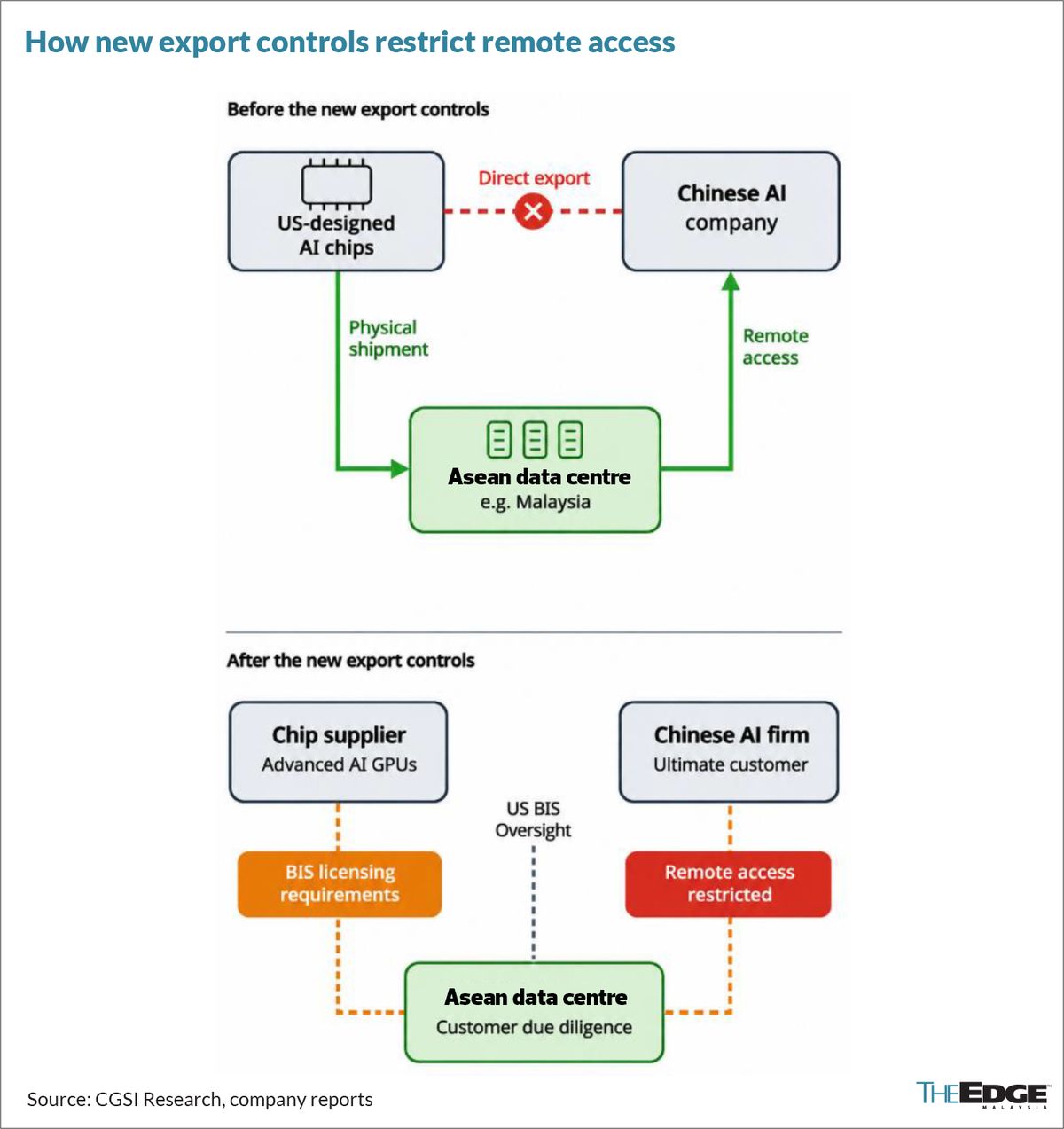
However, the firm cautioned that disclosures on the ultimate end-users are less clear, and it does not discount some indirect exposure to Chinese demand.
The trigger is the US Bureau of Industry and Security’s new export controls, effective Nov 19, 2026, which introduce destination-based licensing for advanced chips and servers supplied to Malaysia, Singapore, Thailand and Indonesia.
The new US rules create two licensing requirements. The first is a destination-based licence for exports, re-exports or in-country transfers of advanced chips and servers to Singapore, Malaysia, Thailand and Indonesia (from which US-headquartered companies and subsidiaries of US-headquartered parents are exempt, subject to reporting obligations).
The second requirement is a global end-use licence for chips and servers used to provide computing capacity above 12 million aggregate total processing performance (TPP) to designated entities.
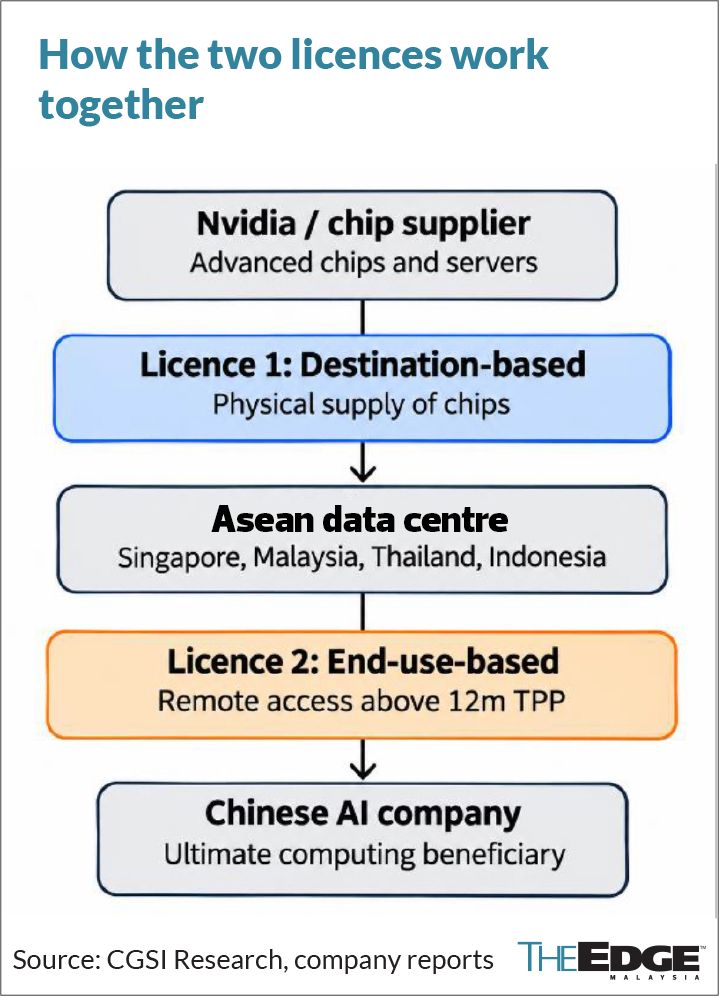
Existing data centres providing such services have 90 days to obtain the necessary authorisation.
They also add global end-use controls on computing access exceeding 12 million aggregate TPP for designated entities, including Chinese companies.
CGS International said the conditional exclusion for qualifying US-parented companies should favour US hyperscalers, while China-facing AI projects and independent graphics processing unit (GPU)-cloud operators face higher execution risks.
It expects the near-term impact on Asean to be felt mainly through slower AI-related capex and foreign direct investment into 2027, “as investors await licensing clarity”, with limited downside to Asean gross domestic product growth.