

This article first appeared in The Edge Malaysia Weekly on November 16, 2026 - November 22, 2026
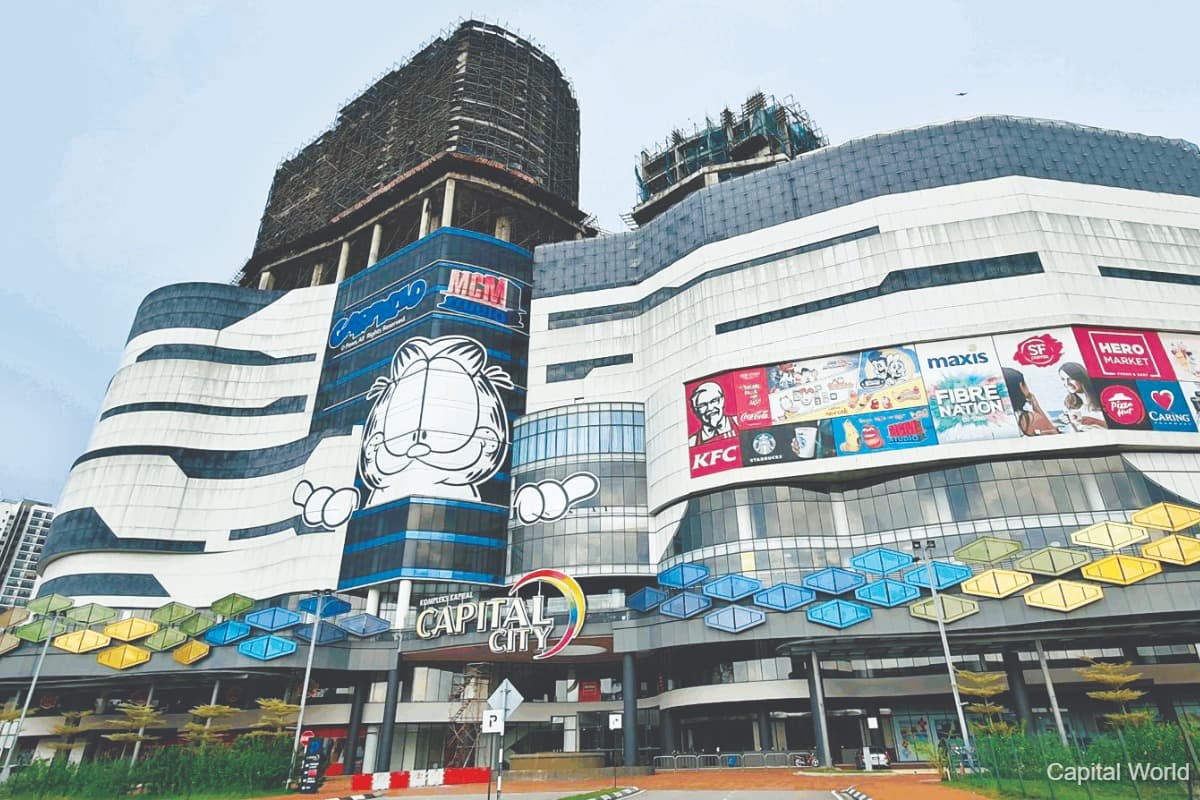
THREE and a half years can be a long time in business. In January 2023, Capital World announced what looked like a transformative deal for its long-troubled Capital City Mall in Johor Bahru. Singapore retailer Mustafa was buying 591 unsold retail units and other assets in the mall for RM368 million.
The deal was supposed to pave the way for Mustafa’s first department store in Malaysia. At the time, the store was expected to open in the second half of 2023. With less than two months to go before the end of 2026, Mustafa has yet to open for business at Capital City Mall.
That does not mean nothing has happened. Mustafa has put substantial money on the table. Capital World said in August that aggregate deposits received had reached about RM143.7 million, representing 39% of the purchase price.
In April, the property group announced that fit-out and renovation works had begun for an initial 240,000 sq ft Mustafa store and said the outlet was targeted to open before the first quarter of 2027 — a timeline it reiterated in its latest annual report.
All these are meaningful developments. But after so many missed expectations, shareholders are understandably more interested in completed transactions and open doors than another target date.
The bigger issue is that the sale itself has not even been completed. As at its latest disclosure, Capital World had secured Johor State Authority approval for only 55 of the 591 units. The remaining 536 units are still awaiting state approvals, including permission for units reserved for bumiputera buyers to be sold to Mustafa.
These are not necessarily matters entirely within Capital World’s control. Property transactions involving hundreds of strata units and regulatory approvals can be complicated. But that does not make the passage of time irrelevant. Rather, the Mustafa transaction has become more important, not less.
Capital World’s auditor, Moore Stephens, has flagged a material uncertainty that may cast significant doubt on the group’s ability to continue as a going concern. That ability hinges on, among other things, the completion of the property sale. In other words, what began as a potentially transformative transaction has become critical to Capital World’s financial future.
Buyers are still waiting
Shareholders are not the only ones who have been left waiting on Capital City Mall. A considerable number of people who bought retail units in the development have ended up in litigation involving Capital World’s subsidiaries. One of Capital World’s recent updates makes for sobering reading.
One legal proceeding involves 99 purchasers of retail units that are not among those earmarked for sale to Mustafa. These buyers are seeking, among other things, unpaid rent under tenancy agreements for their retail units. The claims, estimated by Capital World at RM10 million, were initially upheld by Malaysia’s High Court but later overturned by the Court of Appeal. The purchasers have since taken the case to the Federal Court, the country’s highest judicial authority.
Another proceeding involves a group of 20 buyers, who filed separate suits claiming aggregate damages of about RM8.9 million. Their claims relate to delayed delivery of vacant possession, outstanding rental arrears and alleged depreciation in property values. Other purchaser proceedings also remain in progress.
It is important to keep all this in perspective. Capital World is defending the claims and disputes liability, succeeding at various stages in some of these proceedings. The lawsuits do not, by themselves, establish wrongdoing by the company.
What they do show, though, is that the problems surrounding Capital City Mall have been around for years and have affected more than the company’s shareholders. That raises questions about how much progress management has really made in turning the project around.
The five towers
Beyond the retail assets being sold to Mustafa, the wider Capital City development includes five towers — two partially built blocks and three planned serviced-apartment complexes.
Capital World once intended to develop the five towers itself. It later figured that selling its development rights and beneficial ownership would be more advantageous. In October 2024, it signed a non-binding term sheet to sell the rights to Growth Development & Management, a private real estate management firm in Malaysia, for RM25 million.
That deal fell apart after the proposed purchaser withdrew following due diligence. But Capital World has now found new buyers. On Nov 4, it announced that its subsidiary had signed three agreements with Malaysian companies to sell the five towers’ development rights and property interests for a total of RM50 million.
That figure requires some explanation. The actual purchase price is RM25 million. The other RM25 million is earmarked for reimbursing costs associated with obligations Capital World must fulfil after completion, including obtaining provisional strata titles and certain planning approvals. The company said this additional amount may not be fully received in cash.
After deducting a RM3 million transaction arranger’s fee, Capital World expects net proceeds of about RM22 million, before other applicable expenses. It also estimates a disposal gain of RM21.9 million. The RM25 million purchase price is the same as that proposed in 2024, although the new transaction has a different structure.
There’s also a shift in priorities. In 2024, Capital World spoke of using proceeds from the disposal to pursue new development projects. This time, it says the money will go mainly towards working capital.
The tower disposals are not entirely separate from the Mustafa transaction. Capital World must get Mustafa’s written confirmation of certain carpark arrangements, and delays in doing so could extend the completion timetable. The buyers have three months to pay the purchase price, with a possible two-month extension.
For shareholders, the question is no longer whether Capital World can find buyers for the towers, but whether it can complete the sales and realise the cash proceeds.
Wiping the slate clean
Meanwhile, shareholders have just approved a major restructuring of Capital World’s capital at an extraordinary general meeting on Oct 29. Among other things, the company is reducing its share capital and share premium account to eliminate nearly RM939 million of accumulated losses as at June 30, consolidating every 100 existing shares into one share, and redomiciling from the Cayman Islands to Singapore. To be clear, the capital reduction does not make RM939 million of cash disappear. The losses have already been incurred. This is an accounting exercise that eliminates accumulated losses from the balance sheet and does not change the group’s net assets. But the number is nevertheless a striking reminder of Capital World’s history: RM939 million is a lot of accumulated red ink.
The share consolidation, too, may have its merits. Capital World has said it could reduce short-term volatility and percentage transaction costs and potentially make its shares more attractive to investors.
Perhaps it will. But rolling every 100 shares into one does not create economic value, any more than eliminating accumulated losses from the balance sheet recovers the losses already incurred. Ultimately, shareholder value has to be rebuilt through the underlying business. All this makes executive remuneration at Capital World worth examining.
Capital World’s managing director, Eric Tan, received S$500,316 (RM1.6 million) in remuneration for the financial year ended June 30, 2026 (FY2026). That’s not an astronomical sum for the head of a listed company. But remuneration should not be viewed in isolation. The relevant question is what shareholders are getting in return. Capital World reported a RM7.3 million loss for FY2026. Revenue was negative RM2.6 million, largely reflecting accounting provisions rather than a functioning property development business generating meaningful new sales.
Its auditor has raised a material uncertainty over going concern. The Mustafa transaction remains incomplete. Capital World has signed new agreements to sell the five towers, but the deals have yet to cross the finish line. Numerous purchaser-related legal proceedings remain unresolved. And shareholders have just approved a capital restructuring to eliminate RM939 million of accumulated losses. That’s the context in which S$500,316 should be considered.
Tan’s remuneration also deserves some historical context. He became managing director only in January 2025 and received S$235,125 for FY2025. That covered roughly half a year, so it would not be fair to describe the rise to S$500,316 in FY2026 as a doubling of his annual pay. On an annualised basis, both numbers are broadly similar.
Before becoming managing director, Tan was already being paid for advisory work. In FY2024, Capital World disclosed a S$150,000 one-off incentive fee to him for advisory services relating to the company’s resumption of trading on the Singapore Exchange (SGX). It also disclosed S$440,000 in advisory fees to Omrui Advisory, a company wholly owned by Tan. That amounted to S$590,000 of disclosed interested-person transactions involving Tan and his firm in that financial year.
The point is not that these payments were improper. Capital World disclosed them, and the S$150,000 incentive was approved by shareholders. The issue is whether remuneration has been matched by results. For the sums paid, shareholders are entitled to ask when the company’s most important corporate objectives will actually be delivered.
Tan is no stranger to the property business. He is the father of Colin Tan and Edwin Tan, who formerly ran SGX-listed Hatten Land, the property arm of Malaysia’s Hatten Group. Eric Tan himself served as corporate adviser to Hatten Land, which later ran into financial difficulties and entered judicial management.
Hatten Land’s history is not Capital World’s, and Eric Tan should be assessed on his own record. But his long track record in property development is relevant because it is precisely that expertise Capital World is paying for. Tan has spent more than 45 years in property development, investment and corporate strategy. With experience comes expectation.
High time for outcomes
For all its challenges, Capital World is not a lost cause. Mustafa has already paid a sizeable portion of the purchase consideration. Fit-out work has started. The property group has also secured new buyers for its five towers. A Mustafa department store could breathe life back into a mall that opened in 2018 only to close two years later. Johor Bahru itself is benefiting from stronger economic links with Singapore and the development of the Johor-Singapore Special Economic Zone.
But at some point, progress has to be measured not by term sheets, deposits, approvals being sought or targets for future openings, but by transactions completed and businesses operating. Capital World has spent considerable time reorganising itself. There comes a point when restructuring must give way to execution. That point has surely arrived.
That’s also the yardstick by which Tan’s remuneration should be judged. The issue is less about whether S$500,316 is too much to pay a managing director than about whether enough has been delivered to justify it.
If Mustafa opens as targeted and Capital World completes the sale of the five towers, shareholders may well see things differently. But if the latest target for Mustafa’s opening slips again and the tower disposals also fail to materialise, another half-million-dollar remuneration package would be considerably harder to justify. After 3½ years of waiting, shareholders expect outcomes, not another set of targets.
Frankie Ho is consulting editor at The Edge Singapore. This article was first published in The Edge Singapore on Nov 9, 2026.
Save by subscribing to us for your print and/or digital copy.
P/S: The Edge is also available on Apple's App Store and Android's Google Play.