

This article first appeared in The Edge Malaysia Weekly on November 16, 2026 - November 22, 2026
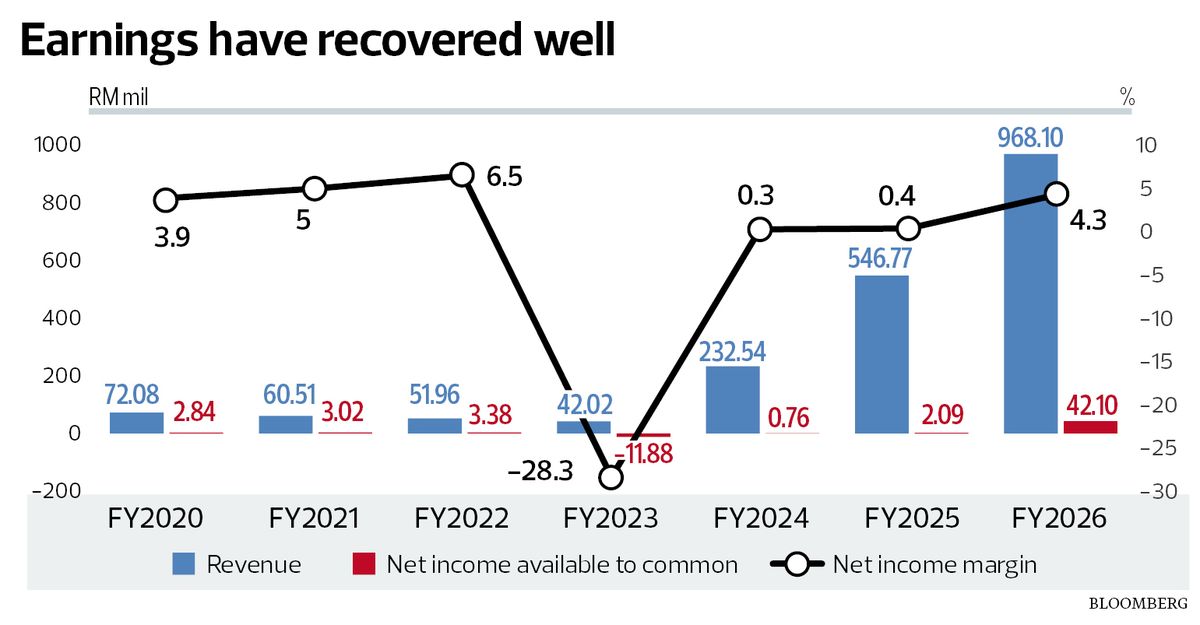
VARIA Bhd (KL:VARIA) delivered stellar results for the financial year ended June 30, 2026 (FY2026). Profit attributable to owners surged 20-fold to RM42.1 million from RM2.1 million, as revenue jumped 77% to RM968.1 million, supported by faster project execution and upward revisions to margins on selected projects.
Yet, despite its record earnings, the group’s share price has seen little action. Closing at 79 sen on Nov 10, it gives the group a market capitalisation of RM342 million — still a far cry from managing director Datuk Benson Lau Beng Sin’s RM1 billion target set in 2024 to reach within three years.
What is the reason for the market’s indifference to the group’s performance? He attributes this to limited market awareness amid the large number of listed companies, as well as investors’ focus on data centres. The trading of its shares is also thin.
Varia’s expansion began in November 2023, when the group — then known as Stella Holdings Bhd — acquired Pembinaan Teguh Maju for RM380 million. The deal gave Varia a contractor with an order book of about RM1.2 billion. Lau says it now has 15 to 16 projects underway.
Despite the scaling up, about 70% of its construction portfolio still comprises subcontracted work, Lau estimates. Of the main-contractor jobs, the most notable to date is the RM571.8 million rehabilitation centre for the Social Security Organisation (Perkeso) in Setiu, Terengganu, which it secured in October 2024.
“For many government projects, we can only participate as a subcontractor because we are not a bumiputera company and cannot bid directly,” he explains, adding that it is why Varia is pushing more aggressively into property development to diversify its earnings.
Since November 2025, the group has signed three joint-venture agreements for projects in prime locations — Jalan Tun Razak in Kuala Lumpur, Bandar Seri Alam in Johor Bahru and Putrajaya — which Lau estimates have a combined gross development value (GDV) of RM1.8 billion to RM2 billion. The Jalan Tun Razak project alone carries an estimated GDV of RM657 million, according to Citaglobal.
He maintains his ambition to have the property development segment contribute 30% to group revenue — a significant distance from the less than 2% the segment contributed in FY2026 on a revenue of RM16.8 million and a pre-tax loss of RM8.8 million.
Margin pressure and slowing order book momentum
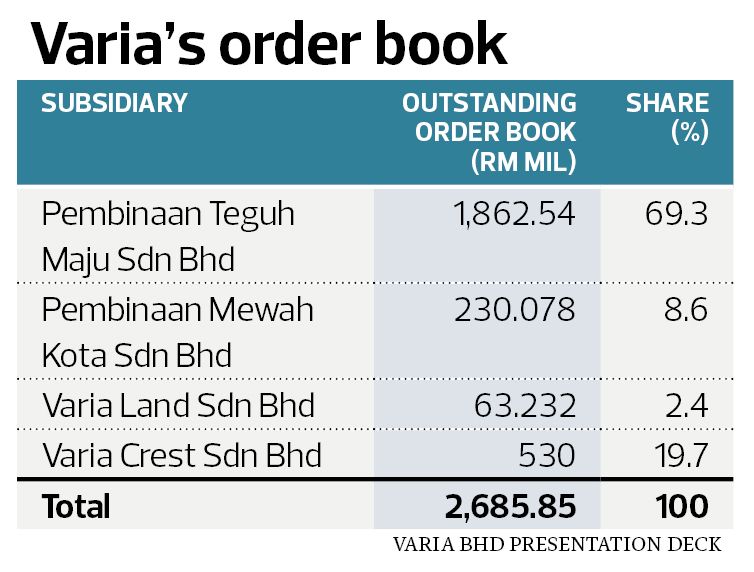
As at end-August, Varia’s outstanding order book stood at RM2.69 billion, including RM530 million for the Citaglobal Tower Development in Jalan Tun Razak and RM63.2 million for a joint-venture development in Kuala Selangor.
About half of the remaining RM2.09 billion construction order book comprises flood-mitigation and sewerage work, while 39% are building and mechanical and electrical works, with the remainder being roads.
However, maintaining order book momentum is becoming tougher. New projects secured slowed from about RM2.4 billion in 2024 to RM800 million to RM1 billion in 2025, says Lau, adding that the group’s bid success rate is about 10%. Two subcontracting jobs announced in 2026, for the Pasir Gudang Highway and Sungai Kim Kim projects, total RM448.33 million.
Meanwhile, bidding for new projects has slowed amid elevated diesel prices — a situation that is affecting the entire construction industry, he says. At RM4.87 per litre, unsubsidised diesel in Peninsular Malaysia is 60.2% higher than the pre-Iran war price. “It’s quite difficult to bid now,” he says, adding that the uncertainty makes it harder to price new contracts.
Lau estimates that the elevated diesel prices could erode the company’s gross margins by 1% to 2% if they remain high. It recorded a gross profit margin of 13.9% in FY2026.
During the Budget 2027 announcement, the government said it would reintroduce variation-of-price clauses for higher diesel and bitumen costs, which would let contract sums be adjusted for changes in specified costs. Whether its existing contracts will benefit from the policy change remains unclear as the government has yet to approve any price adjustments, he says.
Nine of Varia’s 16 construction contracts are scheduled for completion in 2027, including six by June next year. They account for about 40% of the RM2.09 billion outstanding construction order book at end-August 2026. A further 10% is scheduled to finish in 2028, while the remainder comprises flood-mitigation and sewerage projects in 2029 and 2030.
In terms of property development, two of the three projects the group is preparing for recently received their advertising permits and developer’s licences, and they are due to launch in the next two months, says Lau.
There is no take-up yet. He targets property sales of about RM80 million in FY2027, although the timing of recognised revenue will depend on project progress.
Lau wants the construction segment to account for a smaller proportion of the group’s business, with property development and potentially recurring income from concessions forming a more significant part of its operations. “I want to have a more diversified company,” he says.
The intention is partly to extend revenue visibility beyond the relatively short life cycle of construction contracts. But property development brings different risks, particularly the substantial upfront capital required, sales uncertainty and longer periods before cash is collected and recognised.
Varia is also exploring data centre- and power-related infrastructure projects, although these remain prospective opportunities rather than secured contracts.
Cash conversion and valuation gap
The group’s operating cash flow registered an outflow of RM105.1 million in FY2026 — its third straight negative year. Trade receivables and contract assets together rose to RM516.4 million from RM202.2 million while borrowings nearly doubled to RM260.1 million.
Varia does not expect operating cash flow to turn positive while it keeps growing. The company says cash only comes in after the jobs are completed, whereas developers pay for land before they collect from the buyers, so the figure to watch is final cash.
On that measure, Varia ended FY2026 with RM9.2 million in cash and cash equivalents, net of overdrafts and pledged deposits, up from RM4.8 million. Net financing inflows were RM125.9 million — almost all of it borrowings — covering the RM105.1 million in operating outflow.
Varia has a RM3 billion sukuk programme and has issued RM48.9 million of the six-year notes at 5.63% to 5.73%. Further tranches have not been marketed and will depend on new projects, says the company.
For FY2027, Lau targets revenue of at least RM1.2 billion, up 24% from FY2026, and a profit of RM70 million to RM100 million.
Varia’s share price has fallen about 24% from the RM1.04 recorded shortly after its November 2023 acquisition of Pembinaan Teguh Maju. The acquisition also resulted in RM74.84 million of intangible assets, representing customer contracts which are being amortised as the contracts progress, over an estimated useful life of two to five years. The group incurred RM22.71 million in such non-cash expenses in FY2026 and expects to recognise the remaining RM21.91 million in FY2027, with no further customer-contract amortisation charges from FY2028.
The expiry of the amortisation could be the rerating catalyst that some institutional investors have been anticipating for about two years, says an analyst who declined to be named. He added that it would be easier for fund managers to justify buying once Varia’s price-earnings ratio (PER) moves closer to that of the construction sector.
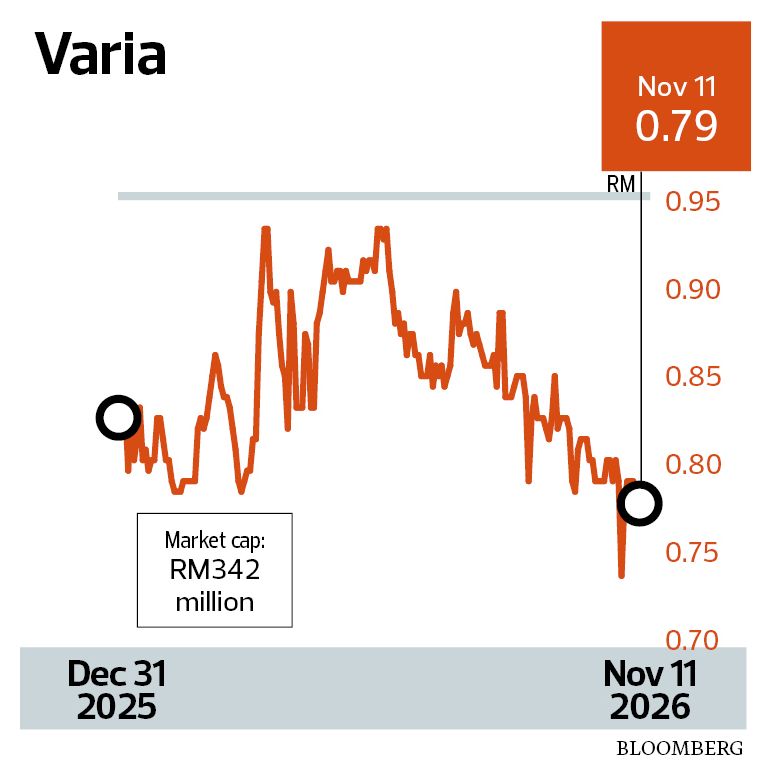
At 79 sen, Varia’s shares are trading at 8.1 times FY2026 earnings per share of 9.73 sen. By The Edge’s calculation, adding back the non-cash amortisation net of 24% tax lifts earnings to about 13.7 sen per share and cuts the trailing PER to 5.8 times. Apex Research notes that the KL Construction Index had a forward PER of 19.7 times on Oct 2, although this is not an apple-to apple comparison. Ending the charge raises its earnings and, in turn, lowers the stock’s PER, so any move towards the sector’s average PER would need a higher share price.
The analyst notes that cash conversion is a key overhang, because high receivables and contract assets carry counterparty risk, and some institutions want evidence of collection before buying. Tight liquidity may also keep some fund managers away, he adds, even though he sees it as less important than a stock’s fundamentals.
By The Edge’s calculation using Bloomberg’s price and volume data, the median of the average daily trading value for nine construction companies with market capitalisations of RM200 million to RM700 million was about RM319,000 in September and October — more than 10 times Varia’s RM30,000 on the days its shares were traded. The estimates use daily closing prices multiplied by trading volumes and cover only days on which the shares are traded.
Shareholding in the group is concentrated. Four shareholders held 63.16% of the company as at Sept 30, 2026: Lau and his older brother Datuk Jason Lau Beng Wei, Varia Engineering & Services Sdn Bhd, in which both have equity interest, and Teo Boon Hing.
Varia’s annual report does not mention a formal dividend policy. No dividend was declared for FY2025 or FY2026.
Save by subscribing to us for your print and/or digital copy.
P/S: The Edge is also available on Apple's App Store and Android's Google Play.