

This article first appeared in The Edge Malaysia Weekly on November 16, 2026 - November 22, 2026
AFTER enduring a three-year downturn amid industry overcapacity, Cnergenz Bhd (KL:CNERGEN) is poised for a turnaround as a fresh wave of investments in artificial intelligence (AI) infrastructure, data centres and advanced electronics manufacturing revive demand for its equipment and solutions.
The Penang-based group, which distributes, designs and integrates surface mount technology (SMT) manufacturing lines, is benefiting from renewed capital expenditure (capex) spending by customers across Southeast Asia.
CEO Lye Yhin Choy tells The Edge that he expects the current up cycle to last until at least 2028, with the group already receiving orders extending into the second quarter of 2027.
“Currently, we have already received orders until the second quarter of 2027. Based on our experience, if there is a strong first and second quarter, the momentum will usually continue throughout the year,” he says.
Lye attributes the recovery to a new wave of factory investments, particularly among manufacturers expanding production to meet growing demand for AI-related products.
“Our customers are building new factories. What you see in terms of growth right now is actually from factories that were built in 2025. In 2026, they come online and start their capex spending. At the same time, they are also building a huge number of factories. So, we believe 2027 will be another year of capex spending for them,” he says.
Cnergenz specialises in SMT manufacturing lines, which are automated assembly systems used to place and solder electronic components onto printed circuit boards (PCBs). Beyond conventional equipment distribution and integration, the group provides smart factory automation solutions and has ventured into original design manufacturing (ODM), producing specialised testing equipment for AI applications.
Lye believes the easing of trade uncertainties following the US Supreme Court’s February ruling on tariffs imposed by US President Donald Trump have also encouraged customers to resume investments deferred over the past two years.
The opportunities span several segments of the electronics supply chain, including AI servers, data centres, networking, photonics and advanced packaging.
Cnergenz operates across Malaysia, Thailand and Vietnam, with each market offering different manufacturing strengths.
“Malaysia remains an important base for semiconductor-related manufacturing and is increasingly moving into advanced packaging. Thailand is seeing stronger demand from data centres, networking and automotive electronics, while Vietnam remains more exposed to consumer electronics and mobile phone manufacturing,” says Lye.
The group’s regional footprint is an advantage as it is well positioned to benefit as manufacturers diversify their production operations across Southeast Asia.
While geopolitical developments and trade uncertainties remain potential risks, Lye believes structural demand generated by AI is increasingly outweighing these concerns. He argues that the industry remains at an early stage of the AI investment cycle, with spending currently concentrated on infrastructure such as data centres, server farms, networking equipment and power management systems.
“I think this will basically last probably the next 10 to 15 years,” he says, drawing comparisons with previous investment cycles driven by the internet and mobile technologies.
He expects the next phase to extend beyond infrastructure into consumer applications, creating further demand for electronics manufacturing capabilities and equipment.
“If you look at AI, we are still at the beginning stage. Once the infrastructure is in place, you will have all the other industries coming up, just like what happened with mobile phones,” he says.
Moving up the value chain through ODM
Beyond the recovery in its traditional SMT equipment distribution and integration business, Cnergenz is building a second growth engine through ODM, allowing it to capture more value by designing, developing and manufacturing specialised equipment that it can market under its own brand.
The group ventured into the business following its acquisition of a 51% stake in Xlent Innovator Sdn Bhd in 2024 for RM2.8 million in cash. The Malaysian automation company brought engineering and design capabilities that enabled Cnergenz to move further up the manufacturing value chain.
One of its notable developments is an AI-related testing machine programme undertaken in collaboration with a US-based automated test equipment provider. The programme has entered the production ramp-up phase following an extensive development and qualification process.
Lye says securing a position in such programmes can be challenging, but the qualification process also creates customer stickiness once a supplier has been selected.
“To enter is not easy. But once you enter, changing suppliers is also not easy because customers will standardise their production lines with the qualified supplier,” he explains.
The partnership emerged after Cnergenz developed a solution to address a specific customer requirement, leveraging the capabilities acquired through Xlent Innovator.
The higher-value nature of ODM work also allows the group to command better margins than its traditional distribution business. “Because we add a lot of value, definitely we can demand a higher margin,” says Lye.
ODM currently contributes less than 10% of group revenue, with chief operating officer Jon Kong Chia Liang targeting to increase this to 30% over the next five years. Over the longer term, management hopes the business can become comparable in scale with its traditional distribution operations.
“That is the target. It will take time. We are looking at maybe more than five years,” says Kong.
The opportunity extends beyond its existing AI tester programme. Cnergenz is exploring ODM opportunities with customers in Germany, the US and Europe, including working directly with their headquarters rather than solely through their Southeast Asian manufacturing operations.
However, scaling up the business will require more specialised resources. “The critical constraint now is possibly the availability and retention of high-quality engineering talent,” Kong says, noting that ODM relies heavily on technical expertise and innovation.
Smart factory solutions another growth avenue
Cnergenz also sees smart factory solutions as another growth driver, particularly as customers build new manufacturing facilities and modernise existing ones.
The solutions combine automation, software integration and manufacturing systems to help customers improve production efficiency.
Given the number of new factories being developed by its customers, Lye is confident the group will secure at least one sizeable contract. “In terms of value, it can be eight-figure or nine-figure. There is a lot in the pipeline now,” he says.
Although revenue from this segment can be lumpy because of the size and timing of individual contracts, Lye believes the group could secure several smart factory projects over the next three years.
The projects could be either greenfield or brownfield in nature. Greenfield projects typically involve implementing an entire manufacturing ecosystem from scratch, while brownfield projects are carried out in stages to avoid disrupting existing production.
The smart factory division accounts for about 20% of Cnergenz’s workforce of about 100 employees, while engineers make up about 70% of the group’s total workforce.
To accommodate anticipated business growth, Cnergenz is proceeding with plans to build a new factory at a capex of not more than RM40 million, with completion targeted by end-2027. The facility will have four times the capacity of its existing premises and house the group’s SMT, integration and ODM operations. This could raise Cnergenz’s overall capacity by four- to fivefold.
‘Worst of downturn is over’
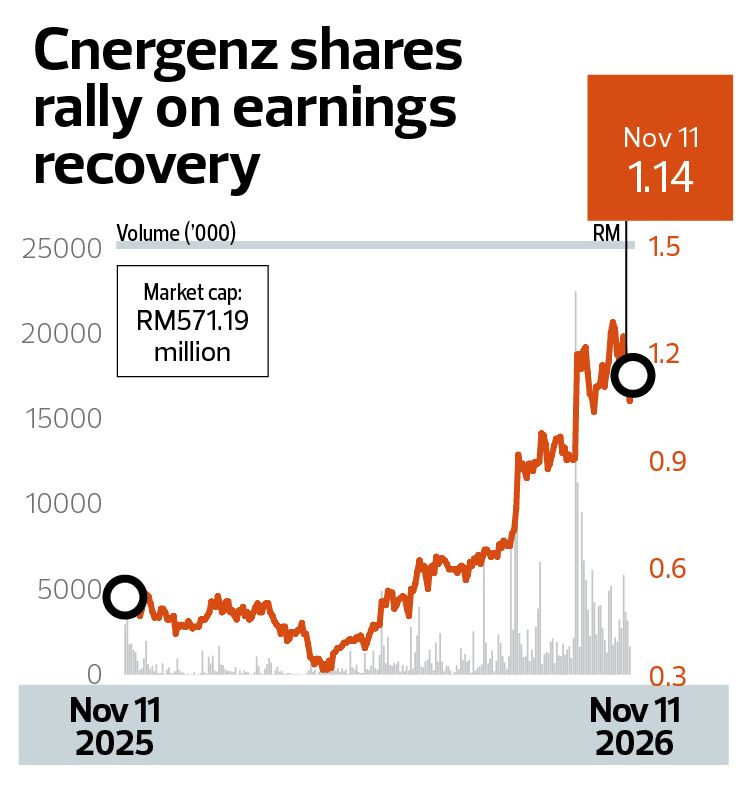
Since its ACE Market debut in May 2022 at 58 sen a share, Cnergenz’s share price initially climbed to RM1.12 before suffering a three-year decline that saw it hit a low of 25 sen.
The share price weakness coincided with a deterioration in its financial performance, with revenue and earnings declining for three consecutive financial years. Net profit fell from RM21.7 million on revenue of RM216.9 million in the financial year ended Dec 30, 2022 (FY2022), to RM3 million on revenue of RM114.8 million in FY2025.
Lye attributes the downturn to overinvestment during the Covid-19 pandemic, when customers rushed to expand capacity amid supply chain disruptions and fears of potential shortages.
“During 2021 and 2022, we saw a strong upward trend. Then came a cooling-off period in 2023, 2024 and 2025,” he says.
The slowdown was compounded by geopolitical uncertainty and US tariff announcements in 2025, prompting customers with manufacturing operations across Malaysia, Thailand and Vietnam to put their investment plans on hold.
However, customers have since resumed spending as rising demand for AI-related products drives the need for new manufacturing lines, unlocking pent-up demand deferred over the past few years.
The recovery is already evident in Cnergenz’s financial performance. For 1HFY2026, the group recorded revenue of RM115.7 million, surpassing its full-year FY2025 revenue, while net profit rose to RM8 million. This was largely driven by a stellar 2QFY2026, in which revenue reached a record RM88.15 million and net profit came in at RM8.5 million, the highest quarterly earnings since 2QFY2022.
Lye is confident that FY2026 will be a record year for the group, which has been operating for 22 years. He also expects FY2027 to deliver an even stronger performance, supported by an order book of more than RM178 million as at June 30, 2026.
One potential risk to the outlook, however, is disruption to shipments, as a significant portion of the group’s equipment deliveries are transported by sea. Since revenue recognition is tied to delivery, any shipping delays could affect the timing of earnings recognition.
The earnings recovery has also been accompanied by a sharp rebound in Cnergenz’s share price, which hit an all-time high of RM1.33 on Oct 28. The stock has gained 154.5% year to date, closing at RM1.14 last Wednesday.
At a market capitalisation of RM571.2 million, Cnergenz is trading at a forward price-earnings ratio of 20.3 times, based on projected FY2027 net profit of RM28.2 million. The two research houses covering the stock have “buy” recommendations, with a target price of RM1.07 from Tradeview Capital and RM1.40 from RHB Investment Bank.
On the balance sheet, Cnergenz had RM107.48 million in cash and no borrowings as at June 30. Its largest liability item was payables and accrued liabilities, which rose significantly to RM118.97 million from RM39.95 million a year earlier.
Management attributed the increase mainly to higher business activity and revenue recorded in the second quarter. Correspondingly, receivables, deposits and prepayments also increased significantly during the period, reflecting the higher revenue and level of operational activity.
Lye is the group’s largest shareholder, with a 44.52% stake, while Kong holds 23.36%. Its top 30 shareholders also include institutional investors such as insurers Prudential, Manulife and Etiqa, as well as funds under Hong Leong Asset Management and AHAM Asset Management.
Save by subscribing to us for your print and/or digital copy.
P/S: The Edge is also available on Apple's App Store and Android's Google Play.