

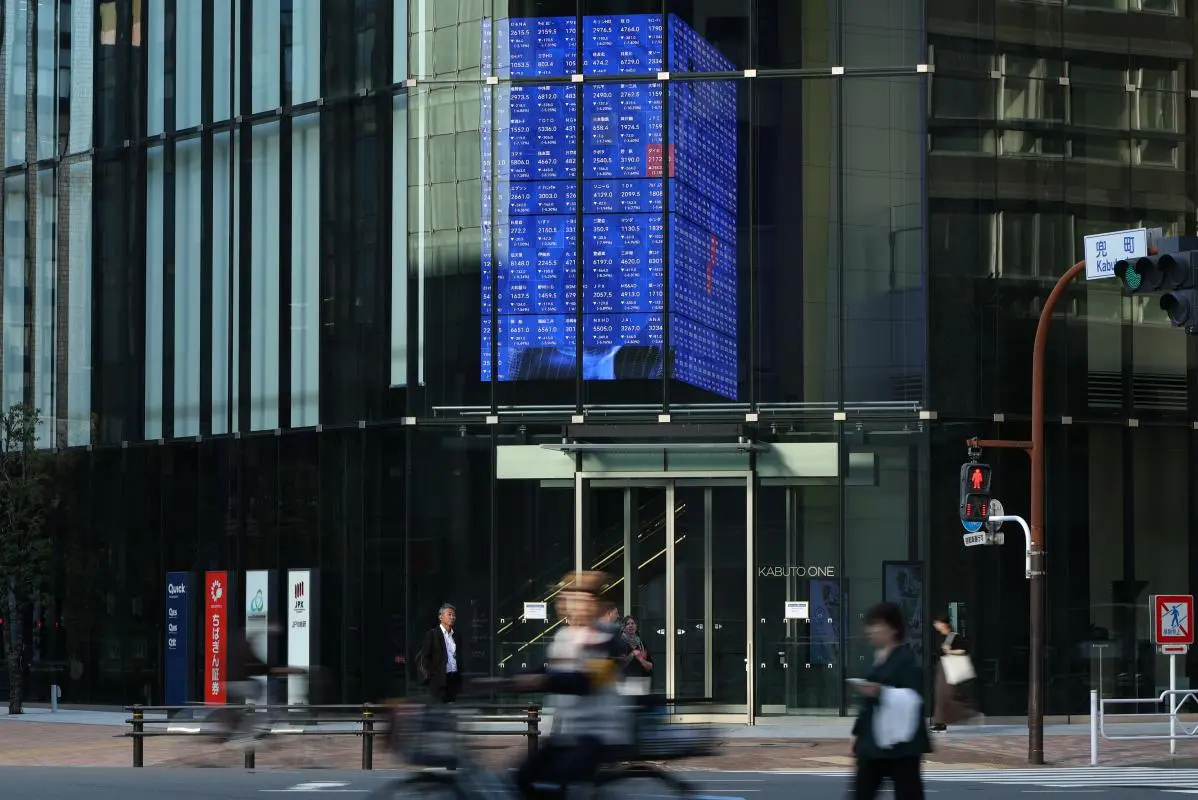
(Nov 18) : Asian stocks were poised for declines Wednesday after a selloff in US equities deepened as concerns over the technology sector persisted. Nvidia Corp. delivered a sales forecast that topped Wall Street expectations after the market closed.
The chipmaker’s shares rose about 2% in late trading after the company said revenue will be US$130 billion in the fiscal fourth quarter, plus or minus 3%, versus the analyst average of US$125.3 billion.
Nvidia’s shares slid for a fourth day during the regular session as investors grappled with uncertainty over the company’s leadership and longer-term outlook following Jensen Huang’s ouster. Huang has expressed willingness to return as chief executive officer, though the board isn’t currently considering such a move.
Equity-index futures for Australia and Japan pointed to declines, while those for South Korea were little changed. Earlier, the Nasdaq 100 fell 0.7% as a series of technical disruptions added to unease around technology companies, this time affecting the US electronic spy agency and Apple Inc.’s services. The S&P 500 slid 1%, touching its lowest since June. Treasuries rose on haven demand, while the dollar slipped and oil fluctuated.
Nvidia’s stronger-than-expected outlook offered some reassurance over the durability of AI demand, though may do little to dispel broader concerns over the scale and payoff of spending on the technology. As the dominant supplier of chips underpinning AI, the company has become a key barometer for a trade that has driven global equity markets.
Wall Street is also focused on Anthropic PBC’s initial public offering, with the firm said to be guiding prospective investors that it expects to price the shares at the high end of the range or above. The IPO is set to price Nov. 18.
Two of Anthropic’s biggest customers, Amazon.com Inc. and Alphabet Inc.’s Google, are set to own nearly 15% and 14% of the firm’s outstanding capital stock, respectively, following the IPO and private placement.
Still, strong demand for the offering comes as investors grow more wary of the payoff from heavy AI spending. A Bank of America Corp. survey showed the share of fund managers overweight technology fell to a net 12% from 37% in October, the biggest drop since 2006.
Investors are sending a “big” message that companies should pause artificial intelligence spending, BofA strategist Michael Hartnett wrote in a note.
Elsewhere, oil swung in choppy trading as renewed fighting in the Middle East challenged an increasingly comfortable supply outlook.
Vessel attacks were reported in and around the Strait of Hormuz as Tehran targeted Bahrain for the third time in less than a week and threatened civilian infrastructure near US or Israeli military bases. American warplanes, meanwhile, struck an Iranian missile launch site on Qeshm Island in the Persian Gulf, a US military official said.
In bonds, Treasury yields slipped across the curve on haven demand, though the 10-year yield remained above 5% and is nearing its longest stretch above that level in almost two decades. Investors are positioning for further Federal Reserve tightening as inflation remains stubbornly elevated.
Traders are fully pricing a quarter-point rate increase at the central bank’s Dec. 9 meeting and see more than 80 basis points of tightening by September 2027.
Fed Bank of St. Louis President Alberto Musalem signaled support for multiple hikes, while his New York counterpart John Williams said the central bank still has work to do to bring inflation back to target, though he dismissed the need for an outsized increase.
“At our last meeting we said we wanted to collect more information,” Williams said. “Right now the data is telling us something pretty clear — the economy is strong, strengthening and inflation is stubbornly high and we need to get it down.”
uploaded by Isabelle Francis