

This article first appeared in The Edge Malaysia Weekly on November 16, 2026 - November 22, 2026
BANK stocks on Bursa Malaysia have come under sustained selling pressure since their February peak, with 10 of the 11 banking stocks listed on the exchange now trading in negative territory year-to-date (YTD), as concerns over earnings prospects, rising bond yields and impending index rebalancing weigh on investor sentiment.
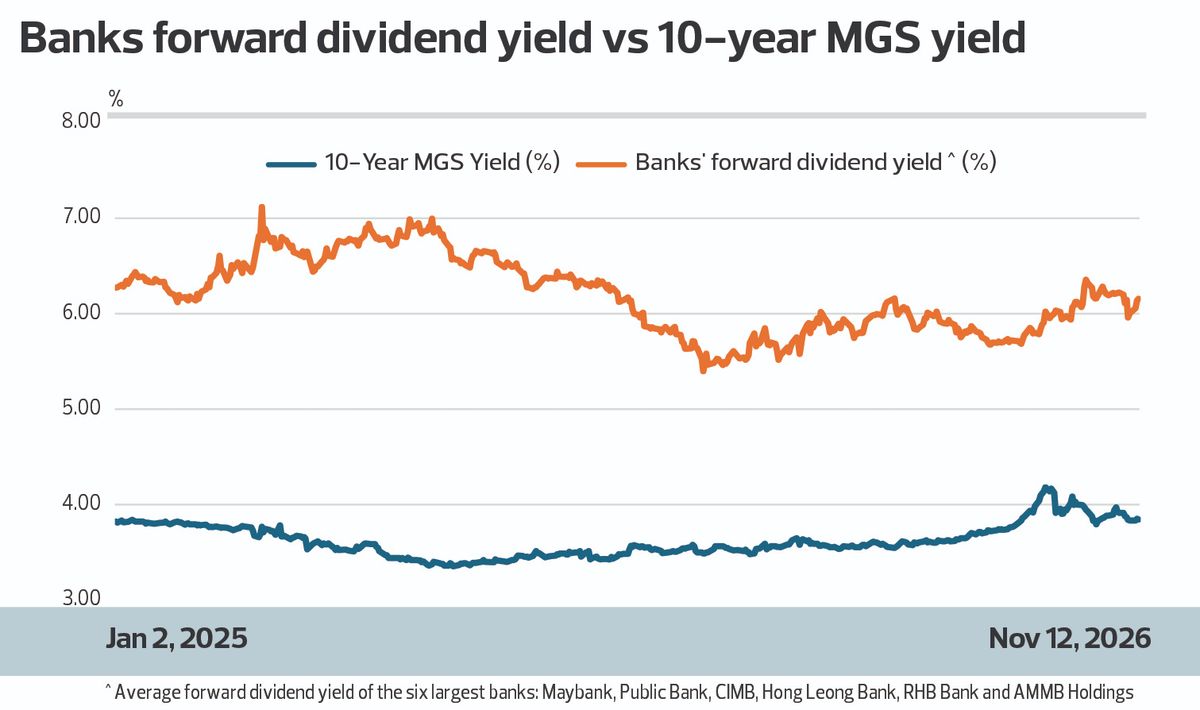
Malayan Banking Bhd (KL:MAYBANK), the country’s largest bank by market capitalisation, has seen its share price retreat about 20% from its all-time high of RM12.42 on Feb 25, although its YTD decline is a more modest 5.44%. CIMB Group Holdings Bhd (KL:CIMB) has fallen 14.1% while losses have been steeper among smaller lenders, with MBSB Bhd (KL:MBSB) shedding 28.4%, Bank Islam Malaysia Bhd (KL:BIMB) declining 17.5% and Affin Bank Bhd (KL:AFFIN) losing 16.6%.
The broad-based weakness marks a sharp reversal from February, when investor optimism was high, underpinned by expectations of higher dividends and improved capital management, as banks explored ways to enhance shareholder returns under Basel IV, including the potential release of excess capital.
Sentiment in February was further supported by declining US Treasury yields, which narrowed the interest rate differential between the US and Malaysia, lending support to the ringgit and encouraging foreign capital inflows into Malaysian equities, particularly banking stocks, as global funds increased their exposure to emerging markets.
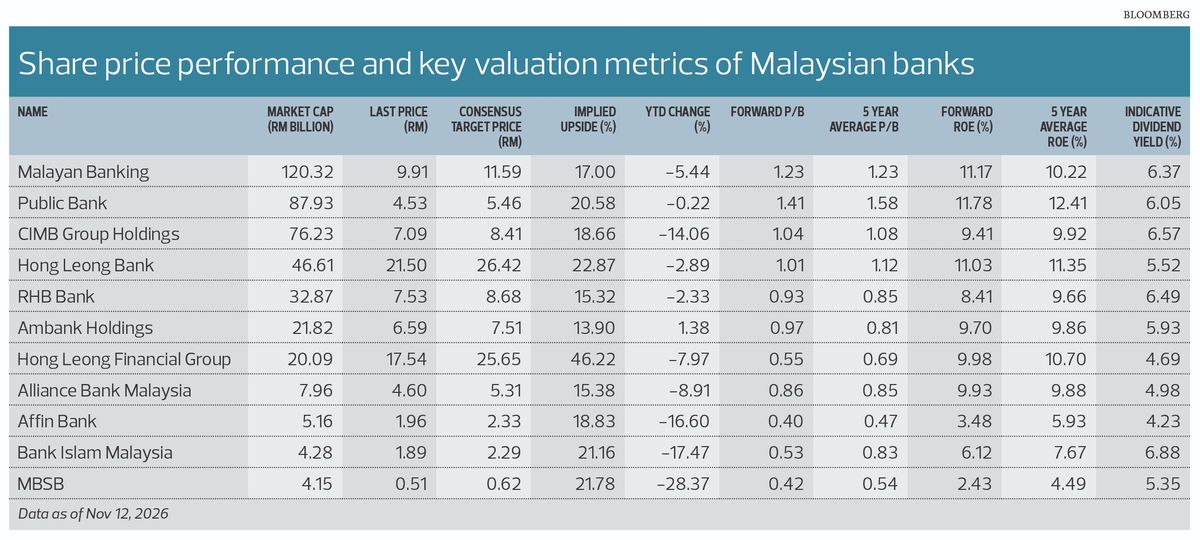
At the time, the yield on the 10-year Malaysian Government Securities (MGS) stood at about 3.5%, its lowest level in five years.
Nine months later, the investment landscape has changed considerably. The outbreak of the Iran war has complicated the inflation outlook, with persistent fuel costs raising concerns over renewed price pressures.
Markets are now pricing in a 25-basis-point rate hike at the Fed’s December 2026 meeting, following the resumption of its rate-hiking cycle in September, with further increases potentially extending into early 2027.
The shift in interest rate expectations has also been reflected in the local bond market. Yield on the 10-year MGS climbed to a year-to-date high of 4.17% on Sept 15 before moderating to about 3.85% currently.
Higher bond yields could present challenges for banks by increasing funding costs, particularly as commercial papers are among the instruments used by financial institutions to raise funds.
Higher yields could also affect banks’ investment portfolios through mark-to-market losses on fixed-income securities, weighing on non-interest income and earnings visibility in the near term, says Berjaya Research Sdn Bhd head of research Kenneth Leong.
Public Bank Bhd’s (KL:PBBANK) recent third-quarter results, released on Nov 6, have prompted investors to reassess the sector’s earnings trajectory. Management indicated that its return on equity (ROE) for FY2026 could come in closer to 12%, compared with its earlier guidance of 13%. It also flagged that net interest margin (NIM) could narrow by as much as 10 basis points, raising concerns over intensifying deposit competition and the sustainability of banks’ profitability.
Another reason behind the selling pressure is the upcoming expansion of the FBM KLCI from 30 to 50 constituents. The expansion will be implemented in two phases to minimise market disruption and facilitate a smoother portfolio rebalancing process. The first phase is scheduled for Dec 21.
Malacca Securities Sdn Bhd head of research Loui Low Ley Yee estimates that the banking sector’s weighting in the benchmark index could decline from 42.7% currently to 39.4% in December 2026, before falling further to 36.6% by June 2027.
The changes could prompt portfolio adjustments among passive funds tracking the benchmark, potentially creating additional selling pressure on banking stocks.
As a rule of thumb, Low estimates that for every RM1 billion in passive funds tracking the FBM KLCI, about RM61 million of exposure to the financial sector would need to be reduced across both phases, assuming fund assets remain unchanged and the projected index weightings materialise.
Nevertheless, he believes some of the selling pressure may already have been absorbed by the market. “Some active fund managers may have already repositioned their portfolios ahead of the Nov 23 cut-off date for determining the new index constituents. This could potentially reduce the remaining selling pressure once the rebalancing takes effect,” he says.
Fund flow data up to Nov 5 points to substantial selling activity in the sector. Local institutional investors net sold RM2.597 billion worth of financial services stocks while foreign investors offloaded another RM1.511 billion.
Sell-off lifts dividend appeal
Despite the earnings uncertainties and potential technical selling, analysts believe the correction has improved the banking sector’s risk-reward proposition, particularly for investors seeking dividend income.
Leong says Malaysian banking stocks are becoming increasingly attractive following the recent weakness, although valuations have yet to reach deeply discounted levels, suggesting that investors should remain selective when accumulating shares.
The sector is currently trading at 1.17 times price-to-book (P/B), with its forward P/B ratio at 1.13 times, slightly below its long-term historical average of 1.2 times, he says.
Dividend yields offer a more compelling investment proposition. Leong estimates the sector’s forward dividend yield stands at roughly 6.5%, compared with the 10-year MGS yield of 3.85%, representing a spread of 265 basis points. This is significantly wider than the historical average spread of about 150 basis points.
“We believe the wider yield spread, coupled with reasonable price-to-book valuations and resilient ROE, provides a supportive valuation cushion and could encourage selective accumulation for income-oriented investors, provided dividend distributions remain sustainable,” he says.
Low is similarly positive on the sector’s valuations following the correction, estimating that banking stocks are trading at about one time P/B and 9.6 times price-earnings (P/E) — both below their respective historical averages.
“With sector ROE at approximately 10% and dividend yields ranging between 5.5% and 6.5%, we believe the recent weakness offers opportunities for gradual accumulation,” he says.
Based on Bloomberg data compiled by The Edge, Hong Leong Bank Bhd (KL:HLBANK) and Public Bank Bhd are the only banks trading at a discount to their respective five-year average P/B valuations.
In terms of profitability, only Maybank and Alliance Bank Malaysia Bhd are expected to deliver ROE above their respective five-year historical averages, based on analysts’ forecasts.
As for dividend yield, CIMB’s estimated dividend yield of 6.57% is the highest among the large-cap banks, followed by RHB Bank Bhd (KL:RHBBANK) at 6.49%, Maybank at 6.37% and Public Bank at 6.05%.
CIMB preferred for recovery potential
CIMB emerges as the preferred pick for both Leong and Low, who cite its attractive valuation, dividend proposition and potential earnings recovery.
Leong says CIMB’s established regional franchise, coupled with ongoing efforts to streamline operations and sharpen its focus on key markets, could create opportunities to improve operational efficiency and unlock further growth.
Low believes the stock could offer further upside once earnings expectations stabilise and selling pressure associated with the index rebalancing subsides.
Maybank, meanwhile, remains a preferred choice for investors seeking more defensive dividend income. Its strong domestic franchise, resilient earnings base and consistent shareholder distributions make it an attractive option for income-oriented investors, Leong notes.
Low also likes Maybank for its defensive dividend proposition while identifying RHB Bank as another potential beneficiary for investors seeking value and attractive dividend yields.
Save by subscribing to us for your print and/or digital copy.
P/S: The Edge is also available on Apple's App Store and Android's Google Play.