


This article first appeared in The Edge Malaysia Weekly on November 16, 2026 - November 22, 2026
UNLIKE in most years, intense competition among Malaysian banks for deposits, in particular fixed deposits (FDs), is expected to persist beyond the usual year-end season and spill into next year, prolonging the pressure on their net interest margins (NIMs).
However, a widely anticipated hike of 25 basis points (bps) in the overnight policy rate (OPR) next year — which some market watchers expect as early as the first quarter — could offer banks some measure of relief.
“I think there is the likelihood of [the intense competition persisting into next year] if we don’t see a pickup in deposit growth,” says a banking analyst. “The reality is that, so long as your deposit growth continues to lag behind loan growth, it does mean that funds are flowing elsewhere, and this is likely to persist. So, either you continue to do promotional deposits or you have to resort to [other forms of] borrowings. Either way, your funding cost goes up.”
Managing NIM has arguably been one of the most significant challenges faced by Malaysian banks in recent months.
A look at recent bank deposit campaigns show much higher promotional interest rates ranging from 3.6% to over 4% on new money FDs compared with board rates of about 2.15% to 2.26% for FDs of three to six months.
In a recent interview with The Edge, Hong Leong Bank Bhd (KL:HLBANK) group managing director and CEO Kevin Lam said he expects the competition to persist well beyond the year-end seasonal period. The outlook for NIM is “very, very challenging”, he noted. “Usually after the seasonal competition for deposits, things will normalise. But [this year] I don’t think it will. If you look at the loan-to-deposit (LDR) ratio of the Malaysian banks … many are at 95% to 100%. Public Bank is about 100%. We are one of the few below 90% (HLBB: 88.4%). So, I think that intensity for deposits will continue, even after the seasonal period.”
Lam drew a comparison with Nordic countries, where banks also operate with relatively high LDRs, but are less of a concern to analysts given their well-established pension fund systems. He argues that, much like the Nordic model, Malaysia’s large institutional savings pools, including the Employees Provident Fund (EPF), are increasingly channelled into the broader financial system through investments in debt instruments and bank equities, rather than remaining as bank deposits.
“If EPF can pay 6%, for instance, it makes little sense for savers to leave their money in deposits earning 2% to 3%. I think structurally, Malaysia is moving in that direction. It is something banks will have to learn to live with and manage over the long term,” he opined.
He added that banks would need to look beyond conventional deposits and consider other liability-management strategies, including hybrid and structured deposits, medium-term instruments and funding through Cagamas Bhd.
The margin pressure is already reflected in banks’ earnings guidance. Public Bank Bhd (KL:PBBANK), the first among Malaysian lenders to report its July to September quarter results, told analysts last week that it now expects NIM to compress by 9bps to 10bps for the full year, compared with its earlier guidance of a mid-single-digit decline. It also lowered its return on equity (ROE) expectation to about 12%, from as much as 13% before.
“We continue to view these revisions as reflecting a more challenging funding environment rather than a deterioration in underlying franchise strength,” CIMB Securities says in a report.
As the reporting season gathers steam this month, more banks are likely to guide for lower NIMs, some analysts say.
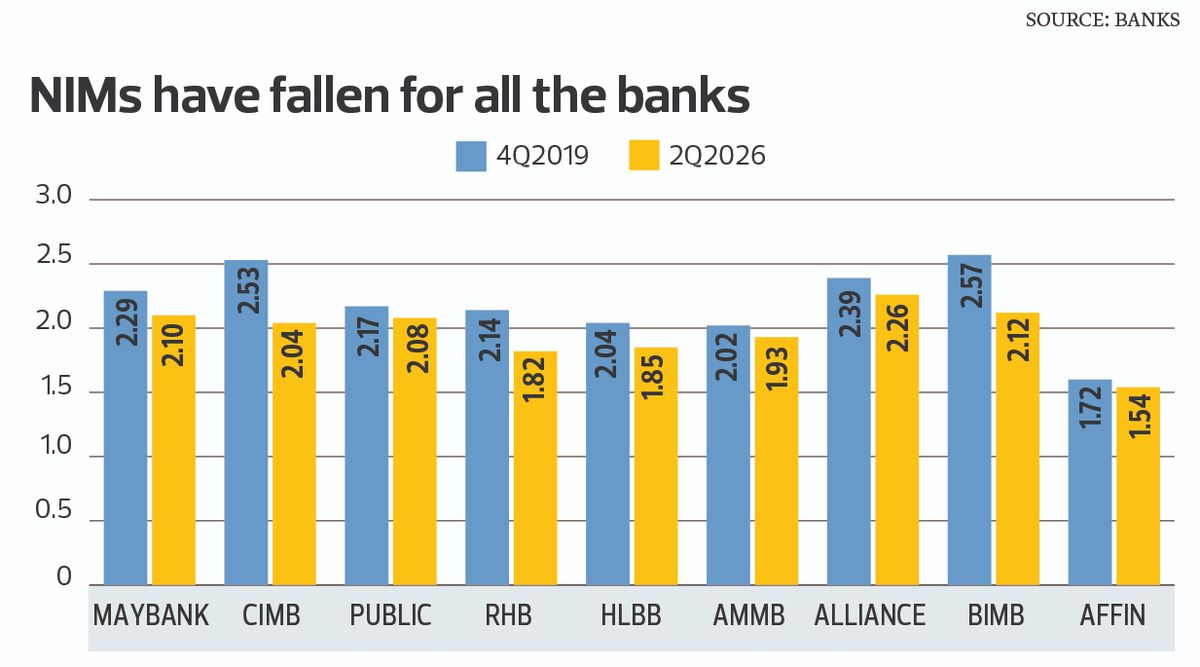
Among the banks that experienced the sharpest year-on-year (y-o-y) declines in margins in the quarter ended June 30, 2026, were MBSB Bhd (KL:MBSB), whose NIM fell 50bps to 1.6%; CIMB Group Holdings Bhd (KL:CIMB), down 11bps to 2.04%; Public Bank, down 10bps to 2.08%; and AMMB Holdings Bhd (KL:AMBANK), down 8bps to 1.93%.
Public Bank, whose NIM fell further to 2.03% in 3Q2026, announced two weeks ago that it had established a RM20 billion Islamic medium-term notes programme, allowing it to issue senior and subordinated sukuk from time to time. This provides another funding channel for the bank.
Even if an OPR increase provides some relief next year, banks’ ability to maintain a healthy mix of low-cost deposits, manage alternative funding and grow non-interest income will remain critical to protecting profitability.
Reasons for the pressure on margins
The pressure on bank margins stems partly from the fact that loan growth has persistently been outpacing deposit growth. Bank Negara Malaysia’s latest monthly banking data shows that loans grew 6.1% y-o-y in September compared with deposit growth of 3.7% excluding repurchase agreements (repos), or 5.2% including repos.
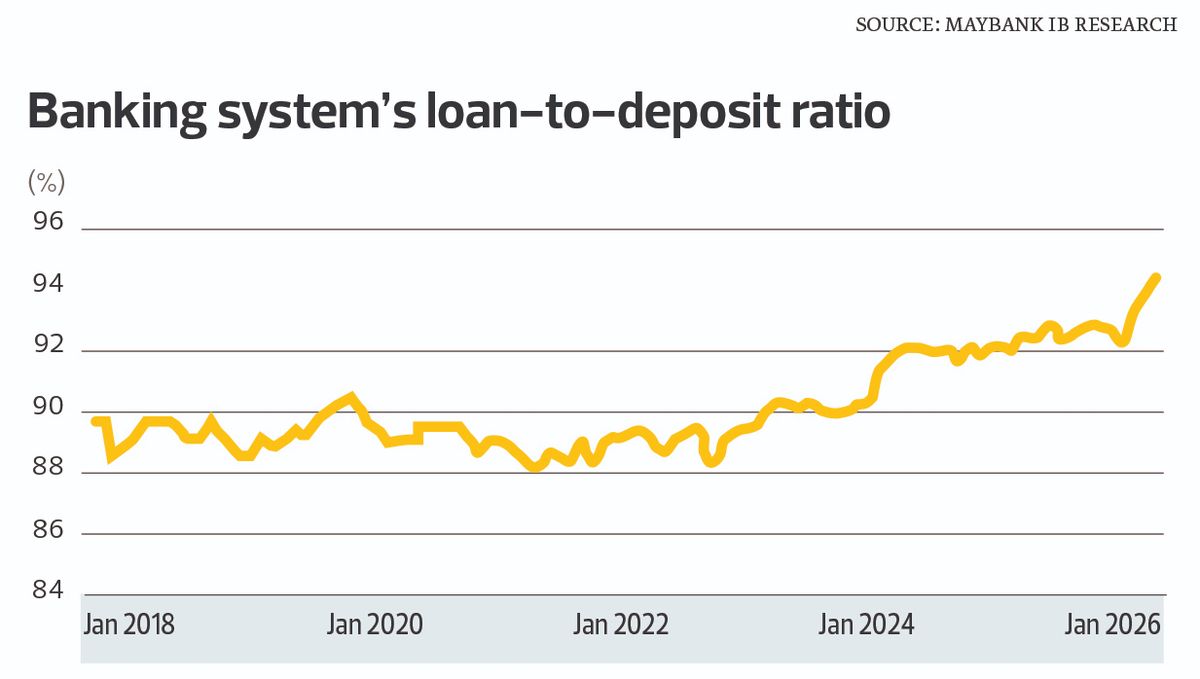
“Loan growth has, in most instances, outpaced deposit growth since March 2022 and at a multiple of 1.67 times in September 2026,” Maybank Investment Bank (IB) Research says in a Nov 6 report. As a result, the industry’s LDR has risen to 94.6% as at end-September, from about 88% five years earlier.
However, a higher LDR should not be taken to mean that the banking system is facing a liquidity shortage. Maybank IB Research notes that the industry’s loan-to-fund (LTF) ratio, which accounts for funding sources beyond deposits, including interbank borrowings and debt securities, has remained within a relatively narrow range of 81% to 84% since January 2018.
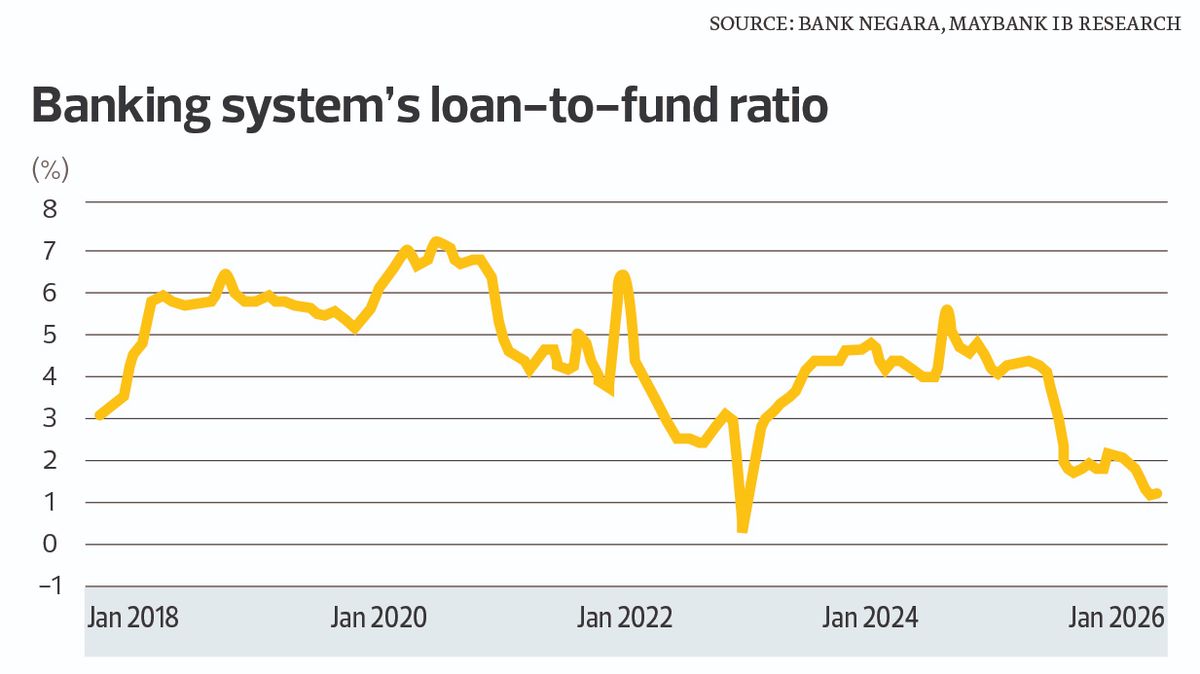
In other words, banks continue to have access to alternative funding, although these sources may be more expensive than conventional deposits and therefore add to funding costs.
“Nevertheless, in our opinion, the outpacing of loan growth alongside increased reliance on more expensive borrowings (relative to board rate deposits) has, among other reasons, contributed to higher funding cost and lower margins for banks,” Maybank IB Research said.
Banks continue to retain substantial liquidity buffers, with the aggregate Liquidity Coverage Ratios (LCRs) and Net Stable Funding Ratios (NSFRs) comfortably above the regulatory minimum of 100%.
Maybank IB Research also attributes the pressure on bank margins to several factors, including savings being channelled into investments outside the banking system, faster growth in foreign-currency deposits, portfolio investment outflows and some deposits shifting to foreign banks.
“Banks’ coping mechanisms have included lowering board rates for FDs, remodelling their deposit mix, sourcing for alternative funding (such as commercial papers/medium-term notes) and shying away from intense mortgage competition,” it observes.
For now, deposit competition persists as banks look to lock in funding ahead of anticipated rate hikes in 2027. “While this continues to weigh on interest margins, the early build-up of deposits could help moderate the pressure into 2027, in our view. This, alongside our expectation of a 25bps OPR hike in early 2027, underpins our forecast for stable NIMs in 2027, following an estimated 4bps compression in 2026,” said Maybank IB Research.
“Our forecasts are therefore unchanged and with stable margins as a contributory reason, we expect aggregate core net profit growth for banks under our coverage to accelerate from 1.7% in 2026 to 5.1% in 2027,” adds the research house, which maintains its “neutral” call on the sector.
Hong Leong Investment Bank Research views a possible OPR increase next year as an earnings tailwind for the banking sector, rather than a catalyst for a broader re-rating of bank stocks.
“Malaysia’s resilient growth strengthens the case for a 25bps OPR normalisation to 3% in 1H2027, which we estimate could lift 2027 sectoral NIM by 1.9bps to 6.2bps and Patami (profit after tax and minority interest) by 1.3% to 9.3%. However, tighter liquidity and persistent deposit competition could accelerate funding-cost catch-up, limiting the durability of NIM gains and a return to previous margin peaks. We therefore view OPR normalisation as an earnings tailwind rather than a sector re-rating catalyst,” it says in a Nov 4 report, maintaining its “neutral” call on the sector.
AmInvestment Bank Research, which has an “overweight” on the sector, believes the outlook for NIM is not as bleak as investors may fear.
“While FD rivalry has intensified and promo rates have surpassed pre-OPR cut levels in July 2025, we believe equity investors are placing excessive emphasis on near-term NIM pressure, while under-appreciating profit upside from better pricing discipline and potential OPR hike in 2027. Banks stand to gain as loans reprice faster than FDs, while funding costs need not rise in tandem,” it notes in a Nov 4 report.
Its sensitivity analysis suggests that every 25bps increase in the OPR could widen sector NIM by 5bps to 6bps and lift annual earnings by 3% to 4%, with Alliance Bank Malaysia Bhd (KL:ABMB) and Bank Islam Malaysia Bhd (KL:BIMB) among the potential beneficiaries, while Malayan Banking Bhd (KL:MAYBANK) and Public Bank could see relatively smaller gains.
A survey of nine research houses show six having a positive call on the sector and four, a “neutral”, with the top-cited preferred stocks being HLBB, Public Bank and RHB Bank.
Save by subscribing to us for your print and/or digital copy.
P/S: The Edge is also available on Apple's App Store and Android's Google Play.