


This article first appeared in City & Country, The Edge Malaysia Weekly on November 16, 2026 - November 22, 2026
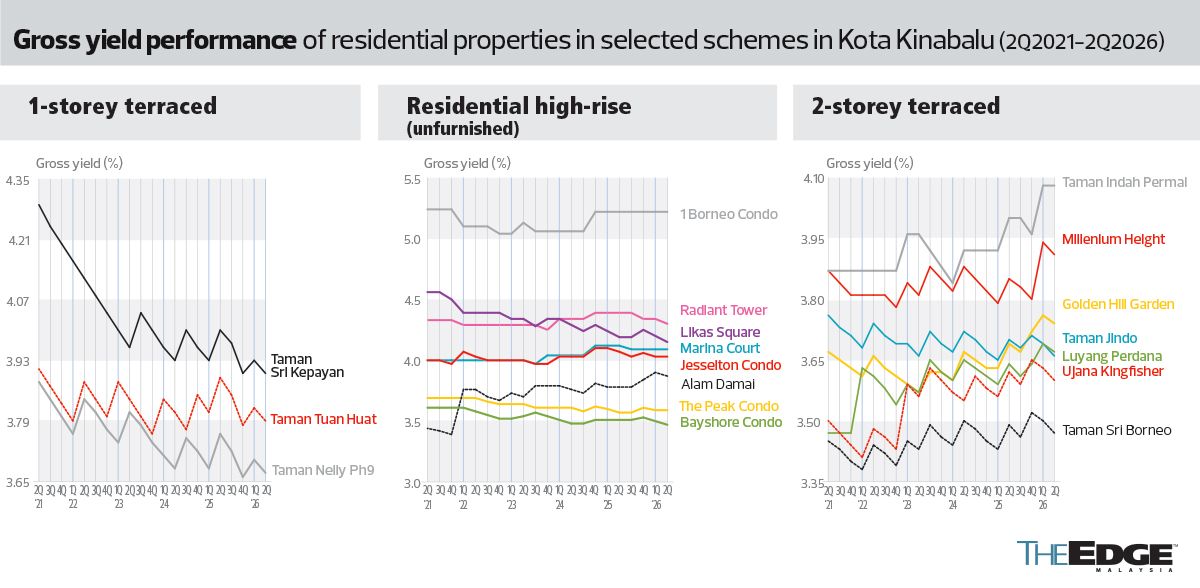
One-storey terraced houses continued to outperform other residential property types in Kota Kinabalu in the second quarter of 2026, with average prices rising 5.37% year on year (y-o-y), supported by affordability, owner-occupier demand and limited replacement supply.
Performance was broadly unchanged from the 5.38% growth recorded in the first quarter, while 2-storey terraced houses posted a more moderate appreciation of 2.6%. Condominiums and apartments also recorded positive growth, although the average increase of 1.89% reflected a more competitive high-rise market with a wider choice of new and secondary properties.
Sabah’s residential market remained relatively stable during the quarter, recording 1,367 transactions worth RM562.66 million. Still, transaction volume fell 5.07% y-o-y and transaction value fell 3.93%, suggesting a more measured pace of activity than the corresponding period last year.
“The sustained growth over the first half of the year indicates that demand for 1-storey terraced houses remains strong despite the ageing profile of much of the existing stock,” says Rahim & Co Chestertons Kota Kinabalu branch director Max Sylver Sintia in presenting The Edge Malaysia | Rahim & Co Chestertons Kota Kinabalu Housing Property Monitor 2Q2026.
Established landed homes remain resilient
Prices of all three monitored 1-storey terraced housing schemes gained more than 5% y-o-y in 2Q2026. Taman Tuan Huat saw the strongest appreciation, with average values rising 5.65% y-o-y to RM560,000 in 2Q2026, from RM530,000.
Taman Sri Kepayan was next, with average values rising 5.26% y-o-y to RM600,000, from RM570,000; and Taman Nelly Phase 9 following with a 5.2% increase to RM605,000, from RM575,000.

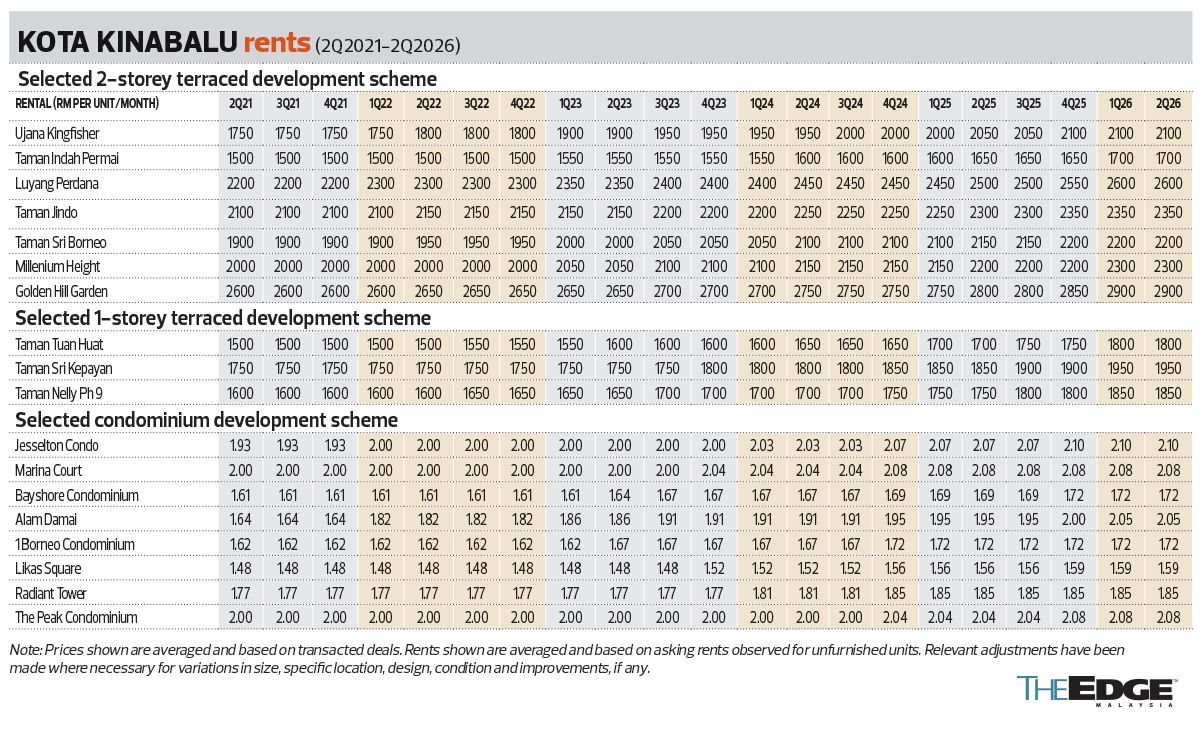
Max says 1-storey terraced houses offer a relatively affordable entry into landed home ownership than many 2-storey terraced houses in established Kota Kinabalu locations. They appeal to young and growing families moving from apartments or condominiums, as well as smaller families and older households that prefer single-level living. The land also offers flexibility for renovation, extension or rebuilding.
Supply is another factor supporting prices. New 1-storey terraced housing developments in established Kota Kinabalu locations have become uncommon, as higher land and construction costs push developers to maximise land use with 2-storey houses, townhouses or higher-density projects.
“The existing stock of conventional 1-storey terraced houses in mature neighbourhoods is therefore becoming increasingly scarce and difficult to replace,” he says.
As existing housing stock ages, the underlying land component is also becoming more important. Houses with favourable land sizes, frontage and locations may attract buyers interested in renovating, extending or rebuilding, resulting in greater price differentiation according to property condition, parking and improvement potential.
Two-storey terraced houses also continued to record positive growth across all monitored schemes, although appreciation moderated to an average of 2.6%, from 2.88% in 1Q2026.
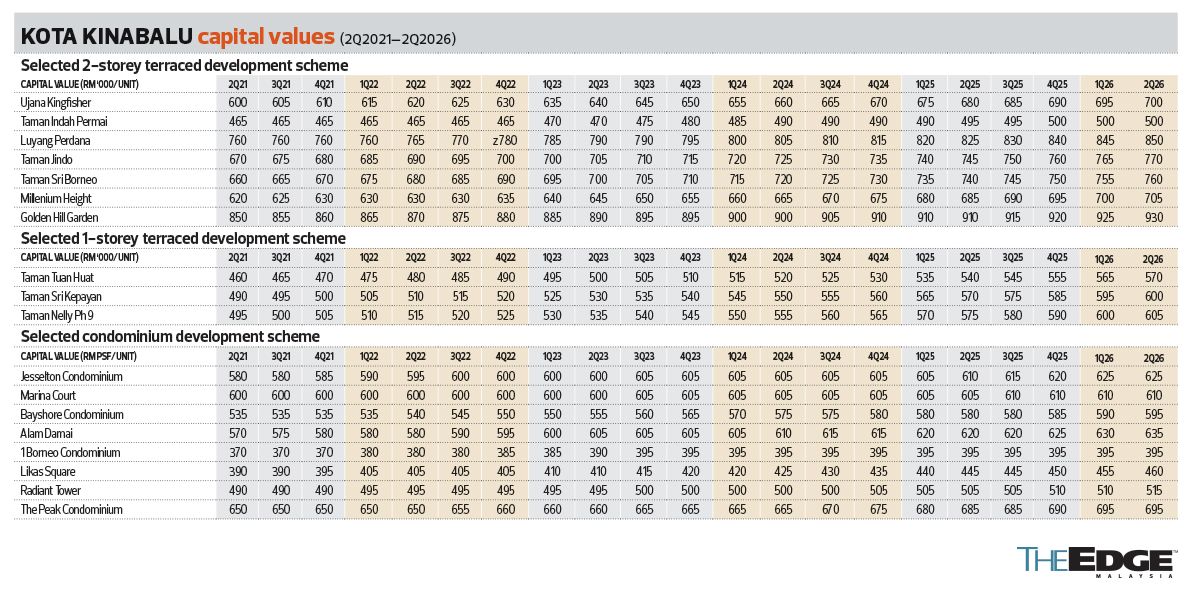
Taman Jindo recorded the strongest increase, with average values rising 3.36% to RM770,000, from RM745,000. Luyang Perdana followed, rising 3.03% to RM850,000, from RM825,000, and Ujana Kingfisher rose 2.94% to RM700,000, from RM680,000.
Millennium Height gained 2.92% to RM705,000, while Taman Sri Borneo rose 2.7% to RM760,000. Golden Hill Garden remained the highest priced scheme in the sample, with average values increasing 2.2% to RM930,000. Taman Indah Permai recorded the most moderate growth, at 1.01%, to RM500,000.
Location remains an important differentiator. Established residential areas such as the Luyang-Lintas belt and the Likas-Kingfisher areas continue to benefit from mature amenities, accessibility and proximity to commercial areas. With limited opportunities for new landed development in these neighbourhoods, existing homes retain some scarcity value.
“More affordable locations continue to provide an entry point into landed home ownership, while established central neighbourhoods command a premium for accessibility, neighbourhood maturity and the scarcity of comparable landed alternatives,” Max says.
Meanwhile, new landed housing is gradually extending towards the northern and southern outskirts of Greater Kota Kinabalu. To the north, development is moving through Inanam, Menggatal, Sepanggar and Telipok towards Tuaran. To the south, growth is extending through Penampang, Putatan, Lok Kawi and Kinarut towards Papar and Benoni, where land availability and generally more affordable entry prices provide opportunities for newer housing.
“As landed housing becomes more difficult and expensive to develop within established city locations, households seeking newer landed homes at more affordable price points will have a wider choice in the northern and southern corridors,” he says.
Condominium market remains competitive
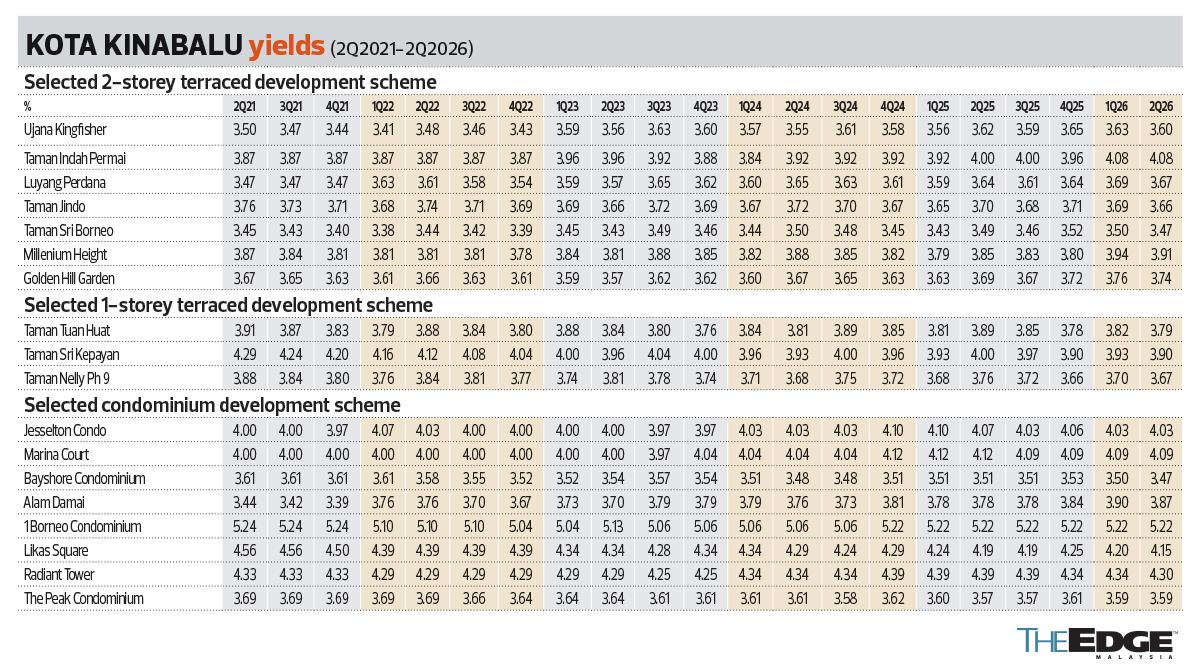
Kota Kinabalu’s condominium market remained stable in 2Q2026, with average price appreciation improving slightly to 1.89%, from 1.76% in the preceding quarter. However, growth remained below that of the landed housing segments.
Among the monitored developments, Likas Square recorded the strongest y-o-y gain, with average values rising 3.37% to RM460 psf, from RM445 psf. Bayshore Condominium followed with a 2.59% increase to RM595 psf, from RM580 psf; while Jesselton Condominium rose 2.46% to RM625 psf.
Alam Damai gained 2.42% to RM635 psf, and Radiant Tower increased 1.98% to RM515 psf. The Peak Condominium remained the highest priced development in the sample at RM695 psf, up 1.46%. Marina Court recorded a more modest increase of 0.83% to RM610 psf, while 1 Borneo Condominium remained unchanged at RM395 psf.
The variation reflects differences in location, age and market positioning. Established city and near-city developments continue to benefit from accessibility, employment centres and mature amenities. Buyers have more options, however, making building condition, maintenance, management quality, facilities, parking and value for money increasingly important in purchase decisions.
Max notes that the distinction between landed and high-rise residential property is becoming clearer. Established landed housing is increasingly difficult to replace, while high-rise supply can continue to expand through higher-density development.
“This does not necessarily point to an overall oversupply, but rather a more competitive and segmented market as additional units and newer products are introduced,” he says.
The condominium market is also seeing a broader range of products, from established secondary properties to newer developments offering integrated retail, F&B outlets and lifestyle facilities. Projects such as Sutera Avenue, Jesselton Quay and Jesselton Residences illustrate this shift, while the transformation of Kota Kinabalu’s waterfront and Likas Bay is expected to bring further high-rise and mixed-use development.
An example of the changing product mix is The Playground @ Kota Kinabalu, launched in June on Jalan Sembulan Lama. Developed by Sembulan Emas Sdn Bhd, a wholly-owned subsidiary of Golden Land Bhd, the RM230 million project comprises 364 fully furnished commercial lifestyle suites and 13 retail lots in a nine-storey development. The suites are priced at RM500,000 to RM1 million.
While the growing range of high-rise products gives buyers more choice, it also increases competition between new and existing developments. Max says established secondary condominiums that offer proven locations, larger unit sizes and more competitive pricing should remain relevant, while newer projects will need to distinguish themselves through design, facilities and integrated amenities.
Affordability continues to shape demand
Affordability remained central to Sabah’s residential market in 2Q2026. Properties priced below RM300,000 accounted for 623 transactions worth RM120.89 million, representing 45.57% of total residential transaction volume. Another 458 transactions, worth RM181.01 million, were recorded in the RM300,001-to-RM500,000 price bracket.
Combined, homes priced below RM500,000 accounted for 79% of residential transactions in the quarter. Properties priced between RM500,001 and RM1 million recorded 224 transactions worth RM152.73 million, while those above RM1 million accounted for 62 transactions valued at RM105.05 million.
“Affordability, location and value for money continue to be key considerations, particularly as buyers are presented with a wider choice of new and secondary properties,” Max says.
Terraced houses remained the state’s most actively transacted residential property type, with 571 transactions worth RM218.06 million. They represented 41.77% of transaction volume and 38.75% of transaction value. Condominiums and apartments followed, with 339 transactions worth RM108.98 million, while semi-detached houses recorded 161 transactions valued at RM101.23 million.
Greater Kota Kinabalu, comprising Kota Kinabalu, Penampang and Putatan, remained Sabah’s main residential market, with 690 transactions worth RM344.27 million. This represented 50.48% of the state’s transaction volume and 61.19% of its transaction value. Nevertheless, volume declined 7.63% y-o-y, while value fell 10.32%.
Within Greater Kota Kinabalu, condominiums and apartments recorded 247 transactions worth RM88.1 million, compared with 222 transactions worth RM99.33 million for terraced houses. The higher value generated by terraced houses despite fewer transactions reflects the generally higher capital values of landed properties in the area.
Sabah recorded 2,731 residential transactions worth RM1.16 billion in the first half of 2026. Transaction volume fell 1.5% y-o-y, while value rose 2.4%, suggesting a broadly stable market in which buyers are becoming more selective.
The supply pipeline is likely to add to this selectivity. Residential stock stood at 253,378 units as at 1H2026, with terraced houses accounting for 36% and condominiums and apartments, 28%. Of the 11,095 units under construction, 61% were condominiums and apartments, compared with about 30% for terraced houses.
Sabah also had 2,058 completed unsold residential units worth RM1.3 billion, of which 1,415, or about 69%, were condominiums and apartments. The concentration of unsold stock in the high-rise segment, alongside incoming supply, is expected to give buyers more choice and increase competition among developments.
Looking ahead, Max expects the market to remain generally stable, although performance will differ according to location, property type and price segment.
“Established landed housing should continue to benefit from limited new supply, while the high-rise market is expected to become increasingly competitive as new projects enter the market,” he says.
Across both segments, affordability, accessibility and appropriate pricing will remain important. For condominiums, facilities, management standards and overall value for money will also play a growing role in sustaining buyer interest and long-term value.
Save by subscribing to us for your print and/or digital copy.
P/S: The Edge is also available on Apple's App Store and Android's Google Play.