

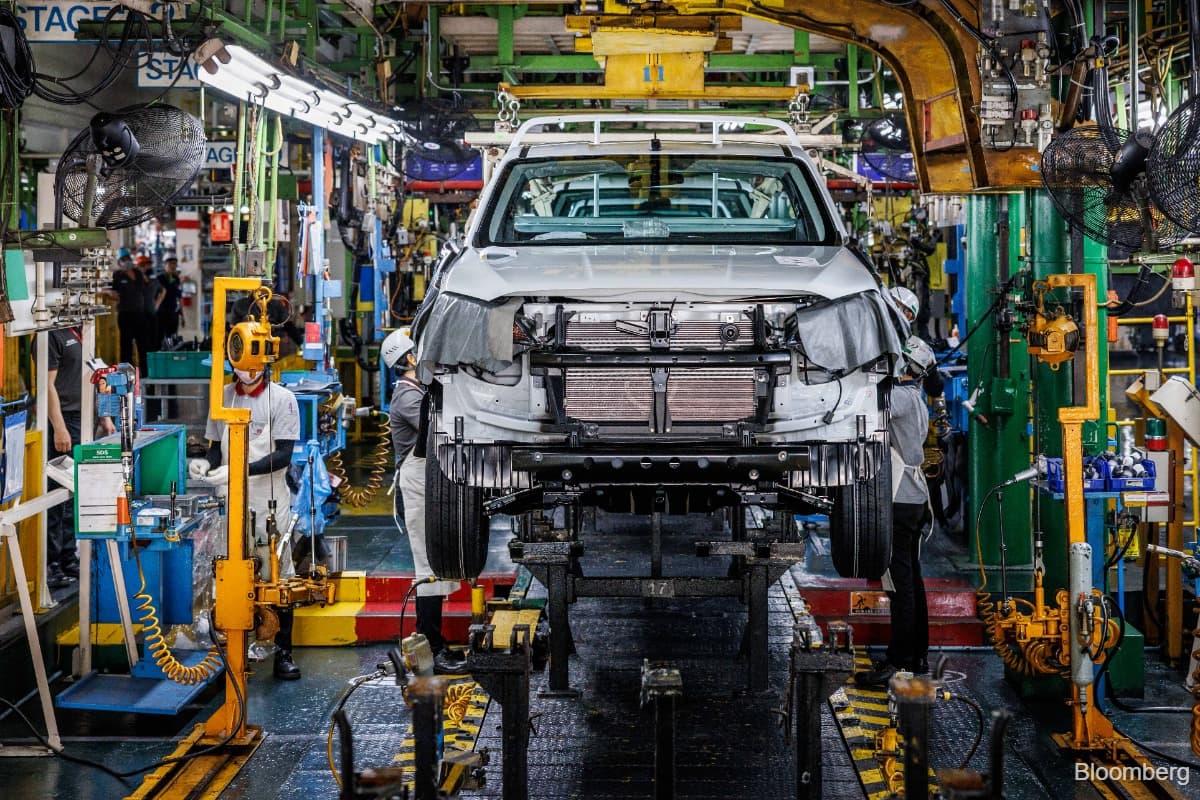
(Nov 16): Thailand’s economic growth accelerated in the third quarter, with the artificial intelligence boom powering exports while masking persistent weakness in household spending and tourism.
Gross domestic product in the three months through September rose 2.9% from a year earlier, the National Economic and Social Development Council said Monday (Nov 16). That was below the 3.1% median estimate in a Bloomberg survey.
The pickup partly reflected a favourable comparison with a year earlier, when US tariffs and a border conflict with Cambodia disrupted trade. But it also showed the growing impact of the global tech investment cycle on Thailand, where electronics exports and private investment have surged.
The baht held gains of 0.1% versus the dollar as the local currency looked past the weaker-than-expected GDP.
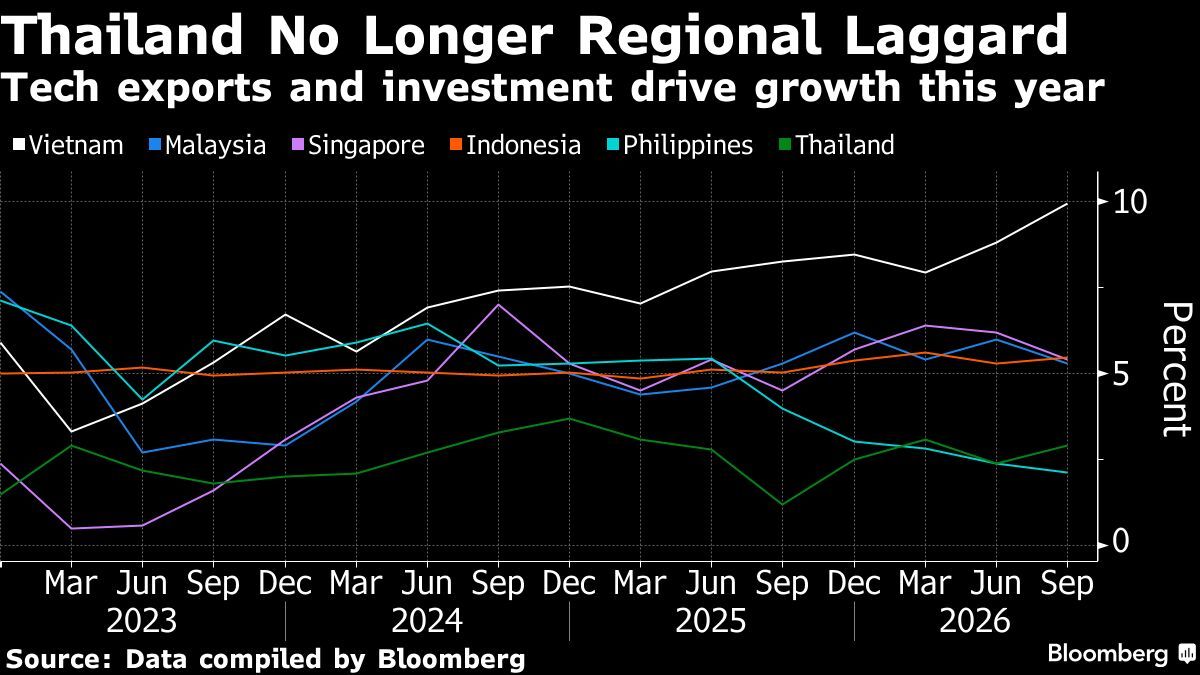
Evidence of the tech sector’s impact was visible in an 11.8% jump in investment growth and an 18.3% surge in exports of goods and services.
But household consumption ticked up just 2.5% while government spending shrank 1.6%. That supports cautionary comments from the Bank of Thailand that gains from the AI boom have not reached all corners of the economy.
“The tech/AI cycle is improving economic momentum but the benefits remain concentrated among businesses and workers in related manufacturing and services sectors,” Standard Chartered plc economist Tim Leelahaphan said in a note. “Overall growth remains below potential.”
Nomura Holdings Inc economist Euben Paracuelles expects the central bank to keep its policy rate at 1% throughout 2027 as growth momentum fades in the final quarter. “The improvement wasn’t really strong and it’s driven by likely unsustainable factors such as government cash handouts,” she said.
Economic growth this year should be around 2.5%, the government said, giving a range of 2% to 3% for 2027. The current quarter’s growth may be softer because of a slowdown in private sector investment and a high base last year, NESDC secretary-general Danucha Pichayanan told reporters in Bangkok on Monday.
“Risks next year include a slowdown in global growth and trade, changing weather conditions affecting agricultural crops, relatively high household debt and a credit crunch for SMEs,” the council said.
The risks to Thailand’s agricultural sector from El Niño have been highlighted by crises in neighbouring countries, with climate change worsening wildfires in Indonesia and the Philippines seeing disappointing farm output.
It also remains to be seen whether AI demand will continue to surge, with the ouster of Jensen Huang as head of Nvidia Corp raising questions about the sector’s outlook.
But the overall economic data put Thailand ahead of the Philippines, which expanded 2.1% in the quarter. Thailand still trailed most regional peers, with Vietnam growing almost 10% and Indonesia, Singapore and Malaysia all expanding more than 5%.
Over the past decade, annual growth above 3% has become unusual for Thailand, an ageing tiger economy constrained by high household debt and limited fiscal room. Using new methodology to better capture manufacturing data from various agencies, the government restated second-quarter growth to 2.4% from 1.9% and raised first-quarter growth to 3.1%.
“We have increased the sample size used in the calculation and adjusted the methodology to better reflect changes across industries,” Danucha said. “There are new businesses emerging, particularly in the services sector, which is an area we need to focus on.”
The stronger performance comes during a period of unusual political stability. Thai Prime Minister Anutin Charnvirakul leads one of Thailand’s strongest governing coalitions in decades, giving his administration more room to pursue investment and economic policies even with a no-confidence vote looming next month and street protests simmering.
Thailand has also attracted a surge in investment tied to AI, data centres and advanced electronics while foreign investors have returned to its bonds and stocks.
The Bank of Thailand, which last month left its policy rate unchanged for a fourth straight meeting, raised its 2026 growth forecast to 2.4%, citing stronger-than-expected exports and AI-related investment. It has also flagged potential upside from revisions to manufacturing data.
The central bank has nevertheless maintained that monetary policy should remain accommodative to support an uneven recovery. Officials have highlighted a K-shaped expansion, with growth concentrated in sectors benefiting from the technology and AI investment cycle while other parts of the economy remain weak.
According to BOT’s recent monetary policy report, the expansion in AI-related shipments accounted for roughly 50%-67% of Thailand’s overall export growth. The top 1% of exporters, or about 69 firms, accounted for 83% of AI-related exports in the first eight months of 2026 and more than 70% of those firms were foreign-owned.
Uploaded by Arion Yeow