

(Nov 16): China’s growth weakened across the board in October as consumption and industrial output undershot expectations, while investment unexpectedly worsened, in a sign Beijing’s latest stimulus measures have yet to feed through to the economy.
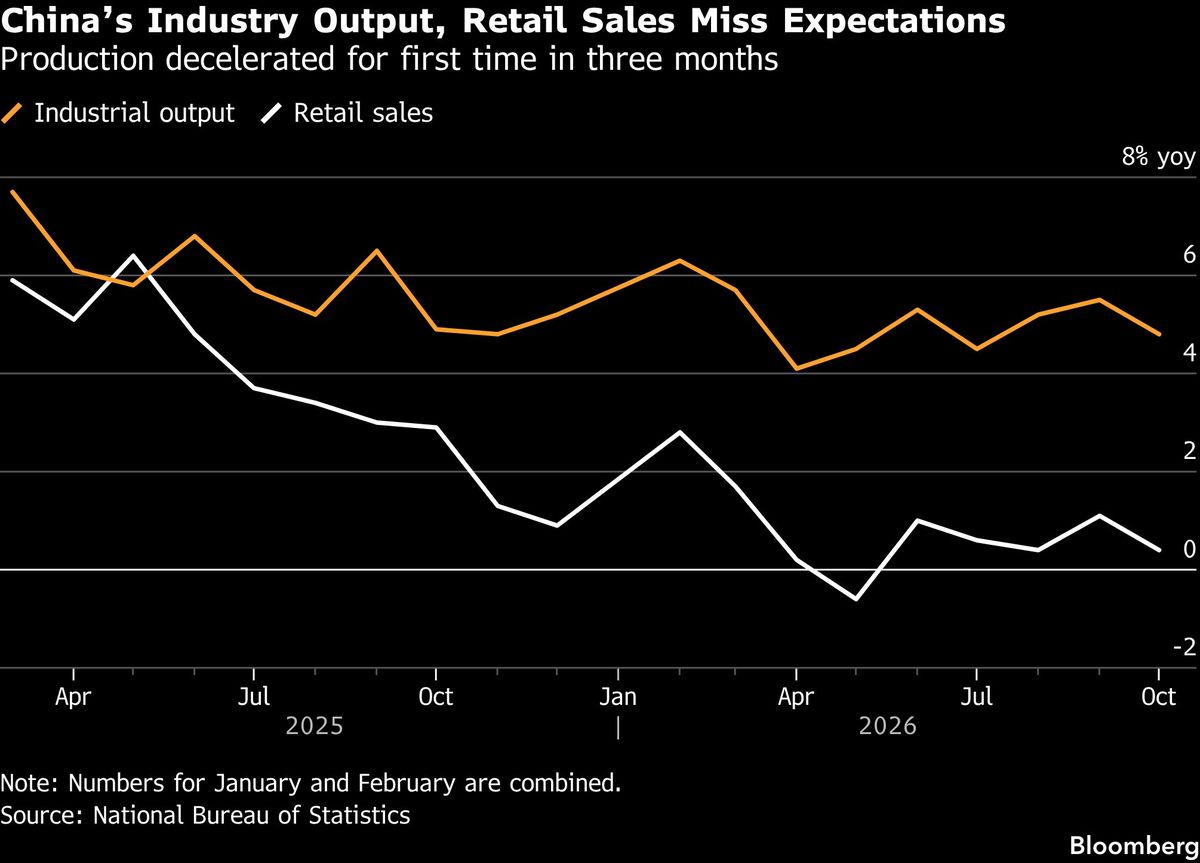
Retail sales rose 0.4% from a year ago, far worse than the consensus forecast of 0.8% by economists polled by Bloomberg. That compares with an increase of 1.1% in September.
Fixed-asset investment fell 8.1% in the first 10 months of 2026 from the same period last year, lower than the 7% decline expected by economists. Investment dropped 7.2% in the January-September period.
Industrial output grew 4.8% in October from a year ago, missing expectations for a 5.3% increase and slowing from September.
The figures pointed to a downbeat picture of an economy that’s losing momentum, after Beijing stepped up efforts to bolster growth in late September. Officials rolled out a moderate stimulus package including mortgage subsidies and greater public borrowing quota, while accelerating measures to shore up investment.
Separate data on Monday showed residential prices continued to fall in October, extending a slump that’s dragged on economic growth for more than five years. Property investment plunged 21.6% in the first 10 months of the year from a year earlier, compared with a 20.6% decline in January-September.
The economy was “overall stable” and “extended a trend of renewing growth engines and improving its structure,” the NBS said in a statement. The statistics agency highlighted challenges faced by the economy include an uncertain global environment, imbalances between supply and demand, as well as difficulties in some businesses’ operation.
Despite indications that growth has come under pressure, the urban surveyed jobless rate unexpectedly slipped to 5.1% last month from 5.2% in September. Many economists see the official unemployment gauge as an incomplete reflection of the labor market because it excludes migrant workers who returned to the countryside after losing work.
The economy rebounded in the third quarter, with growth reaching the lower end of Beijing’s annual target of 4.5% to 5%. But the recovery remained heavily reliant on overseas demand, with net exports contributing almost 40% of the increase in gross domestic product — the most for any quarter since the start of 2025.
That dependence is becoming a bigger risk as questions mount over the sustainability of the global artificial intelligence investment boom, which has powered demand for Chinese electronics and other manufactured goods. A slowdown in exports would increase pressure on domestic consumption and investment to pick up the slack.
The October figures will be closely scrutinised by top officials ahead of the Central Economic Work Conference, usually held in the first half of December. The gathering will offer clues on Beijing’s economic priorities for 2027 and the scale of any additional support.
Policymakers may lean more heavily on fiscal measures if the economy loses further momentum. The People’s Bank of China has signalled caution about cutting interest rates when borrowing demand is already weak.
Uploaded by Liza Shireen Koshy