

(Nov 15): Buyouts, a slump in initial public offerings (IPOs) and concentrated ownership structures are weighing on the United Arab Emirates’ (UAE) efforts to attract international investors.
The country has spent years opening its stock markets to the world, selling stakes in major companies and building Dubai and Abu Dhabi into financial centres. Yet ownership often remains concentrated among a handful of shareholders, limiting the amount of stock available for trading.
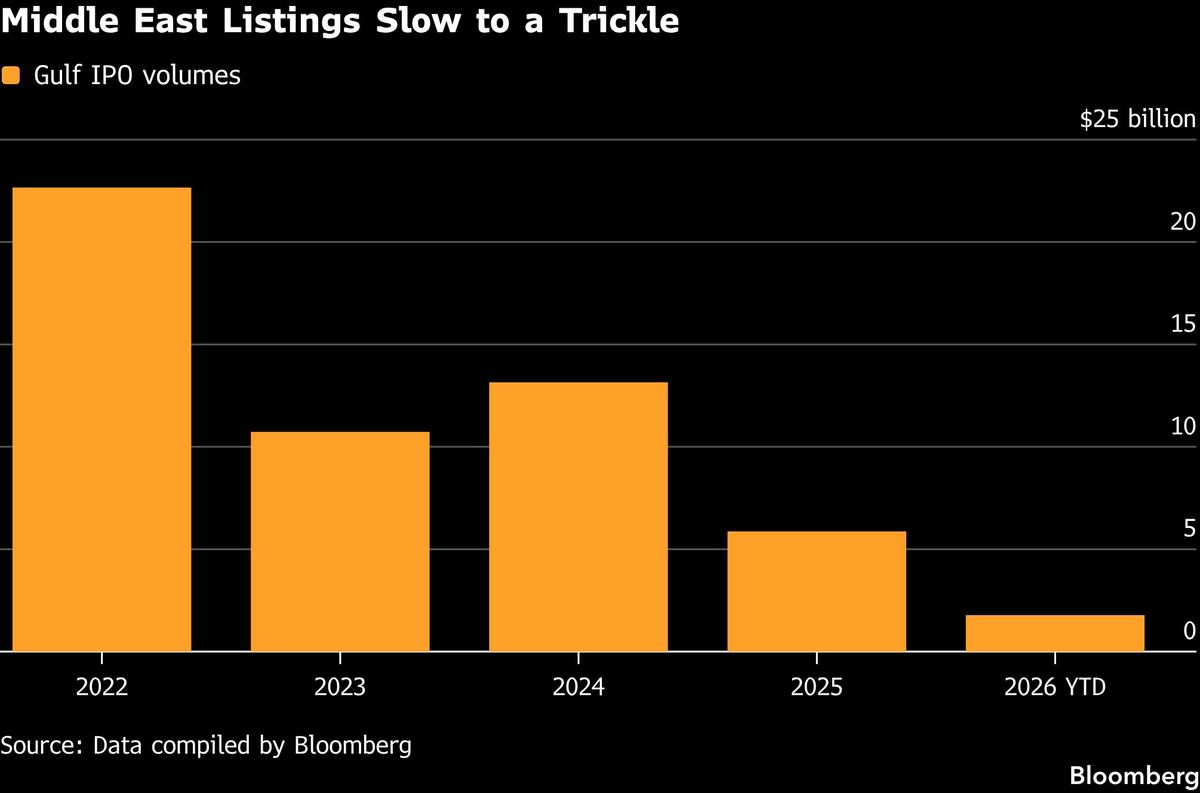
A slowdown in listings — down to just one this year — and a series of buyouts are tightening that constraint. The trend has come into sharper focus in recent months, with Emaar Properties PJSC proposing to buy out the remaining shares in its construction arm following two similar transactions in Abu Dhabi.
Dubai has the highest proportion of companies with concentrated ownership in the Middle East, followed by Abu Dhabi, according to data compiled by Bloomberg. In more than four out of every 10 firms on Dubai’s benchmark index, two shareholders control more than 70% of the equity. In Abu Dhabi, the proportion is more than one in three.
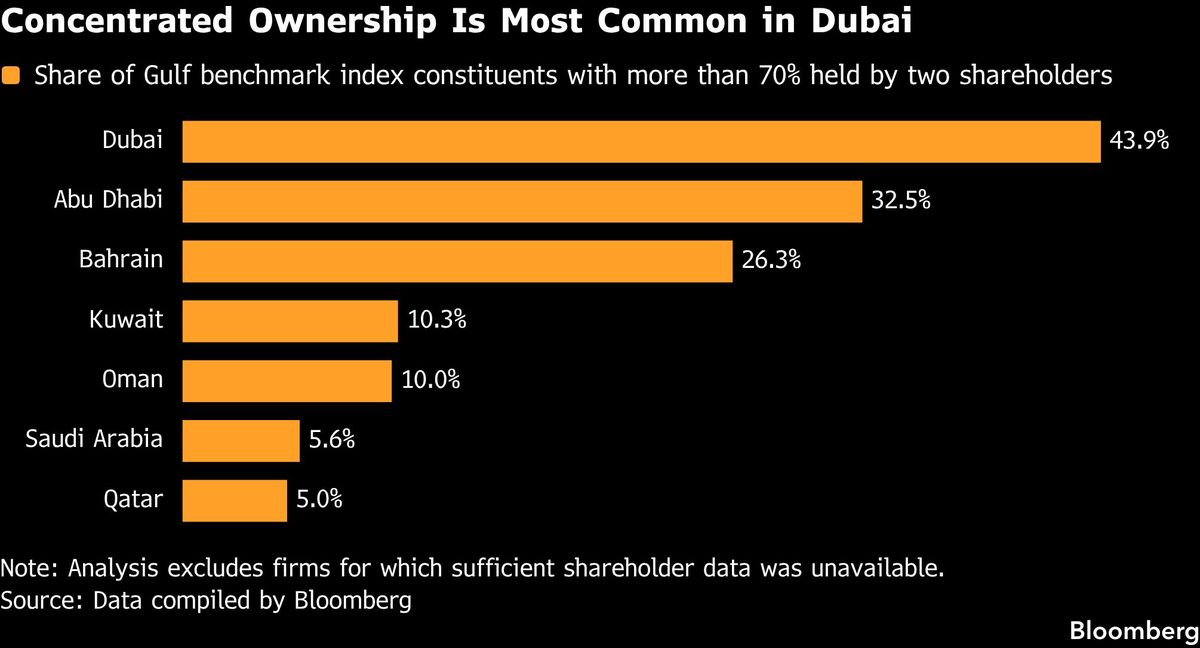
Together, the two exchanges account for nearly half of all such companies across the Gulf. The concentration is less pronounced in Saudi Arabia, where roughly one in 20 benchmark companies have two shareholders controlling more than 70% of their shares.
Such arrangements can leave minority investors with little influence should controlling shareholders decide to consolidate their holdings, merge businesses or take a company private. They can also limit the amount of stock available for trading, making it harder for outside investors to buy or sell significant positions.
Going public has done little to dilute ownership. For instance, Dubai’s government controls large stakes in Dubai Electricity and Water Authority PJSC (Dewa), Salik Co, Dubai Taxi Co and Alec Holdings PJSC, while Dewa itself owns more than 80% of Emirates Central Cooling Systems Corp. In Abu Dhabi, sovereign investment vehicles and affiliated companies hold similarly significant positions across listed businesses.
Investors have pushed for further selldowns to improve liquidity, but most such deals in the UAE have involved listed subsidiaries of Abu Dhabi National Oil Co, in part to help them qualify for inclusion in stock indices.
The proposed buyout of Emaar Development PJSC brought those concerns into sharper focus. The offer, at a premium of about 8% to the pre-announcement closing price, gives minority shareholders an immediate cash exit while allowing the parent to take full control of its residential development business. Still, it may not fully reflect the unit’s growth potential, said Tahir Abbas, head of research at Ubhar Capital.
“While such transactions demonstrate the strategic value of listed assets for Dubai’s bourse, repeated acquisitions and delistings risk reducing free float, market depth, and investment opportunities for public shareholders,” he said. “The priority for UAE capital markets should be to balance consolidation with a sustained pipeline of IPOs, new listings and greater institutional participation.”
A spokesperson for the UAE’s Capital Market Authority said its merger and acquisition rules align with international standards, and are designed to balance corporate restructuring with investor protection.
The Dubai Financial Market said foreign investors account for 51% of traded value on the exchange, and that deepening liquidity and broadening access remain key priorities. The Abu Dhabi exchange has a similar share of international investors, a representative said, adding that the bourse offers a diverse range of securities with investable free floats as well as transparent, active secondary markets.
For Emaar Development, a delisting could be the “right decision,” though investors must weigh several considerations, including the loss of future dividends, said Mohammed Ali Yasin, chief executive officer of Ghaf Benefits. But the firm accounts for about 7% of Dubai Financial Market’s annual traded value, he said, and its removal could further reduce liquidity on the exchange.
That buyout could be followed by a delisting of a warehousing firm, and comes shortly after Abu Dhabi’s newest wealth fund bought back the tiny listed sliver of the US$81 billion (RM330.77 billion) utility TAQA and then announced a buyout of the city’s port operator.
The transactions recall a familiar cycle for the UAE’s stock markets. A yearslong IPO drought was followed by a wave of delistings during the Covid-19 pandemic, amid a drop in valuations.
Officials later embarked on a privatisation drive aimed at lifting the bourses’ combined value to over US$1 trillion. Firms including Dubai’s main utility and subsidiaries of Abu Dhabi’s state-backed oil giant were listed, transforming the market and opening some of the UAE’s biggest assets to global investors.
Years later, the region is contending with both a broader slowdown in regional dealmaking and new listings.
At the same time, some companies, including those that were recently listed such as Talabat Holding Plc and ADNH Catering Plc, are also buying back shares. Against that background, more IPOs are needed to replenish the market, said Shahrukh Saleem, a portfolio analyst at Mashreq Capital.
“We lose good, liquid names and the free float gets thinner,” he added. “That’s not great when we’re trying to attract more institutional money.”
Uploaded by Felyx Teoh