

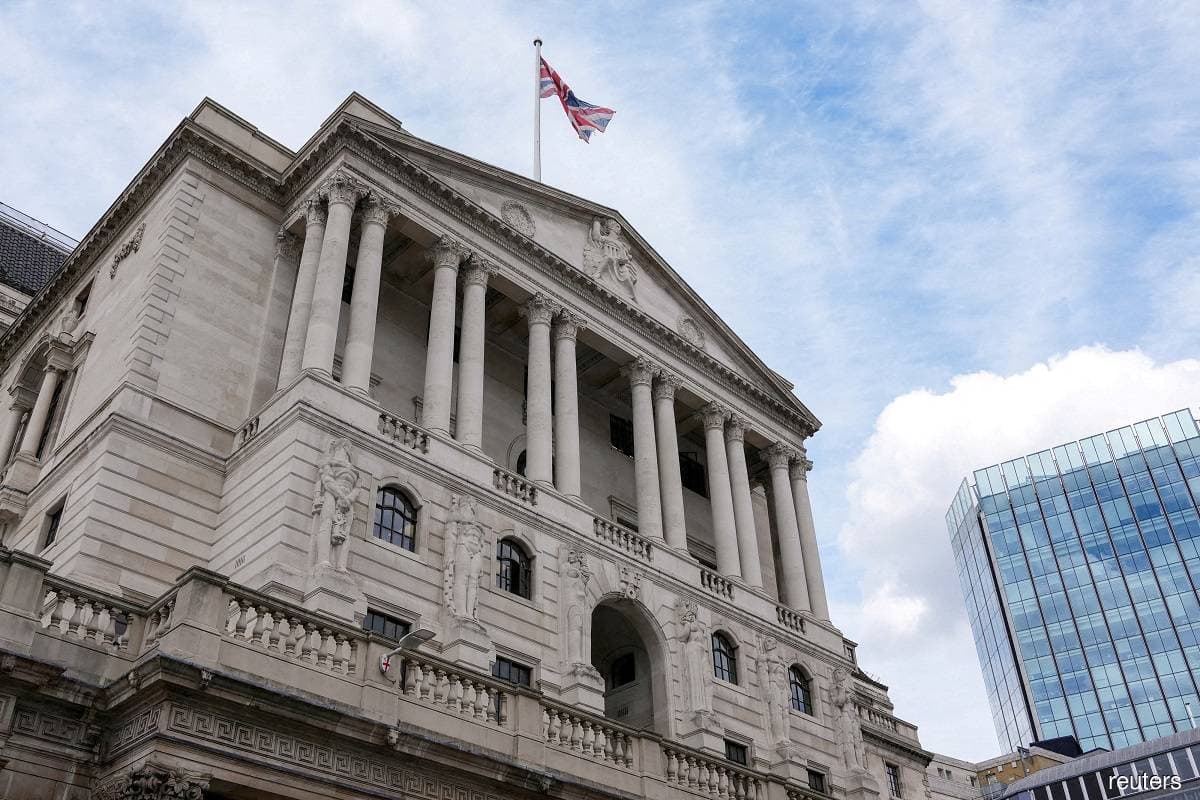
(Nov 15): UK data in the coming days may show a stabilising jobs market and inflation at a one-year high, piling pressure on the Bank of England to raise interest rates again.
Climbing motor fuel costs and an increase in household energy bills are predicted to push consumer-price growth to 3.6% in figures due on Wednesday.
The day before, labour data are anticipated to show headcounts rising for a third month and unemployment steady at 4.7%, suggesting that a two-year downturn in the labour market is coming to an end.
While the BOE hiked borrowing costs for the first time in over three years earlier this month, the latest numbers could cement growing bets by investors for another move in December.
The British central bank was the last in the Group of Seven to raise rates since the start of the Iran war. Peers in that club are poised to act again, with some Federal Reserve officials even airing the potential for a half-point move.
For the UK, a combination of rising price pressures, resilient economic growth and stabilising demand for workers are bolstering the case for an accelerated hiking cycle. Speaking on Tuesday, deputy governor Clare Lombardelli refused to rule out a December move.
“Should energy prices fail to meaningfully retreat in the run up to the BOE’s December meeting, we think the majority of the Monetary Policy Committee will probably favour a hike before the end of the year,” said Bloomberg Economics.
The central bank expects inflation to approach 5% in due course after the resurgence in oil and gas prices in recent months, although officials aren’t yet seeing evidence that the energy shock is spreading widely.
Policymakers fear, though, that surprisingly strong GDP growth and lingering wage pressures means the domestic backdrop isn’t as benign as they once thought. More resilient economic data have also raised questions about whether rates have been as restrictive as the BOE had assumed.
Elsewhere, inflation data from Canada to Japan, a possible rate hike in Indonesia, and new European Union economic forecasts will be among the highlights.
Below is our wrap of what’s coming up in the global economy.
US and Canada
In the US, October retail sales data on Tuesday will offer hints about Americans’ spending appetite given the recent uptick in inflation. Sales outside of car dealers and gas stations are projected to post another modest advance, indicating a resilient yet cautious consumer.
Industry figures showed auto sales weakened to the slowest pace since the start of the year. The value of receipts at gas stations may decline as fuel prices retreated.
Meanwhile, separate reports are expected to underscore a housing market hamstrung by high mortgage rates. Government figures on Wednesday are projected to show housing starts rose in October for the first time in four months, suggesting construction is stabilising at a weak level.
Additionally, a National Association of Realtors’ index of contract signings on previously owned homes is expected to drop again, to a fresh record low.
Also on Wednesday, the Fed will release minutes of its October policy meeting, when officials kept interest rates unchanged. The latest inflation figures, combined with a flurry of commentary by Fed officials, cemented market expectations for a rate increase at the central bank’s next meeting in December, its final gathering for 2026.
Looking north, Canada’s consumer price index likely rose to 3.2% in October, though core measures are expected to have held steady around 2%. The release on Monday will be the final inflation print before the Bank of Canada sets rates in December. The bank has signalled that it’s willing to raise borrowing costs again and as of Friday morning, the market put chances of a hike at slightly more than 50%.
Asia
All eyes will be on Bank Indonesia when it decides on borrowing costs on Wednesday, amid worsening political turmoil that’s sent the rupiah to another record low.
Early projections have the central bank raising rates by 25 basis points, although the new governor, Destry Damayanti, has resisted tightening since her appointment in September to avoid stalling economic growth.
That’s the only rate decision in the region for the week, though investors are keen to see the minutes on Tuesday from the Reserve Bank of Australia’s latest meeting, where it raised borrowing costs. Governor Michele Bullock speaks on the same day, and Monetary Policy Board member Renée Fry-McKibbin has an appearance on Friday.
Growth will be another major focus. China releases October retail sales, industrial production, fixed-asset investment, employment and property investment data, offering a broad read on domestic demand. New and used home prices will provide further clues on whether China’s prolonged property downturn is stabilising.
Japan reports third-quarter growth, with annualised gross domestic product seen slowing sharply, to 0.2% from 1.4% in the previous quarter. Private consumption may contract, while business spending is expected to improve. Industrial production and capacity utilisation will offer another gauge of manufacturing activity, while machine orders will provide a read on investment momentum.
Inflation and monetary conditions will also remain in focus. Japan’s consumer-price data may show inflation accelerated, potentially complicating the Bank of Japan’s policy-normalisation path.
China sets its one- and five-year loan prime rates, with both expected to remain unchanged. India reports wholesale inflation, alongside unemployment and core industries output, offering further clues on domestic price pressures and activity.
External demand will provide another important signal. Japan’s trade figures will shed light on export momentum, while India’s trade data are expected around the start of the week. The trade deficit is seen widening after elevated oil prices in October, although the recent cooling in crude may help ease pressure on the rupee and external balances.
In Australia, wage and employment data will help investors assess domestic price pressures and the outlook for the central bank.
Europe, Middle East, Africa
More twists in the wrangling over European Central Bank appointments may arrive in the coming days. The deadline for candidates for two ECB vacancies is Wednesday, while governments are also looking toward naming a successor to president Christine Lagarde.
New European Commission forecasts on Tuesday will illustrate the outlook that the cohort of policymakers will face, beyond the fiscal challenges in France that fresh street protests may showcase in coming days.
Meanwhile, the ECB’s Financial Stability Review comes out on Wednesday. Euro-zone data include industrial production on Monday and negotiated wages on Friday.
A summit on Friday between the UK and the EU may draw attention for changes to the terms of their economic ties, with Prime Minister Andy Burnham trying to slow down the conversation he started about the country’s long-term relationship with the bloc.
In Switzerland, data on Monday may show a slight retrenchment in the third quarter after a massive growth spurt in the prior three months.
Israel’s October inflation, due on Sunday, probably slowed to 1.4% from 1.6% the previous month, helped by favourable base effects in food prices.
A number of central bank decisions are on the calendar:
- Hungarian policymakers are expected to keep borrowing costs steady on Tuesday, with inflation comfortably below the new 2.5% target.
- In Angola the same day, officials could cut the key rate, currently at 14.75%, for a fourth straight meeting. Banco Nacional de Angola vice-governor Domingos Pedro recently said restrictive policy, relative stability in the kwanza, and increased domestic non-oil production should help contain price pressures.
- In Ghana on Wednesday, the central bank will probably keep its rate steady at 14% for a fourth straight meeting as inflation continues to quicken toward its 6%-10% target range. Icelandic policymakers also set borrowing costs the same day.
- South African officials will probably hold their rate at 7.25% on Thursday after previously raising it by 25 basis points, allowing time for that increase to filter through. Data on Wednesday will probably show annual inflation quickened notably to 5.2% in October.
- Neighbouring Eswatini and Lesotho, with currencies pegged to the rand, will probably also hold rates steady on Friday.
Latin America
In Peru, data due on Sunday will likely show output picked up at the close of the third quarter, with the consensus pointing to a third straight GDP-proxy print of 3% or better for September.
Elevated global copper prices and brisk domestic demand, coupled with business-friendly policies under President Keiko Fujimori, support the central bank’s estimate for growth of 3.2% in 2026.
October unemployment figures may show the jobless rate in the capital city of Lima was in line with or even below September’s 4.4% record low.
In Mexico, the minutes of Banxico’s surprise decision to cut its rate by a quarter-point, to 6.25%, may break little new ground. A reaffirmation of forward guidance for a prolonged pause is widely expected.
Brazil’s economy has been downshifting all year in the face of various headwinds. GDP-proxy data may show renewed weakness in September after August’s slight revival, suggesting Latin America’s No 1 economy flatlined or even contracted in the third quarter.
Growth overall is expected slow for a second year in 2026 and likely yet again in 2027 amid tight financial conditions and government retrenchment, with households largely tapped out as well.
In Colombia, quarter-on-quarter output may have contracted from the three months through June based on the drag from August’s magnitude-7.4 earthquake, drought, and a weakening labor market — even as September GDP-proxy data rebound.
Chile’s Finance Minister Jorge Quiroz in the past week conceded that the economy is in recession, drawing a line under a debate over the central bank’s rounded second-quarter 0.0% print versus posted data showing a -0.02% reading.
Third-quarter figures will show the economy still struggling, and probably contracting for a third straight quarter. Growth is likely to rebound in the year’s final three months before posting a solid expansion next year, while Quiroz puts 2028 growth at about 4%.
Paraguay’s central bank meets as the collapse of Ueno Bank SA reverberates through the economy. Policymakers in October kept their rate unchanged for an eighth consecutive month at 5.5%. Banco Central del Uruguay, meanwhile, meets on Thursday after delivering a surprise quarter-point hike in October to 6% that BCU’s board characterised as pre-emptive.
Uploaded by Magessan Varatharaja